

Group therapy for drug addiction treatment: definition, how it works, types, and process


Table of content
- What is group therapy for drug addiction treatment?
- How does group therapy for drug addiction treatment work?
- What are the different types of group therapy for drug addiction treatment?
- What do group therapy sessions look like for drug addiction treatment?
- How is group therapy done for drug addiction treatment?
- Is group therapy effective for drug addiction treatment?
- How do I know if group therapy is right for me?
- What is the difference between group therapy and person-centered therapy for drug addiction treatment?
- What is the difference between group therapy and support group for drug addiction treatment?
Group therapy for drug addiction treatment refers to psychotherapy delivered to multiple patients with substance use disorder at once and by one or more therapists.
Group therapy for drug addiction treatment works by creating a safe and supportive space for members who receive peer support and motivation, learn healthy coping skills, and undergo deep and lasting personal transformation to modify unhealthy thinking and behavioral patterns.
The different types of group therapy for addiction treatment are cognitive behavioral therapy, psychoeducational group therapy, process group therapy, support groups, and skills development groups.
Group therapy for drug addiction treatment is done in three stages. In the first stage, the participants are informed about the group norms and the recovery process, and therapy goals are defined through consensus. Productive change is initiated in the middle stage while a closure is reached in the last stage.
What is group therapy for drug addiction treatment?
Group therapy for drug addiction treatment is a form of psychotherapy that is simultaneously delivered to two or more individuals with substance use disorder by one or multiple therapists. The goal of group therapy is to reduce the symptoms of addiction and achieve lasting recovery.
Group therapy for drug addiction is delivered in diverse therapeutic environments, such as hospital-based inpatient programs, residential treatment facilities, outpatient clinics, and the private offices of therapists. There are different types of therapy groups aimed at addressing the unique treatment needs of individuals at varying stages of recovery.
How does group therapy for drug addiction treatment work?
Group therapy for drug addiction treatment works by creating a safe, supportive, and non-judgmental environment where participants are able to share their stories, express repressed emotions, learn healthy coping mechanisms, and receive advice, inspiration, and feedback from peers. Steered by a therapist, group members learn from one another and act as accountability partners. These therapy groups are powerful tools for persuasion, stabilization, and comfort.
Group therapy for drug addiction treatment supports sobriety by triggering lasting behavioral changes and addressing the social and emotional aspects of addiction. Addiction recovery brought about by group therapy is lasting because it is driven by the individual’s intrinsic motivation to transform for the better.
What are the different types of group therapy for drug addiction treatment?
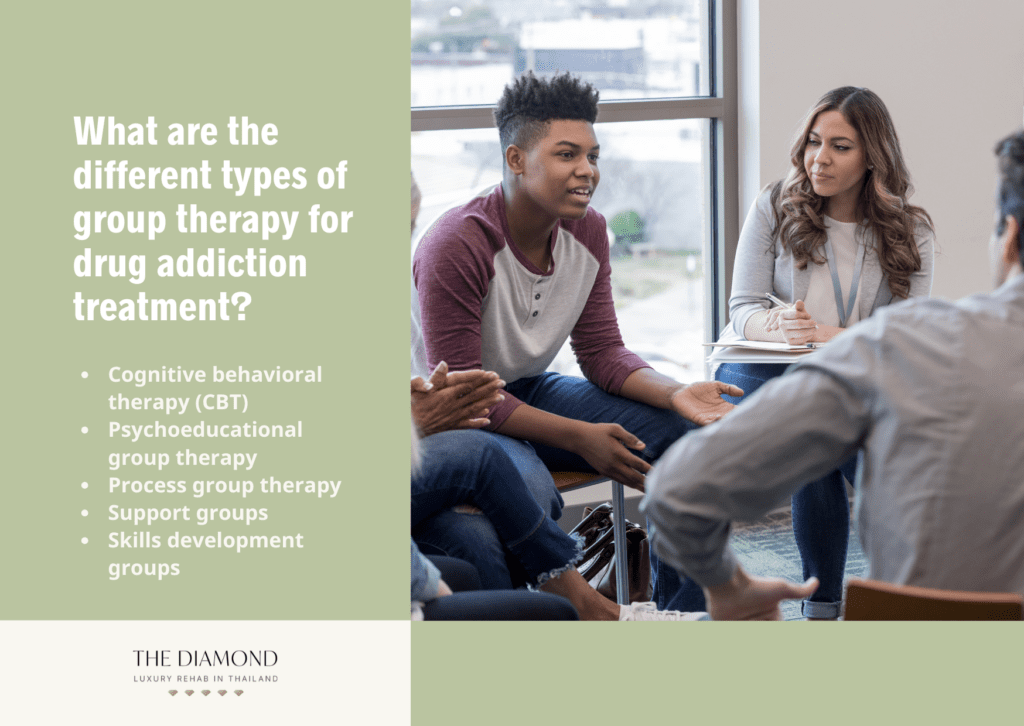
The different types of group therapy for drug addiction treatment are listed below.
- Cognitive behavioral therapy (CBT): CBT is grounded in the premise that substance dependency is a learned behavior. So, cognitive restructuring has the ability to modify these learned behaviors, as noted in the chapter Types of Groups Commonly Used in Substance Abuse Treatment in the 2005 Substance Abuse and Mental Health Services Administration (SAMHSA) publication titled “Substance Abuse Treatment: Group Therapy [Internet].”Cognitive behavioral therapy aims to bring about this restructuring using interventions that identify and alter maladaptive thought patterns, distorted perceptions, and negative beliefs.
- Psychoeducational group therapy: Psychoeducational group therapy educates patients about substance abuse, and associated maladaptive behaviors and consequences. The education imparted to the patients has a direct bearing on their lives and includes information like the impact of drug addiction, the specifics of their particular condition, tips and strategies to remain abstinent, and barriers to recovery. The primary purpose of psychoeducation group therapy is to expand awareness by disseminating relevant information. It does not strive to bring about intrapsychic change.
- Process group therapy: Interpersonal process groups are grounded in the theory of psychodynamics, which deals with how individuals function at a psychological level. The aim is to allow group members to recreate past traumatic events in the present moment and re-examine those life problems that they have attempted to escape from using drugs, all via interactions with other group members. The focus of process group therapy is less on individual issues and more on the here-and-now group dynamics. The therapist observes how individuals interact with others in the group to understand how they conduct interpersonal relationships in their daily lives. The aim is to identify issues and patterns that contribute to addiction or hamper recovery.
- Support groups: Addiction support groups follow the self-help tradition in substance abuse treatment. These groups strive to help members sustain abstinence by guiding them to deal with their real-life concerns, such as issues about daily living, how to prevent a relapse, and building a lifestyle free of drugs. There is no significant effort to analyze or understand the causes of a member’s addiction problem.
- Skills development groups: Skills development groups operate on the premise that individuals who rely on substances to cope with the world do so because they lack critical life skills. So, these groups focus on teaching skills that enhance the member’s ability to achieve and sustain abstinence. These include being able to manage drug-use triggers, enhancing interpersonal communication skills, identifying and altering maladaptive responses to negative emotions like anger, managing finances, and improving parenting skills.
What do group therapy sessions look like for drug addiction treatment?
Group therapy sessions for drug addiction treatment look different depending on the therapeutic approach followed by a specific group, the leadership style of the therapist, and the activities specific to that group. The members convene in a room and sit in a circle. A facilitator is always present. Sessions usually begin with each member introducing themselves and stating why they are in therapy.
Typically, they share their life story, how they are addressing their addiction issues, and the recovery milestones they have accomplished since the last session. Free-flowing conversations are encouraged or the discussions are steered by the therapist according to a pre-defined plan. Participants take part in group-specific tasks, such as practicing newly acquired skills, engaging in role-playing, or setting goals and mapping plans to achieve them.
What are the rules of group therapy?
The rules of group therapy are listed below.
- Confidentiality: Participants commit not to disclose information about other group members and the stories they share during the sessions to anyone who is not a part of the therapy group.
- Privacy: Participants commit to respecting each other’s privacy and refrain from probing into personal stories that have not been shared in the sessions. Every participant has the right to remain silent during discussions if they feel uncomfortable sharing their experiences.
- Respect and non-judgment: Participants agree to communicate respectfully, non-judgmentally, and without using offensive language. They must provide constructive feedback on an issue at hand without resorting to blaming the other individual. They must not offer advice if it is not asked for. They should strive to be empathetic and express support.
- Violence or intimidation: Acts like being violent during a session and intimidating other group members are not tolerated.
- Sober participation: Participants are prohibited from taking part in a therapy session under the influence of substances of abuse, such as alcohol and mind-altering drugs.
- Conflict resolution: There is a pre-defined conflict resolution process to address disagreements promptly and effectively. The therapist mediates during a conflict while participants agree to adhere to the conflict resolution protocols.
How is group therapy done for drug addiction treatment?
Group therapy for drug addiction treatment is carried out in three stages. In the first stage, the participants are introduced to the therapy process and informed about the group rules and treatment goals, the latter being defined through mutual agreement. Beginners’ anxiety is addressed and the members are introduced to one another. In the second stage, productive change in the participants is initiated by the therapist using their skills and specific strategies. The participant undergoes changes in their thought and behavioral patterns and develops supportive connections with other group members. The last stage or the ending phase is a closure that is brought about gradually.
Who leads group therapy sessions?
Group therapy sessions are led by mental health professionals like psychiatrists, psychologists, licensed counselors, or social workers who specialize in issues related to drug addiction and treatment. Groups are also led by non-professional peers who have experiences in battling substance abuse and going through recovery, as in the case of support groups like mutual help groups. The group leader assumes different roles depending on the needs of the patients at different stages of recovery. For instance, the leader of a psychoeducational group performs the role of a facilitator and educator.
A substance abuse counselor has specialized training and education in therapeutic group work and the complex character pathologies, defenses, and realities of individuals with addiction issues. They are knowledgeable about the therapeutic processes associated with groups and are able to comprehend the peculiar dynamics of the groups they lead.
How many people are typically in a group therapy session?
There are typically 5-15 people in a group therapy session, according to an October 2019 release by the American Psychological Association, titled “Psychotherapy: Understanding group therapy.” However, the group size tends to be limited to 8-10 participants in skills development groups to give members ample opportunity to practice the skills they are taught. In instances where conventional small-sized groups are unable to address the needs of specific populations, such as homeless individuals, group sizes tend to be much larger during the earlier stages of recovery.
What topics are discussed in group therapy for addiction treatment?
The topics discussed in group therapy for addiction treatment are listed below.
- Understanding addiction: Participants are educated on the science of addiction. They learn about the neurological aspects of the condition, its chronic relapsing nature, and its long-term physical and mental health effects. This knowledge helps them appreciate why treatment is necessary.
- Identifying drug-use triggers: The therapy sessions involve group members discussing their drug-use triggers. These discussions help others identify their personal triggers so that they are able to remain vigilant and avoid situations, people, and/or places that trigger drug cravings.
- Developing coping strategies: Discussing coping mechanisms helps participants learn new strategies that are effective in dealing with drug-use triggers. This knowledge helps participants formulate personalized plans for avoiding drug triggers or managing them without yielding to them.
- Fostering sober, supportive networks: A lack of supportive social networks makes it challenging to cope with the stresses of life. Participants in group therapy for drug addiction learn to initiate, build, and nurture social connections by learning and practicing techniques like listening actively, exhibiting empathy and validation, sharing candidly and honestly, offering positive feedback, being present, and offering positive reinforcement.
- Experiencing feelings of shame and guilt: The topics for discussion include how to channel and/or modify feelings of guilt and shame and transform these into powerful catalysts that drive recovery. The discussion is geared toward imprinting upon the individual experiencing these feelings that they are capable of changing themselves for the better.
- Preventing relapse: The topics related to relapse prevention center around building skills and cultivating a mindset necessary to overcome the challenges of practicing abstinence without needing to seek solace in drugs. The topics include recognizing the early warning signs of relapse, knowing how to prevent a lapse from progressing to a relapse, and building a robust support system that aids sobriety.
- Building resilience: The topics discussed include emotional regulation, stress management, and self-care techniques like mindfulness, meditation, journaling, yoga, and goal-setting.The insights gathered from these discussions empower group members to deal with life’s stresses without being overwhelmed and feeling compelled to resort to substances.
- Managing anger: Negative emotions like anger are known to trigger a relapse. Participants are taught conflict resolution, stress management, positive thinking, and social skills, so they do not feel overwhelmed by powerful feelings of anger and rage. They are also taught strategies to help them deal with unexpected events without feeling helpless and resentful.
- Building healthy daily routines: Having a structured daily routine that offers predictability and balance is essential to sustaining sobriety. Group therapy discussions on this topic cover strategies like having a consistent sleep cycle, eating healthy meals, exercising regularly, and practicing self-care.
- Improving social and communication skills: Group therapy creates a safe and supportive environment where participants are able to learn or re-learn socialization techniques. The topics discussed include listening actively, expressing assertiveness, rebuilding trust in damaged relationships, and resolving conflicts.
- Setting boundaries:Setting boundaries is critical for safeguarding and sustaining sobriety.The topics for discussion in this regard include identifying what emotional, physical, time, and relationship boundaries look like, learning to say “no” compassionately but assertively, and communicating personal needs to loved ones and reaffirming them. The group discusses how to address challenging situations like relapses and adhere to a self-care routine steadfastly.
- Setting and achieving goals: Celebrating small milestones during the recovery journey is inspiring and motivates individuals to remain committed to the journey even in the face of obstacles. Group therapy sessions focusing on setting and achieving goals help participants identify and define their short- and long-term goals and thus, create a roadmap for their recovery journey.
- Cultivating self-awareness: Cultivating self-awareness is a critical component in the addiction recovery journey. It involves exploring one’s inner world to identify emotions and beliefs that are likely fueling addictive habits. The topics centering around self-awareness include practicing mindfulness, engaging in honest self-reflection, and analyzing difficult feelings.
- Inculcating spirituality: Inculcating spirituality means developing the finer and higher qualities of the human mind that allow an individual to master self-control, cultivate meaningful and healthy interpersonal relationships, and accept one’s flaws and love oneself. The topics of discussion include the power of practicing gratitude, being mindful, developing empathy, and practicing forgiveness.
How long do group therapy sessions last?
Group therapy sessions last 60-90 minutes. It is also possible that these sessions last 90-120 minutes. The duration depends on factors like the type of therapy, the therapist’s style of conducting the proceedings, and group goals.
How often are group therapy sessions held?
Group therapy sessions are held once or twice a week or 3-4 times a day depending on group goals, the needs of the members, and the clinical setting where the therapy is being provided. Residential addiction treatment programs are known to incorporate more frequent sessions. The frequency of therapy sessions also varies depending on the type of program. For instance, 4- to 6-week addiction support programs are known to offer daily treatment while there are fewer daily sessions in a week in a year-long treatment program.
How many sessions are required in group therapy?
The sessions required for group therapy vary in number depending on the specific goals of therapy, a patient’s unique needs, and the duration of the therapy. The minimum number of sessions recommended is six, but individuals have the liberty to continue attending sessions for a year.Short-term group therapy incorporates 4-20 sessions, according to the American Group Psychotherapy Association.Problem-focused groups that do not focus on self-reflection or intend to alter patient insights require fewer sessions.Residential addiction treatment programs conduct more sessions than outpatient programs.
Is group therapy effective for drug addiction treatment?
Yes, group therapy is effective for drug addiction treatment, according to a 2019 article by Coco et al., published in the Journal of Substance Abuse Treatment, titled “Group treatment for substance use disorder in adults: A systematic review and meta-analysis of randomized-controlled trials.” Participating in group therapy produces significant positive outcomes related to drug abstinence when compared to receiving no treatment at all. It has been found that group therapy greatly reduced cocaine use and lengthened the periods of abstinence in a sample population when compared to treatment as usual (TAU), according to a 2021 review by Lopez et al., published in the journal Substance Abuse Treatment, Prevention, and Policy, titled “A review of research-supported group treatments for drug use disorders.”
What are the benefits of group therapy for addiction treatment?
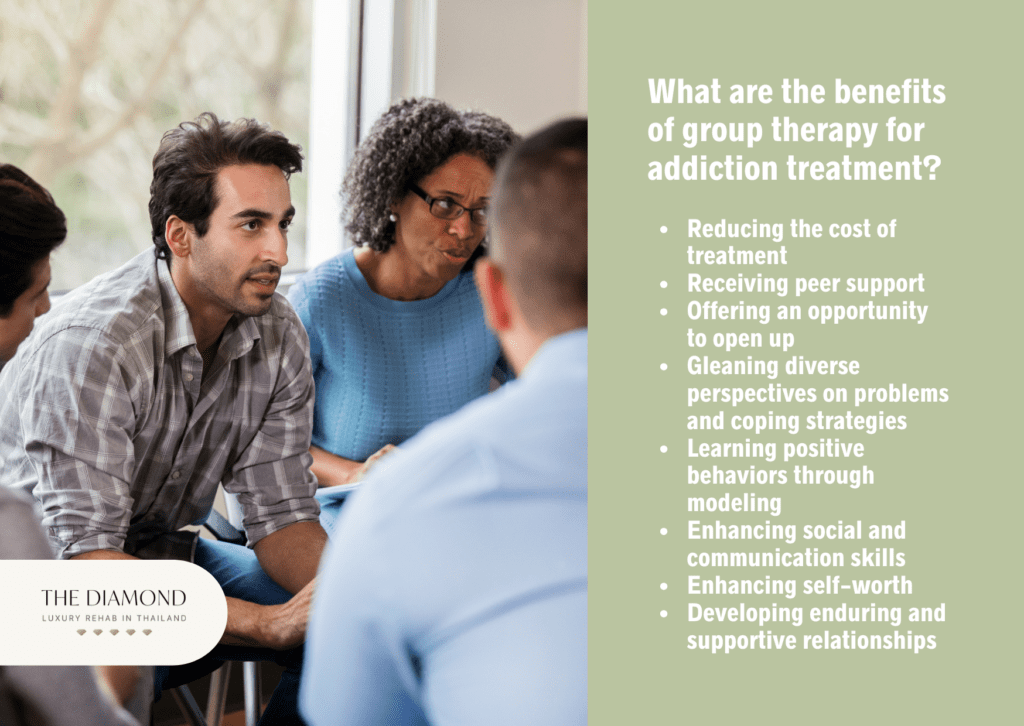
The benefits of group therapy for addiction treatment are listed below.
- Reducing the cost of treatment: Group therapy is typically less expensive than individual therapy because counseling services are provided to multiple patients simultaneously. Thus, more individuals are encouraged to seek treatment. They receive treatment quickly because healthcare system resources are optimized and there are no long waiting lists.
- Receiving peer support: Recovery is a lonely pursuit bereft of meaningful human connections. Group therapy sessions allow individuals to become a part of a supportive community, which dispels loneliness. Additionally, group members provide constructive feedback, support, and motivation, and foster accountability that aids recovery goals.
- Offering an opportunity to open up: Often individuals with substance abuse use are hesitant to share their struggles with others, believing that nobody will empathize with them or they will be rejected, shamed, or ridiculed. Group therapy provides them with a safe and supportive environment where they are able to open up, exchange their life stories, and find relief knowing that they are not the only ones struggling.
- Gleaning diverse perspectives on problems and coping strategies: A group environment brings together individuals with different personas and from diverse backgrounds. They have varied outlooks on substance use struggles and coping mechanisms. Group members are thus able to gain novel perspectives and insights into their addiction issues and learn new coping strategies by regularly talking and listening to others.
- Learning positive behaviors through modeling: A group is a congregation of individuals with shared life experiences and goals. This allows group members to learn positive responses and behaviors by modeling or imitating the actions of those who are further along in their recovery journey.
- Enhancing social and communication skills: Group interactions enable individuals to learn to be present, listen actively, express compassion and empathy, and offer positive feedback.
- Enhancing self-worth: Group members learn how to set and achieve goals, thereby exercising autonomy over their lives instead of being directed by their compulsive and impulsive drug-use habits. In turn, they teach these lessons to other group members. Directing their lives and helping others enhance their self-worth.
- Developing enduring and supportive relationships: Group therapy allows individuals to develop meaningful relationships. These relationships remain a source of lasting inspiration and support beyond the time spent at the therapist’s office.
What are the disadvantages of group therapy for addiction treatment?
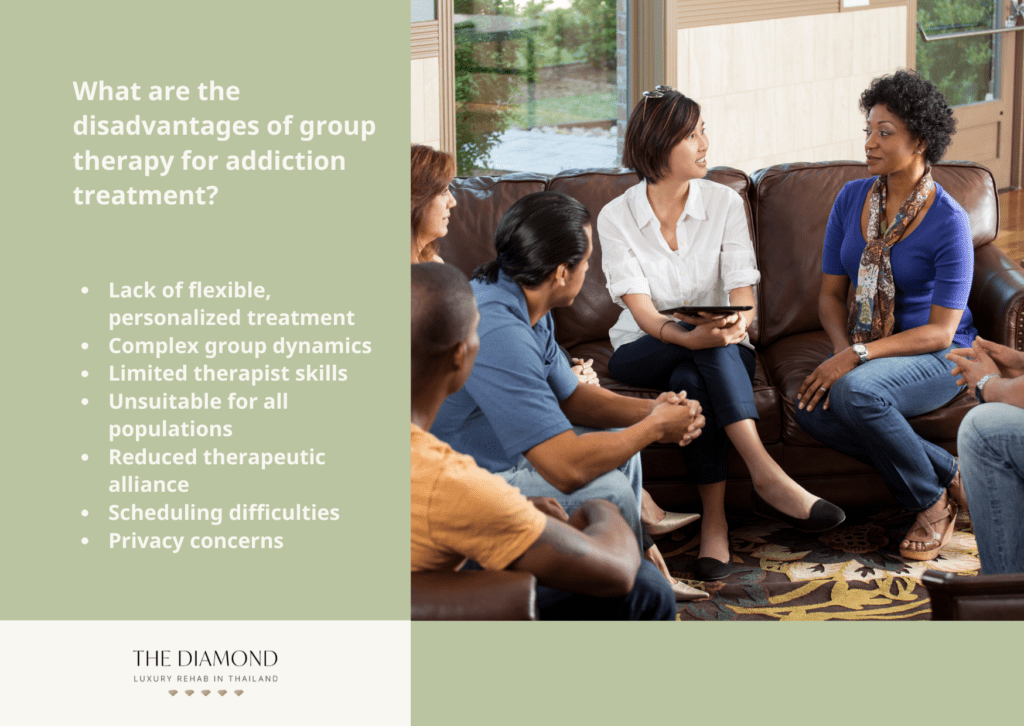
The disadvantages of group therapy for addiction treatment are listed below.
- Lack of flexible, personalized treatment: Group therapy is most effective when treatment is flexible and personalized. This demands that group facilitators adapt and accommodate highly structured or manualized therapies to suit unique group environments. If the facilitator is unable to synthesize multiple theoretical frameworks, topics, and activities and align these with group goals and the unique needs of the members, participants cannot derive maximum therapeutic benefits.
- Complex group dynamics: Substance abuse therapy groups include individuals with diverse personalities and mental makeup who also vary in their degree of addiction severity, propensity to engage with the group, and willingness to change. Participants vary in the way they perceive the world, cope with stress, and communicate with others. It is possible for disagreements, confrontations, and tensions to develop during a session, thereby disrupting the therapy process and causing anxiety among group members.
- Limited therapist skills: There is limited clinician experience in handling group therapy sessions. It has also been noted that there tends to be minimal on-the-job training which leaves clinicians feeling underprepared when they have to conduct group therapy sessions independently.
- Unsuitable for all populations: Group therapy is not suited to individuals who are shy and/or have social anxiety disorder. Group therapy is also unsuitable for individuals with co-morbid mental health illnesses like post-traumatic stress disorder.These patients benefit more from individual therapy, according to a 2021 article by Karsberg et al., published in the journal BMC Public Health, titled “Group versus individual treatment for substance use disorders: a study protocol for the COMDAT trial.”
- Reduced therapeutic alliance: A strong therapeutic alliance is known to promote positive addiction treatment outcomes, according to a 2012 article by Urbanoski et al., published in the Journal of Substance Abuse Treatment, titled “THE ROLE OF THERAPEUTIC ALLIANCE IN SUBSTANCE USE DISORDER TREATMENT FOR YOUNG ADULTS.” However, this alliance is not formed in group therapy sessions where the therapist is unable to form intimate bonds with individual members.
- Scheduling difficulties: It is challenging to align the schedules of a group of individuals with varied personal, professional, and/or academic commitments. Missed sessions and irregular attendance are common in group therapy settings, which disrupt the continuity of the recovery journey.
- Privacy concerns: Even if group members commit to maintaining confidentiality about other participants and the stories shared during the sessions, breaches–intentional or accidental–are not uncommon. These slip-ups erode trust in the group and prevent members from opening up.
How do I know if group therapy is right for me?
To know if group therapy is right for you, first consider your treatment needs and goals. Discuss with a therapist to find out if group therapy will be able to address your mental health needs based on your stage in recovery, emotional stability, and treatment preferences. Then, reflect on your personality traits, your preferred style of communication, and whether you are comfortable sharing your stories in a group environment. Group therapy is right for you if you desire connection with others, are comfortable opening up to strangers, or want to improve your social skills.
How do I find a group therapy session for addiction treatment?
To find a group therapy session for addiction treatment, visit the FindTreatment.gov website. All specialized addiction treatment facilities offer group therapy sessions. Find such a facility on the website by keying in your address, city, or zip code in the field provided at the top of the page. Or, search for an addiction treatment service provider on the website of a professional group like the American Psychological Association or the American Board of Professional Psychology.
What is the difference between group therapy and person-centered therapy for drug addiction treatment?
The differences between group therapy and person-centered therapy for drug addiction treatment arise due to disparities in the patient-therapist relationship, the roles of the group leaders, and their theoretical foundations. The differences are described in the table below.
| Group Therapy | Person-Centered Therapy |
|---|---|
| It involves multiple participants being counseled by one or more therapists. | It focuses on a one-on-one relationship between the patient and the therapist even if the therapy takes place in a group setting. |
| Different group therapy models are based on different theoretical frameworks. | Person-centered therapy is based on a humanistic approach. |
| The therapist typically directs where the conversation flows using counseling interview methods. | The participant is allowed to direct the course of the discussion. |
| The therapist guides the participants by providing interpretations, solutions, tips, and tools to solve their issues. | The participant finds the solutions to their problems themselves. |
| The therapist acts as a leader or a facilitator depending on the type of group. | The therapist acts as a facilitator. |
| Different types of group therapy employ varied techniques like but are not limited to, role-playing, relaxation exercises, problem-solving tasks, CBT, group discussions, and experiential activities. | The techniques include forming a strong therapeutic alliance, allowing self-expression, the participant directing the discussion, active listening, and the facilitator acting as a sounding board. |
| There are multiple types of group therapy formats to suit individuals with varied needs and recovery goals. | It is recommended for individuals who are deemed unsuitable for other types of psychotherapy. |
What is the difference between group therapy and support group for drug addiction treatment?
The differences between group therapy and support group for drug addiction treatment stem from the way the sessions are conducted, leadership profiles and styles, their foundational tenets, and group goals. The differences are described in the table below.
| Group Therapy | Support Group |
|---|---|
| Group therapy sessions are led by professional and licensed mental health providers. | Support groups are typically led by non-professional individuals, called peers, who share similar experiences of addiction and recovery. |
| It offers treatment for drug addiction. | Support groups do not offer treatment. |
| It focuses on changing maladaptive thought and behavioral patterns. | It focuses on strengthening coping mechanisms, providing peer support, and creating an environment of shared experiences. |
| Each group is based on a specific theoretical framework. | It is not directed by any scientific theory. |
| It is structured and follows a specific program. | It is less structured and informal and does not follow a pre-determined program. |
| It is more expensive. | There is little to no cost for joining a support group. |