Alternative therapies for addiction: definition, how they work, different therapies, and effectivity


Alternative therapies for addiction is a broad term used to refer to a body of therapeutic interventions that are not a part of standard or conventional treatment practices. These practices follow a whole-body treatment approach.
Alternative therapies work in addiction treatment as part of a comprehensive and integrative therapeutic regimen. These therapies increase the efficacy of standard treatment protocols and promote relapse prevention through interventions like reducing stress and anxiety, enhancing self-awareness, and helping individuals in recovery develop healthier coping skills.
Alternative therapies are effective for addiction recovery if used as an adjunct to conventional treatment modalities and mutual self-help groups. Currently, there is no scientific consensus on the efficacy of alternative therapies as the sole treatment regimen.
What are alternative therapies for addiction?
Alternative therapies for addiction refer to treatment modalities that are outside the ambit of conventional drug addiction treatment regimens, such as detoxification, pharmacotherapy and behavioral therapies. Alternative therapies include a variety of mind-body practices, manipulative and body-based practices, and energy healing techniques. Alternative therapies encompass a whole-body approach and focus on stimulating the body’s natural ability to heal itself.
The word “alternative” is misleading. The term complementary and alternative medicine (CAM) more accurately represents the philosophy of alternative therapy where “complementary” clarifies that a specific therapeutic approach is to be used as a supplement to, and not as a substitute for, conventional treatments. It is recommended that complementary and alternative therapies are provided alongside mainstream addiction treatments as part of an integrative, multidisciplinary, multisectoral, and holistic therapeutic protocol, as mentioned by Shu-Ming Wang in the chapter titled “The role of alternative therapies in a comprehensive addiction treatment” from the book Substance Use and Addiction Research” published in 2023.
What is the purpose of alternative therapies in addiction recovery?
The purpose of alternative therapies in addiction recovery is to provide comprehensive whole-person treatment that addresses the psychological, physical, cognitive, and spiritual aspects of a multifactorial disease like addiction. By doing so, these therapies aim to create a robust foundation for lasting recovery, especially when delivered alongside traditional interventions and mutual self-help groups.
Additionally, the objective of alternative therapies in addiction recovery is to operate in the gaps that conventional treatment protocols are unable to bridge. Managing addictive disorders is challenging because their symptoms span multiple domains, such as physical, cognitive, psychological, and behavioral. So, treatment regimens must incorporate multiple interventions that target each of these domains, according to a 2018 article by Kuppili et al., published in the Journal of Neurosciences in Rural Practice, titled “Role of Yoga in Management of Substance-use Disorders: A Narrative Review.”
How do alternative therapies work in addiction treatment?
Alternative therapies work in addiction treatment by focusing on establishing a mind-body connection, reducing stress and anxiety, enhancing self-awareness, and helping individuals develop resilience and healthier coping skills. Addiction is a complex and multifaceted disease with physical, psychological, cognitive, social, and spiritual aspects that must be treated using a multidisciplinary, holistic, and multisectoral integrative rehabilitation approach. Alternative therapies complement traditional interventions in multiple ways. Firstly, they enhance their efficacy. Secondly, they bridge treatment gaps left by mainstream interventions by addressing the domains that the latter fails to, for instance, by healing the mind and the spirit. Lastly, they increase psychological resilience in individuals, thereby preventing relapses.
Individuals with substance use disorders frequently have comorbid conditions like anxiety, depression, post-traumatic stress disorder, and insomnia. The symptoms of these conditions tend to worsen during recovery. It is believed that complementary and alternative therapies exert an indirect benefit on substance abuse by alleviating these comorbid conditions, according to a 2022 article by Sylvain et al., published in the European Journal of Integrative Medicine, titled “Complementary and alternative medicines in patients with alcohol or tobacco use disorder: Use, expectations and beliefs.”
Physical exercise has been shown to support drug addiction treatment by reducing substance use and cravings, decreasing relapse rates, and easing the symptoms of anxiety and depression, according to a 2022 article by Wang et al., published in the International Journal of Mental Health and Addiction, titled “A Randomized Controlled Trial Evaluating the Effect of Tai Chi on the Drug Craving in Women.” Traditional addiction treatment interventions like medications, detoxification, behavioral counseling, and mutual help groups do not incorporate physical movement or exercise, which alternative modalities like yoga and Tai Chi do.
An experiment was conducted on two groups of drug-dependent women. Both groups were treated using conventional addiction treatment methods. Additionally, the exercise group undertook physical exercises like aerobic activities and Tai Chi. It was found that subjects in the exercise group reported a quicker and greater decrease in drug-related cravings than the control group.
What are the benefits of alternative therapies for addiction?

The benefits of alternative therapies for addiction are listed below.
- Generates greater monetary savings: Alternative therapies are typically less costly than conventional treatment methods. They offer cost savings because the treatment modalities do not incorporate the use of complex technologies. They, instead, rely on inexpensive remedies that focus on stimulating the human body’s natural ability to heal itself, according to a 2005 article by Herman et al., published in the journal BMC Complementary and Alternative Medicine, titled “Is complementary and alternative medicine (CAM) cost-effective? a systematic review.”
- Increases treatment attractiveness: Specific sections of the population harbor a mistrust of conventional healthcare practices and providers. These individuals generally have a positive attitude toward alternative therapies and perceive these as being more attractive than traditional medicinal modalities.
- Increases treatment engagement and retention: Alternative therapies are non-invasive (except acupuncture) and less harsh on the fragile body of a chronic drug user than conventional Western treatment modalities. Additionally, individuals tend to perceive alternative therapies as pleasurable experiences. This makes them more likely to engage with the treatment regimen and follow through with it.
- Offers greater diversity of treatment modalities: Compared to traditional methods, alternative therapies provide a multitude of therapeutic approaches to suit the needs and preferences of diverse populations. These therapies are more flexible than highly structured and manualized mainstream therapeutic interventions and allow for greater personalization.
- Supports a comprehensive treatment approach: Addiction is a multifactorial disease with physiological, psychological, behavioral, and cognitive manifestations. The treatment regimen should follow a multidisciplinary and comprehensive approach that addresses the diverse aspects of the disease in order to address the root cause of addiction and achieve enduring abstinence. There is evidence to support that the integration of alternative therapies with traditional modalities like allopathic medicinal interventions leads to desirable positive outcomes, according to Shu-Ming Wang in the chapter titled “The role of alternative therapies in a comprehensive addiction treatment” from the book Substance Use and Addiction Research published in 2023.
- Reduces relapse: Various alternative therapies reduce the risk of relapsing by teaching individuals healthy strategies to cope with stress, easing the physical and mental distress of withdrawal symptoms, and boosting physical health that provides the energy needed during recovery. These therapies encourage individuals to develop a healthy and balanced lifestyle built on the pillars of exercise, nutrition, adequate sleep, and self-care that contribute to physical and mental resilience.
- Eliminates side effects: Conventional drug addiction treatment methods, such as physiological detoxification using medications, are direct and effective. However, they have side effects and tend to adversely impact a patient’s physical and psychological health, according to a 2022 article by Cui et al., published in the journal Frontiers in Psychiatry, titled “The Impact of Qigong and Tai Chi Exercise on Drug Addiction: A Systematic Review and Meta-Analysis.” Alternative therapies for addiction usually do not trigger adverse side effects and hence, are safe and effective in drug rehabilitation efforts.
- Promotes mental and emotional wellness: Multiple alternative therapies for addiction have been shown to calm a hyperactive nervous system that manifests as mental illnesses like anxiety, depression, and mood disorders and are associated with the maintenance of addiction. The National Institutes on Drug Abuse estimates that only 18% of addiction treatment programs and 9% of mental health treatment facilities are able to provide integrated treatment for co-occurring addiction and mental health disorders. Alternative therapies promote emotional and mental wellness by helping individuals identify, express, and process underlying trauma and suppressed negative emotions so that they are able to overcome them. These therapies enhance self-awareness and self-esteem and help individuals develop a positive mindset.
- Promotes spiritual wellness: The spiritual dimensions of practices like yoga, Reiki, and meditation encourage individuals to find purpose, feel at peace, and tap into their inner reserves of strength and will to endure recovery and achieve sustained abstinence.
- Improves cognitive functioning: Multiple alternative therapies are believed to improve cognitive functionalities. For instance, physical exercise has the ability to promote cognitive rehabilitation in individuals with substance use disorders. Alternative addiction therapies like Tai Chi has been shown to be more beneficial in this regard compared to conventional aerobic exercises like running and swimming, according to a 2024 article by Zhang et al., published in the journal Healthcare, titled “Effect of Tai Chi Compared to Running on Drug Cravings, Attention Bias, and Physical Fitness in Men with Methamphetamine Use Disorder.” Yoga, too, has been found to be effective in improving cognitive functioning when used as a complementary exercise regimen to treat substance users in an inpatient facility, according to a 2017 article by Ananda Gaihre and Sasidharan K. Rajesh published in the journal Annals of Neurosciences, titled “Effect of Add-On Yoga on Cognitive Functions among Substance Abusers in a Residential Therapeutic Center: Randomized Comparative Study.”
- Rebuilds damaged relationships: By helping individuals develop greater self-awareness and heal emotionally by processing trauma, alternative therapies help them rebuild strained relationships and expand and/or bolster their social networks.
- Greater inclusivity for individuals with unique needs: It is alleged that traditional treatments for addiction fail to consider the unique psycho-social realities, aspirations, and social roles of women,according to a 2014 article by Aletraris et al., published in the Journal of Addictions Nursing, titled “The Use of Art and Music Therapy in Substance Abuse Treatment Programs.” Art therapy facilitates the exploration and verbalization of deep-seated emotions in a way that mainstream addiction treatments cannot. Additionally, alternative therapies offer a non-medical approach to treating substance abuse that suits individuals who have developed resistance to or are allergic to addiction medications.
What are the different alternative therapies for addiction?
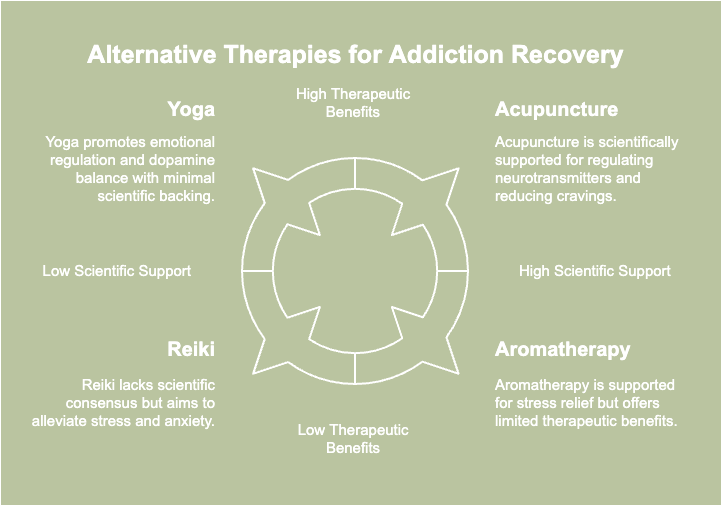
The different alternative therapies for addiction are listed below.
- Yoga: During addiction recovery, yoga promotes healing by reducing mental stress, improving brain fog that is common in the early stages of recovery, regulating emotions, and fostering a deeper connection to the self that allows an individual to tap into one’s inner reserves of strength. Addictive behaviors are referred to as “Reward Deficiency Syndrome.” Dopamine plays a key role in the regulation of the brain’s reward circuitry and substance abuse interferes with the normal functioning of this system by triggering an imbalance in the levels of dopamine. Dysregulation of the dopaminergic systems contributes to reward deficit in multiple ways, according to a 2024 article by Nilkamal Singh published in the journal Frontiers in Psychiatry, titled “Neurobiological basis for the application of yoga in drug addiction.” These include magnification of the reinforcing effects of drugs and reduction in the neuronal activities in regions of the brain involved in inhibitory control and executive functioning. The mind-body practice of yoga has been found to restore dopamine balance in the brain, according to a 2018 article by Kuppili et al., published in the Journal of Neurosciences in Rural Practice, titled “Role of Yoga in Management of Substance-use Disorders: A Narrative Review.” The authors mention that yoga has been found to promote subjective well-being, improve mood, and decrease cravings in studies on nicotine users.
- Meditation: Meditation has the possibility of becoming an effective component of addiction recovery by inducing neurological, behavioral, emotional, and psychological benefits, according to a 2023 article by LaBelle et al., published in the Journal of Substance Use and Addiction Treatment, titled “The role of mindfulness, meditation, and peer support in recovery capital among Recovery Dharma members.” Generally, meditation is associated with positive treatment outcomes like greater emotional regulation, less mental distress, increased psychological well-being, and improved pro-social emotions and behaviors. It has been found to be beneficial in reducing substance use. Meditation has been shown to increase executive functioning and cognitive control over impulsive behaviors and automatic habitual responses, according to a 2018 article by Priddy et al, published in the journal Substance Abuse and Rehabilitation, titled “Mindfulness meditation in the treatment of substance use disorders and preventing future relapse: neurocognitive mechanisms and clinical implications.” Additionally, meditation promotes addiction recovery by easing withdrawal-related symptoms like insomnia, anxiety, and depression by soothing the nervous system, improving mood, boosting one’s ability to stay in the present, and managing pain.
- Tai Chi: Tai Chi has been found to significantly improve symptoms of depression and anxiety, withdrawal side effects, sleep, and quality of life in individuals with drug addiction, according to a 2022 article by Cui et al., published in the journal Frontiers in Psychiatry, titled “The Impact of Qigong and Tai Chi Exercise on Drug Addiction: A Systematic Review and Meta-Analysis.” The authors believe that these benefits stem from improvements in the individual’s general physical health and/or a reduction in the frequency and/or severity of their chronic disease symptoms. The practice of mindful focus, as emphasized in Tai Chi, improves well-being by modulating the autonomic nervous system that controls involuntary physiologic processes like blood pressure, heart rate, and digestion. Cui et al., suggest that Tai Chi supports drug addiction treatment by improving emotional regulation via its action on the hypothalamic-pituitary-adrenal (HPA) axis. A study on men with methamphetamine use disorder found that practicing Tai Chi reduced drug cravings and improved attention bias toward drug cues and reaction time, according to a 2024 article by Zhang et al., published in the journal Healthcare, titled “Effect of Tai Chi Compared to Running on Drug Cravings, Attention Bias, and Physical Fitness in Men with Methamphetamine Use Disorder.”
- Reiki: Reiki is an energy-based holistic therapy that is believed to support conventional addiction treatment by alleviating symptoms of stress and anxiety. It is believed to improve insomnia, increase vitality, and improve mood, thereby, easing the recovery journey, which is physically demanding and mentally stressful. Reiki is also used frequently to manage chronic pain and thus support addiction recovery. Individuals with substance use disorders tend to receive less than adequate pain management treatment than those without an addiction. But, inadequate pain relief raises the risk of a relapse. However, there is no scientific consensus regarding the efficacy of Reiki as an addiction treatment.
- Acupuncture: The World Health Organization accepts acupuncture as a treatment modality for substance abuse. Acupuncture in addiction treatment is believed to work by increasing the levels of specific chemicals in the central nervous system and plasma. These chemicals include dopamine, serotonin, endorphin, norepinephrine, enkephalin, and epinephrine, and they are associated with the mediation of drug abuse, according to a 2016 article by Motlagh et al., published in the journal Chinese Medicine, titled “Acupuncture therapy for drug addiction.” Drug-dependent individuals in studies have reported decreased mental distress and enhanced self-esteem after acupuncture therapy. Authors Lee et al., in their 2021 article titled “Bidirectional role of acupuncture in the treatment of drug addiction” published in the journal Neuroscience & Biobehavioral Reviews state that acupuncture reduces drug cravings and prevents relapse by regulating neurotransmitters, restoring biochemical balance, and modulating the neuronal pathways in the reward circuitry of the brain. Dysregulation of these mechanisms of the brain is implicated in the development, maintenance, and relapse of substance abuse.
- Massage therapy: The American Massage Therapy Association in a March 2013 article on their website, titled “Massage and Addiction” written by Clare La Plante, states that massage therapy supports addiction recovery by increasing serotonin and dopamine and decreasing cortisol levels, especially during the early phase of withdrawal. During this phase of recovery, dopamine tends to drop causing discomfort. Low dopamine levels in the body manifest as troubled sleep, depression, anxiety, low mood, and lack of motivation and vitality. Cortisol is a stress hormone, and high levels of this chemical during withdrawal compound this already stressful process by weakening the immune system and increasing pain. Massage therapy has been shown to be beneficial as an adjunct to conventional medical detoxification for alcohol addicts, according to a 2005 article by Reader et al., published in the Journal of Alternative and Complementary Medicine, titled “Massage therapy improves the management of alcohol withdrawal syndrome.”
- Spiritual therapy: Spirituality is an integral component of addiction treatment. Authors Miller et al., in their 2008 article titled “Spiritual Direction in Addiction Treatment: Two Clinical Trials” published in the Journal of Substance Abuse Treatment refer to multiple studies that suggest that there is a positive relationship between spirituality and recovery. The Twelve Step Facilitation therapy, with its intensive focus on spirituality, has shown total abstinence rates that are higher than Motivational Enhancement Therapy or Cognitive Behavioral Therapy. It is believed that spiritual practices like introspection, prayer, meditation, and conscious connection with a power higher than oneself act as a buffer against life’s stresses, replace negative beliefs about self, others, and the world with positive ones, and promote healing and personal growth. Reporting the findings from a study in Malaysia, authors Seghatoleslam et al., in their 2015 article titled “Achieving a Spiritual Therapy Standard for Drug Dependency in Malaysia, from an Islamic Perspective: Brief Review Article” published in the Iranian Journal of Public Health mention that spiritual therapy integrated into conventional psychotherapy delivered alongside Methadone Maintenance Therapy has the potential to treat heroin dependence effectively.
- Reflexology: Reflexology is a holistic therapy that aims to support addiction treatment by improving overall health and well-being, improving symptoms of depression and anxiety, boosting the body’s natural healing processes, and relaxing the body and the mind. Thailand’s tobacco control mission incorporates foot reflexology into its treatment regimen. It has been found that the success rate of smoking cessation with this technique is close to 50%, which is comparable to the success rate achieved with conventional bupropion treatment, according to a 2022 article by Wattanaruangkowit et al., published in the journal Evidence-Based Complementary and Alternative Medicine, titled “The Effects of Foot Reflexology for Smoking Cessation on Brain Activities with Functional Magnetic Resonance Imaging (fMRI): A Pilot Study.” However, the authors clarify that it is not yet known whether the beneficial effect of foot reflexology on tobacco addiction outcomes is in reality the indirect effect of relaxation. They warn that there is no scientific evidence to suggest that reflexology, on its own, has the ability to treat addiction.
- Nutrition therapy: There is an intertwined and exacerbating relationship between addiction and nutritional deficiency, according to a 2009 article by Margherita Grotzkyj‐Giorgi published in the journal Drugs and Alcohol Today, titled “Nutrition and addiction — can dietary changes assist with recovery?” Individuals who abuse drugs often suffer from nutritional deficiencies stemming from inadequate food consumption. Malnutrition is believed to induce drug-seeking behaviors and hamper recovery efforts, according to a 2017 article by Kendall D. Jeynes and E. Leigh Gibson published in the journal Drug and Alcohol Dependence, titled “The importance of nutrition in aiding recovery from substance use disorders: A review.” Nutrition influences the pace and quality of addiction recovery and primes an individual–physically, mentally, and cognitively–to function at their highest during recovery. Additionally, neural circuits required for survival are stimulated by both specific foods and substances of abuse. So, cravings for food experienced during recovery by a nutritionally deficient individual are apt to be mistaken for drug cravings, thereby precipitating a relapse. The American Dietetic Association recommends the presence of a certified dietician in any treatment team for recovery from substance abuse.
- Aromatherapy: Aromatherapy has been found to support recovery by easing stress, as suggested by Alison Knopf in a 2023 article titled “Research finds aromatherapy eases stress during SUD treatment” published in the Alcoholism & Drug Abuse Weekly. Essential oils used in aromatherapy have been found to promote calmness and relaxation, alleviate the symptoms of stress and anxiety, and treat insomnia. Brain fog and confusion are common in the early stages of recovery. These symptoms decrease self-awareness and dull consciousness so that individuals in recovery are unable to reflect on their habitual impulsive and compulsive drug choices and regulate their actions. Specific essential oils boost cognitive faculties, enhance mental clarity, and sharpen focus by quietening intrusive and racing thoughts and promoting mindfulness. Authors Cathy Skipper and Florian Birkmayer in the chapter titled “The Role of Aromatherapy in the Treatment of Substance Use and Co-Occurring Disorders” from the book Integrative Addiction and Recovery published in September 2018 explain that olfactory receptors are found in most regions of the central nervous system associated with addiction and motivation control. This is why essential oils are able to alleviate multiple nervous symptom disorders induced by addiction. Essential oils also ease minor physical problems like muscle and joint pain, headaches, digestive issues, and stomach pain that are common during detoxification and early recovery.
- Art therapy: The benefits of art therapy in drug addiction treatment are extensively recorded in scientific literature. This treatment modality provides an opportunity for self-expression. Recovering individuals are able to express negative thoughts and traumatizing emotions that they are unable to verbalize or do not want to say during talk therapies. Art therapy has been shown to take individuals past denial, reduce feelings of shame, and spur positive change by moving them away from an inert state of reflection and rumination and into that of goal-directed action, according to a 2014 article by Aletraris et al., published in the Journal of Addictions Nursing, titled “The Use of Art and Music Therapy in Substance Abuse Treatment Programs.” Author Patricia Quinn in a 2025 article titled “Art therapy’s engagement of brain networks for enduring recovery from addiction” published in the journal Frontiers in Psychiatry mentions that art therapy has been found to boost learning capabilities, insight, and drive; help individuals access and process suppressed traumatic memories; and ground them in the present moment by engaging them in activities that demand organization and external planning. The experiential nature of art therapy has been found to promote a sense of self-efficiency and personal agency.
Are alternative therapies effective for addiction recovery?

Yes, alternative therapies are effective for addiction recovery, but only if delivered alongside conventional treatment protocols and mutual self-help groups. The case for alternative therapies in addiction is strong considering that traditional interventions to manage substance addiction, such as cognitive behavioral therapy, motivational interviewing, and 12-step support groups, have a high relapse rate of 60% during the year after treatment, according to a 2018 article by Priddy et al, published in the journal Substance Abuse and Rehabilitation, titled “Mindfulness meditation in the treatment of substance use disorders and preventing future relapse: neurocognitive mechanisms and clinical implications.”
It has been observed that acupuncture supports opioid addiction treatment by easing withdrawal symptoms, according to a 2022 article by Sylvain et al., published in the European Journal of Integrative Medicine, titled “Complementary and alternative medicines in patients with alcohol or tobacco use disorder: Use, expectations and beliefs.” There is limited evidence to suggest that therapies like acupuncture, meditation, and yoga reduce tobacco use or promote abstinence in problematic users. Yoga is believed to be beneficial as an adjunctive treatment for substance abuse while massage therapy has the ability to ease alcohol withdrawal symptoms and reduce anxiety in alcohol, opioid, and cocaine withdrawal. However, these findings are based only on preliminary research.
Currently, there is no robust scientific evidence to support the use of these therapies to treat substance use disorder. So, they must not be used in place of traditional treatment modalities as the sole therapeutic regimen, as cautioned by the U.S. Department of Veterans Affairs in their web release titled “Substance Use Disorder Treatment: Complementary Approaches” written by Aleksandra Zgierska and Cindy A. Burzinski and last updated on 17 March 2025.