
National Association of Alcoholism and Drug Abuse Counselors (NAADAC): definition, role in addiction recovery, and responsibilities


Table of content
- What is the National Association of Alcoholism and Drug Abuse Counselors (NAADAC)?
- What is the role of NAADAC in addiction treatment and recovery?
- What are the responsibilities of alcoholism and drug abuse counselors?
- What are the core values of NAADAC?
- What are the ethical guidelines of NAADAC?
- How to become a NAADAC-certified addiction counselor?
- What are the NAADAC certification requirements?
- Who can join NAADAC?
- What are the benefits of NAADAC membership?
- How does NAADAC support addiction counselors?

The National Association of Alcoholism and Drug Abuse Counselors (NAADAC) is a professional organization dedicated to supporting addiction-focused counselors, educators, and healthcare professionals. Education, advocacy, and certification are offered by NAADAC to advance the ethical and effective treatment of substance use disorders.
The role of NAADAC in addiction treatment and recovery is to equip professionals with resources, ethical standards, and support to effectively work with people suffering from substance abuse issues.
The responsibilities of alcoholism and drug abuse counselors include conducting assessments, developing treatment plans, providing counseling, educating patients and families, monitoring progress, coordinating care, promoting relapse prevention, and upholding ethical standards.
What is the National Association of Alcoholism and Drug Abuse Counselors (NAADAC)?
The National Association of Alcoholism and Drug Abuse Counselors (NAADAC), now known by its new name—NAADAC, the Association for Addiction Professionals, is a national organization supporting individuals working in the field of addiction prevention, treatment, and recovery.
Counselors, educators, and medical professionals specializing in treating people afflicted by drug addiction, alcohol addiction, alcoholism, and substance use disorder find professional resources in the group.
Continuing education, nationally recognized certifications, and the promotion of ethical norms are all avenues through which NAADAC works to guarantee high-quality care is provided by practitioners working in addiction treatment.
What is the role of NAADAC in addiction treatment and recovery?
The role of NAADAC in addiction treatment and recovery is to provide guidance and empowerment to professionals in charge of assisting persons with substance-related challenges.
Responsible and empathetic care are promoted by the organization’s ethical guidelines. NAADAC offers credentialing programs to make sure counselors are qualified and have the requisite abilities.
Practitioners are kept apprised about emerging strategies and research through the provision of continuing education by the organization. NAADAC participates in policy advocacy to enhance the accessibility of services and fortify support systems. Addiction treatment improves through standardized training and professional guidance delivered by the association.
Families benefit from better-informed counselors with an expertise on how to approach intervention with care and structure. Healthy communities and lasting addiction recovery are achieved with the support of NAADAC’s advocacy for excellent counseling techniques.
What are the responsibilities of alcoholism and drug abuse counselors?
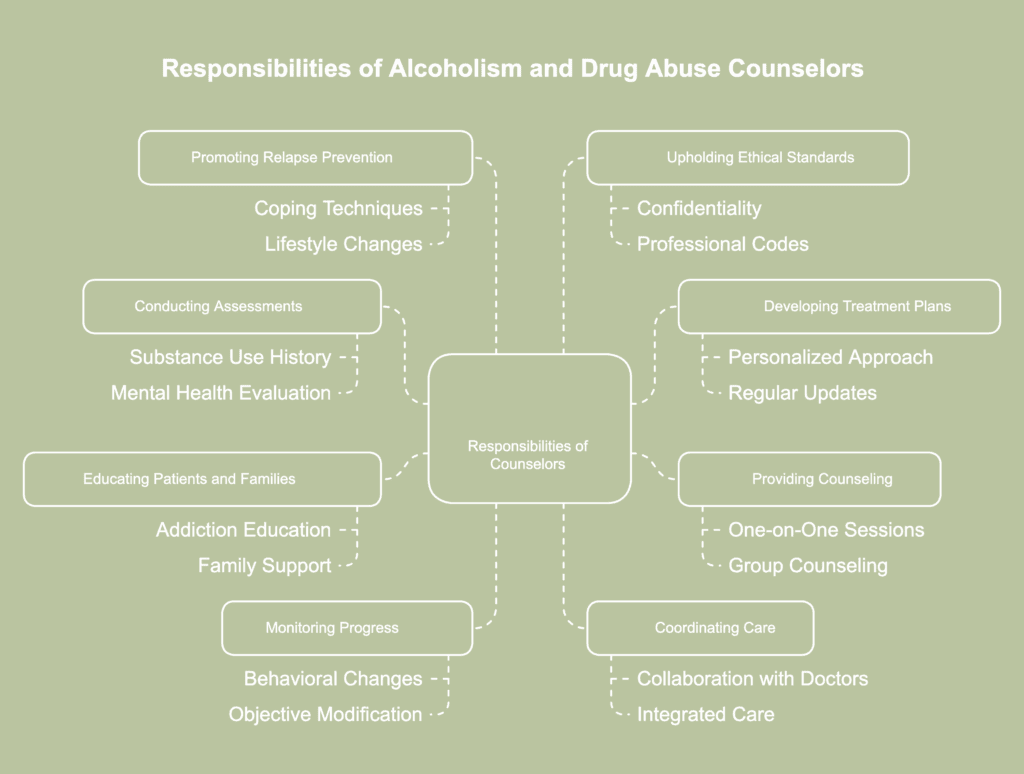
Responsibilities of alcoholism and drug abuse counselors refer to the professional duties involved in assessing, treating, and supporting individuals with alcohol and drug addiction. The responsibilities of alcoholism and drug abuse counselors are listed below.
- Conducting assessments: Alcoholism and drug abuse counselors begin by evaluating a patient’s substance use history, mental health, and personal background. The evaluation helps determine the severity of the addiction and identify co-occurring issues. Accurate assessments guide the development of an effective treatment plan tailored to the person’s needs. The process often involves interviews, standardized tools, and collaboration with healthcare providers.
- Developing treatment plans: Counselors design structured plans outlining goals, interventions, and timelines for recovery. Treatment plans consider the individual’s unique circumstances, such as social support, mental health status, and motivation. Regular updates ensure the plan evolves as the client progresses through recovery. A personalized approach increases engagement and improves long-term outcomes.
- Providing counseling: One-on-one and group counseling sessions offer emotional support, education, and behavioral strategies. Helping identify triggers and cultivate healthy coping mechanisms is a key component of counseling. Meeting regularly fosters confidence and provides a secure environment for addressing challenging events. Insight, accountability, and a shift in behavior are the outcomes of effective therapy.
- Educating patients and families: Counselors inform patients and loved ones about addiction, treatment options, and recovery strategies. Education helps lower stigma and improve knowledge of the difficulties in conquering drug use. Families discover how to help in recovery without supporting destructive habits.
- Monitoring progress: Tracking a patient’s recovery journey helps identify improvements, setbacks, and emerging needs. Throughout treatment, counselors record participation, attendance, and behavioral changes. Frequent assessments aid in modifying objectives and interventions to keep the momentum going. Continuous observation guarantees responsibility and keeps recovery on course.
- Coordinating care: Collaboration with doctors, social workers, and mental health professionals ensures individuals receive comprehensive support. Integrated care addresses both addiction and related physical or emotional conditions. Coordinating services helps eliminate gaps in treatment and prevents relapse. A substance abuse counselor often serves as a central point of contact in the recovery network.
- Promoting relapse prevention: Counselors teach patients how to recognize warning signs and apply strategies to avoid relapse. Relapse prevention planning includes coping techniques, support systems, and lifestyle changes. Practice and preparation reduce the likelihood of returning to substance use.
- Upholding ethical standards: Maintaining confidentiality, setting boundaries, and acting in the client’s best interest are fundamental responsibilities. Counselors follow professional codes to protect people and promote trust. Ethical behavior safeguards both the counselor and patients receiving care. Upholding ethical standards ensures the integrity and credibility of addiction services.
What are the core values of NAADAC?
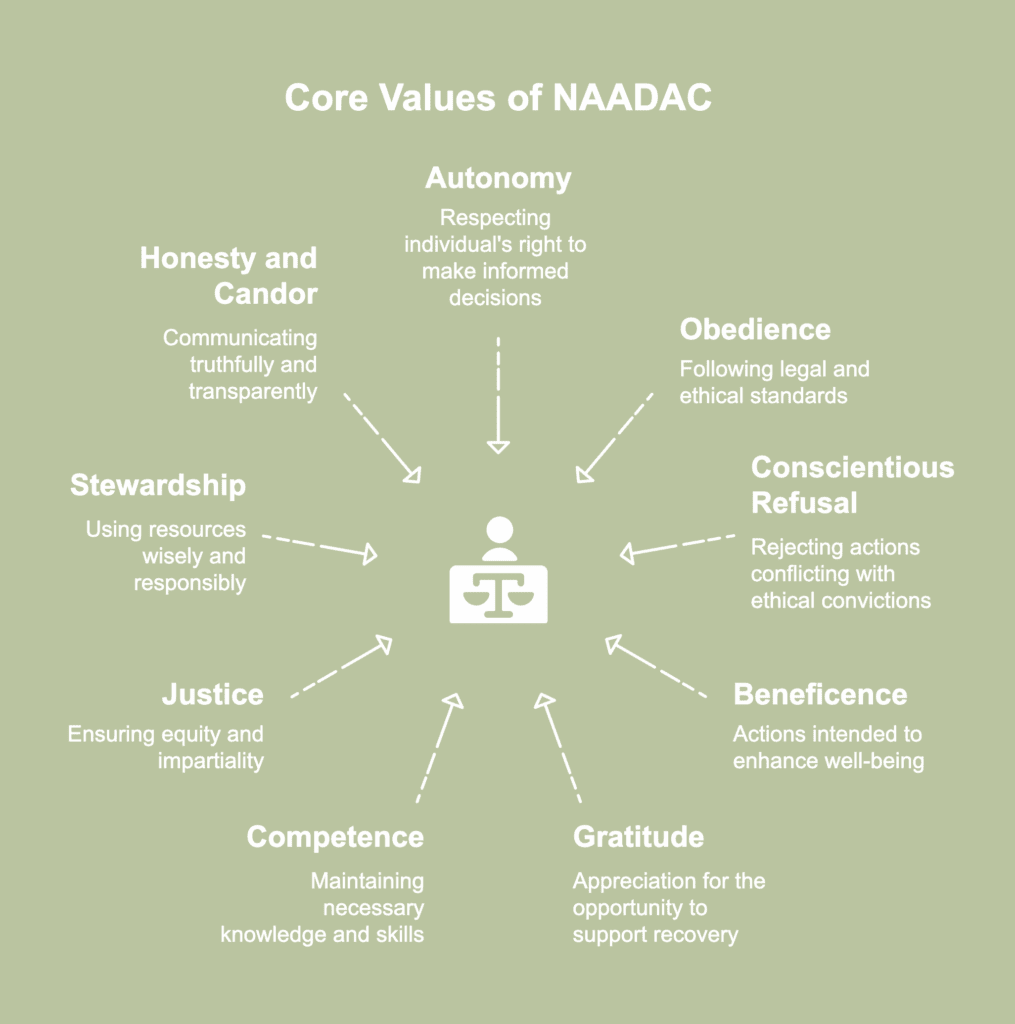
Core values of NAADAC refer to the fundamental principles guiding the ethical and professional conduct of addiction counselors represented by the organization. The core values of NAADAC are listed below.
- Autonomy: Autonomy refers to respecting a person’s right to make informed decisions about their care. A 2025 publication titled “Code of Ethics” from NAADAC, the Association for Addiction Professionals defines autonomy as granting individuals the liberty to determine their own destiny. Counselors offer clear information and encourage people to direct the course of recovery. Respecting autonomy gives one greater control and deepens therapeutic trust.
- Obedience : Obedience involves following legal requirements, ethical codes, and professional standards in practice. Addiction counselors are expected to comply with rules set by regulatory bodies and licensing agencies. Adhering to established guidelines maintains accountability and protects client welfare.
- Conscientious refusal : Conscientious refusal permits counselors to reject actions or directives conflicting with their own ethical convictions. The principle prevents participation in harmful or unjust practices. Integrity remains intact, and ethical boundaries stay firmly in place.
- Beneficence : Beneficence involves actions intended to enhance the well-being and recovery of individuals. Counselors focus on supportive interventions, emotional care, and favorable results. Every decision is guided by the intent to do good and reduce harm.
- Gratitude : Gratitude reflects a counselor’s appreciation for the opportunity to support recovery and learn from patient experiences. Practice of gratitude fosters compassion, empathy, and humility in therapeutic relationships.
- Competence : Competence requires counselors to maintain the knowledge and skills needed to provide effective addiction services. High standards are ensured in part via continuous training, supervision, and self-evaluation. Competent practice increases results and client confidence.
- Justice : Justice necessitates equity and impartiality in the provision of addiction services to all individuals. Access to care, human rights, and the elimination of bias are among the goals counselors work for. Treating everyone fairly promotes trust in the community and encourages ethical behavior.
- Stewardship : Stewardship involves using resources wisely and responsibly in service to patients and the profession. Counselors manage time, energy, and tools efficiently to support recovery efforts. The integrity of the profession is maintained and influence is maximized by means of responsible stewardship.
- Honesty and candor : Honesty and candor require counselors to communicate truthfully with clients, colleagues, and the public. Transparency fosters confidence and guarantees well-informed choices.
What are the ethical guidelines of NAADAC?
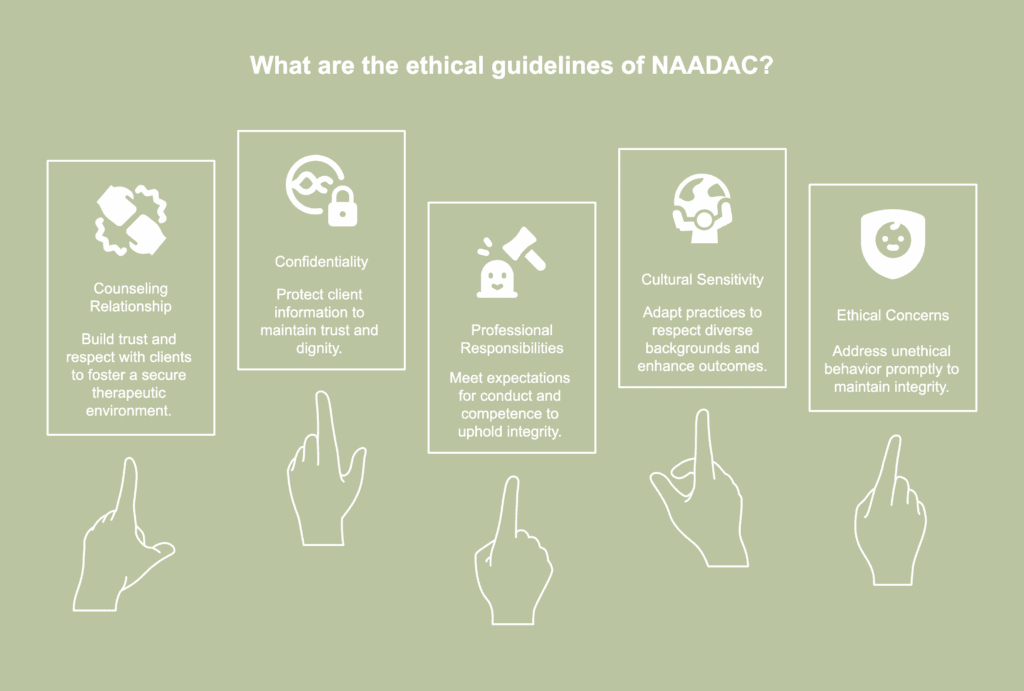
Ethical guidelines of NAADAC refer to the established standards directing the professional conduct of addiction counselors affiliated with the Association for Addiction Professionals. The ethical guidelines of NAADAC are listed below.
- The counseling relationship: This guideline focuses on building a therapeutic relationship rooted in respect, honesty, and support. Professionals in addiction treatment establish a secure environment where patients feel respected and heard during the process of recovery. Meaningful interaction is built upon clear boundaries, empathy, and trust.
- Confidentiality and privileged communication: Protecting information remains central to ethical addiction counseling. Counselors maintain discretion, sharing details as required by law or with written consent from clients. Respecting privacy fosters trust and safeguards the dignity of each individual.
- Professional responsibilities and workplace standards: Ethical practice includes meeting professional expectations in conduct, competence, and accountability. Counselors follow rules, avoid conflicts of interest, and perform duties with care. Maintaining a responsible work ethic supports the integrity of the profession.
- Working in a culturally diverse world: Cultural awareness and sensitivity guide ethical interactions with people from different backgrounds. Addiction professionals adapt practices to respect beliefs, values, and traditions. Embracing diversity promotes inclusion and strengthens therapeutic outcomes.
- Assessment, evaluation, and interpretation: Ethical standards require accurate, fair, and appropriate use of assessment tools. Counselors consider cultural, social, and personal factors during evaluation. Misuse or misinterpretation of data is avoided to ensure effective care planning.
- Use of e-therapy, e-supervision, artificial intelligence (AI), and social media: Technology must be used responsibly and ethically in addiction counseling. Professionals safeguard client data, maintain boundaries, and ensure services are delivered securely. Whether using AI tools or engaging online, transparency and accountability remain priorities.
- Supervision, consultation, and education: Ethical standards emphasize the value of seeking guidance, sharing knowledge, and supporting professional growth. While consultation offers new perspectives on complicated issues, supervision ensures high-quality care. Education keeps counselors informed and ethically grounded.
- Addressing ethical concerns: Counselors are expected to respond to unethical behavior promptly and appropriately. Concerns are handled through proper channels, always prioritizing welfare and professional integrity. Silence or avoidance undermines trust and weakens accountability.
- Research and publication: When engaging in research, addiction professionals follow strict ethical protocols to protect participants and ensure honesty. Findings are presented truthfully, with sources acknowledged and data accurately reported. The goal is to advance knowledge without compromising ethics.
- National certified peer recovery support specialist (NCPRSS): NCPRSS professionals uphold ethical principles while offering peer support. Recovery is modeled through consistent behavior, clear boundaries, and respect for confidentiality in every interaction. Lived experience adds credibility and reinforces guidance grounded in ethics.
- Ethics pertaining to member organizations: Organizations associated with NAADAC must follow the same ethical expectations as individual professionals. Fair treatment, honest communication, and responsible leadership reflect shared values. Ethical policies guide organizational decisions and protect clients and staff alike.
How to become a NAADAC-certified addiction counselor?
To become a NAADAC-certified addiction counselor at the National Certified Addiction Counselor, Level I (NCAC I) level, applicants must meet specific qualifications or eligibility requirements, as laid out by NAADAC, the Association for Addiction Professionals on a publication titled “NCAC I.”
A high school diploma, general education development (GED), or a higher educational credential is required to begin the process. Individuals must hold a valid and active license or certification in addiction counseling or a related profession, such as mental health, social work, marriage and family therapy, or Licensed Associate Professional Counseling (LAP-C), issued by a recognized state or credentialing body.
A minimum of three years of full-time employment or 6,000 supervised hours working as an addiction or substance use counselor is necessary. Additionally, applicants must complete at least 270 contact hours of specialized education or training in addiction counseling or related fields.
Within those hours, six must focus on ethics, and another six must cover HIV or other infectious pathogens, both completed within the past six years. A passing score on the NCAC I exam provided by the National Certification Commission for Addiction Professionals (NCC AP), or the ADC exam offered by the International Certification & Reciprocity Consortium (IC & RC), is required.
What are the NAADAC certification requirements?
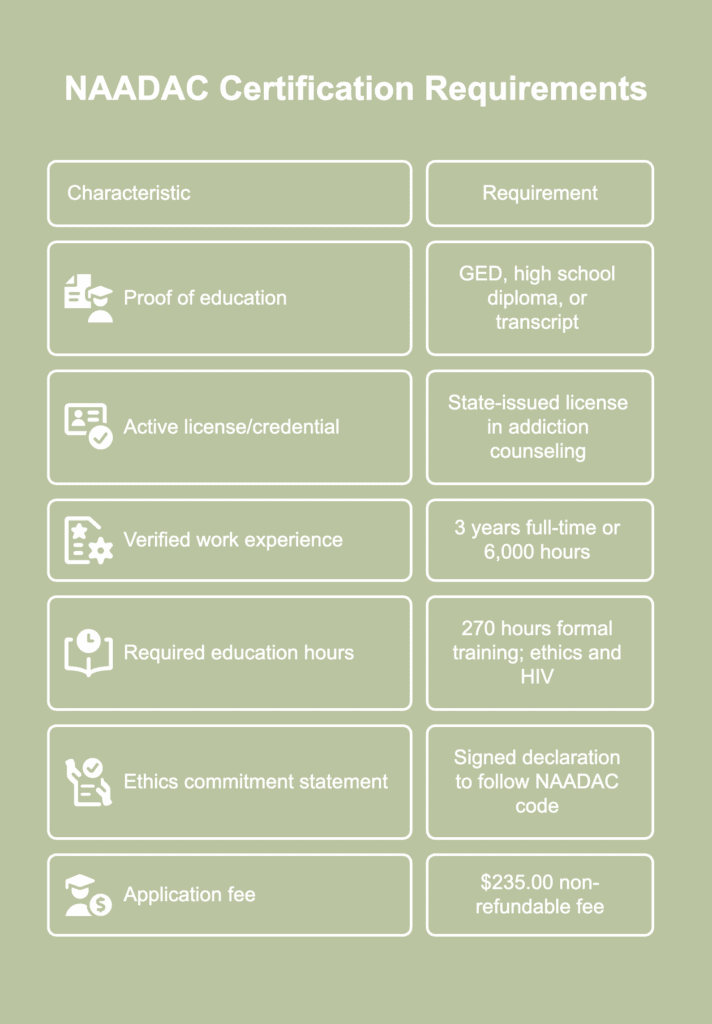
NAADAC certification requirements refer to the set of professional standards and qualifications individuals must meet to earn official recognition through the National Association for Alcoholism and Drug Abuse Counselors. The NAADAC certification requirements are listed below.
- Proof of education: A copy of a GED, high school diploma, or official transcript from a higher institution is necessary to verify academic completion. The requirement confirms the applicant’s foundational knowledge. Educational background sets the baseline for professional development in addiction counseling.
- Active license or credential: Applicants must provide documentation of a valid state-issued license or credential in addiction counseling or a related field like mental health, social work, or marriage and family therapy. Recognition from a credentialing authority supports professional legitimacy. Such verification guarantees the counselor functions under regulated standards.
- Verified work experience: A supervisor or qualified health professional must submit written proof confirming three years of full-time work or 6,000 hours in addiction counseling. The verification must include direct observation of the candidate’s performance across core skill areas, confirming real-world application of professional knowledge.
- Required education hours: Candidates need 270 hours of formal training in addiction or related counseling topics. Six of the required hours must be ethics-related, and another six must be devoted to HIV or infectious illness education, and both have to have been completed within the last six years. Training reflects a commitment to staying informed and ethically responsible.
- Ethics commitment statement: A signed declaration must confirm the applicant has read and agrees to follow the NAADAC/NCC AP Code of Ethics. A written commitment upholds accountability and professional behavior. Adherence to ethical standards protects both the public and the counseling profession.
- Application fee: A $235.00 non-refundable fee is required when submitting the application for review. Payment covers the administrative and evaluation process. Investing in certification reflects dedication to career advancement.
Who can join NAADAC?
Licensed, certified, registered, or credentialed addiction professionals can join NAADAC, according to an article titled “Join or Renew” from NAADAC, the Association for Addiction Professionals website.
Individuals working toward licensure, as well as persons in non-clinical roles such as probation officers, public health workers, administrators, outreach coordinators, and marketing staff, are welcome to join as well.
NAADAC offers membership to peer recovery support specialists, students enrolled in approved addiction studies programs, and retired professionals who are no longer practicing. International applicants living and working outside the United States are eligible to join through the international chapter.
Those connected to the U.S. military, like active duty members, veterans, spouses, and committee members, are permitted to join through a dedicated military chapter. The organizational membership option is available to agencies, businesses, and institutions aiming to support the addiction profession while boosting presence within the community.
What are the benefits of NAADAC membership?
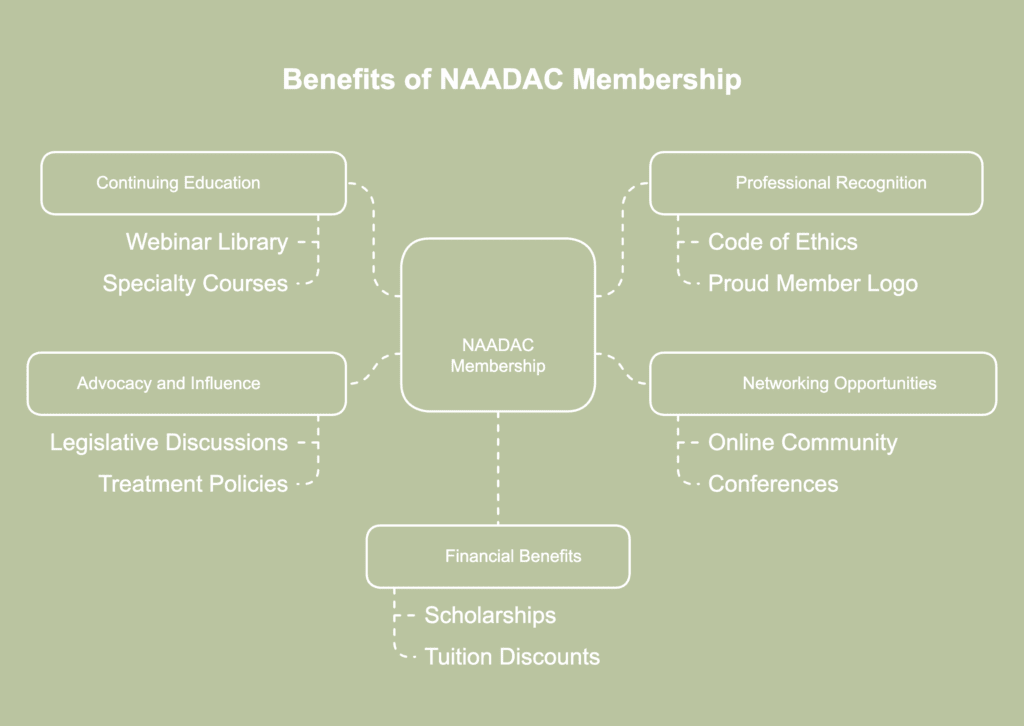
Benefits of NAADAC membership refer to the professional advantages and support services available to persons and organizations who join the Association for Addiction Professionals. The benefits of NAADAC membership are listed below.
- Access to free and discounted continuing education: Members unlock over 360 hours of no-cost continuing education through NAADAC’s on-demand webinar library. Such webinars help professionals earn CE (continuing education) credits by simply viewing sessions and completing quizzes online. Specialty courses remain available at reduced rates, offering more options for advanced or focused training.
- Recognition of NAADAC CEs by credentialing boards: Continuing education hours from NAADAC are accepted by various licensing boards and certification bodies. Members benefit from wide recognition when maintaining or renewing credentials.
- Complimentary digital subscription to NAADAC’s magazine: Membership includes free online access to Advances in Addiction & Recovery, the organization’s official publication. The resource delivers timely articles, expert insights, and research updates in the addiction field.
- Lower costs on study materials and publications: Members enjoy discounts on essential resources, including the Basics of Addiction Counseling: Desk Reference, often used for exam prep and practice guidance. NAADAC additionally offers 20% off the digital edition of Uppers, Downers, All Arounders – Provider Edition. Savings make educational tools more accessible for professionals at every stage.
- Reduced fees for events and workshops: Lower admission rates are available for NAADAC-sponsored conferences, regional workshops, and public policy events. Gatherings provide valuable education and networking opportunities in various locations. The NAADAC Master Calendar makes finding relevant events simple.
- Active advocacy at state and federal levels: NAADAC speaks on behalf of addiction professionals in legislative and regulatory discussions. Through the group’s advocacy efforts, members gain greater influence over funding decisions and treatment policies.
- Tuition and scholarship opportunities: Student members have the opportunity to apply for the William White Scholarship, offering $1,000 to an undergraduate and $2,000 to a graduate recipient. Members additionally qualify for tuition discounts at institutions like Walden University and Purdue Global. Family members who meet eligibility requirements have access to the same educational support, promoting continued learning in addiction-related studies.
- Connection through the online community and conferences: An exclusive online forum allows members to share strategies and seek support from peers nationwide. National and local events foster in-person interactions, helping build stronger professional relationships.
- Professional recognition and code of ethics access: Membership helps define and reinforce the identity of addiction professionals within the healthcare system. The association offers a respected Code of Ethics to guide ethical conduct. Members are able to display the “Proud Member” logo to highlight affiliation and credibility.
- Insurance access with public exposure: Members benefit from reduced-rate liability coverage through the American Professional Agency, tailored to counselors, students, and support specialists. A complimentary six-month listing on Psychology Today’s Therapy Directory further boosts professional reach. Both features offer practical support and industry credibility.
- Digital tools for clinical efficiency: OakTree Practice Management software comes with exclusive savings for NAADAC members. Designed for telehealth and administrative tasks, the tool integrates patient records, development tools, and AI-based features. Free demos help members evaluate the software’s functionality before committing.
- Career and job search assistance: The NAADAC Career Center allows members to explore nationwide and international employment opportunities or promote open roles. The platform connects employers and qualified candidates in the addiction services field.
How does NAADAC support addiction counselors?
NAADAC supports addiction counselors by means of professional development, advocacy, and education. For the purpose of helping counselors in fulfilling the requirements for certification and licensure, the association offers more than 360 hours of free continuing education.
Members are entitled to conferences, publications, and advanced training at a reduced cost. NAADAC additionally promotes funding and public policy impacting addiction services across the country. Counselors gain access to ethical guidance through a nationally recognized Code of Ethics. Opportunities for clinical training are made accessible to enhance skills in practical environments and facilitate professional development.
The association strengthens professional identity by offering resources and state affiliate connections. Career assistance is offered via employment boards, liability insurance alternatives, and practice management resources.