Is psilocybin addictive?


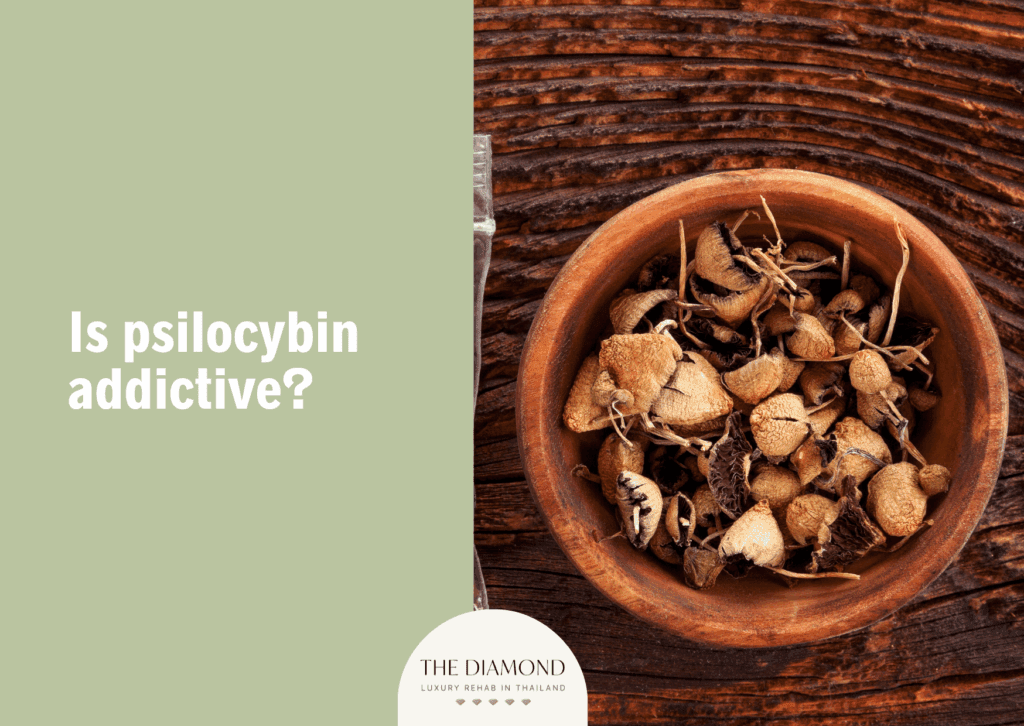
Psilocybin mushrooms are a group of more than 200 mushrooms that contain psilocybin as their active compound. Psilocybin is a hallucinogenic substance and psilocybin-containing mushrooms have mind-altering properties.
Psilocybin is typically not addictive. It has minimal reinforcing properties and has not been shown to produce physical withdrawal. However, it is hallucinogenic. It has been classified as a Schedule I controlled substance due to its high abuse potential.
Psilocybin activates serotonin receptors in the brain and causes desynchronization of neural networks involved in forming an individual’s sense of space, time, and self. The disruption of functional connectivity in these areas induce the characteristic psychedelic experiences that are associated with taking psilocybin mushrooms.
Psilocybin use is not typically dangerous at controlled doses and when taken in a clinical and medically-supervised setting by individuals who are not vulnerable to its adverse effects.
What are psilocybin mushrooms?
Psilocybin mushrooms are hallucinogenic mushrooms that have psilocybin as their active component. The mushrooms usually contain less than 0.5% psilocybin alongwith trace amounts of psilocin, which too has hallucinogenic properties. There are more than 200 species of these mushrooms, and they are found all over the world. These mushrooms are psychedelic substances with the ability to alter states of consciousness by distorting perception, emotion, and cognition. Psilocybin mushrooms are known by names like magic mushrooms, shrooms, boomers, or caps. Throughout centuries, psilocybin mushrooms have been used by the indigenous tribes of Central and South America as tools to aid spiritual exploration and induce mystical experiences.
Psilocybin is a classic serotonergic hallucinogen that does not act directly on the dopaminergic system of the brain, according to a 2016 article by David E. Nichols published in the journal Pharmacological Reviews, titled “Psychedelics.” Dopamine is linked to the feelings of pleasure that most addictive drugs induce. The stimulation of the dopaminergic system by addictive drugs triggers dependence, which is a hallmark of addiction. Specifically, the dopamine neurons in the ventral tegmental area (VTA) are critical for producing reward-seeking behaviors by influencing reward perception, motivation, attention, learning, reinforcement, decision making, and impulsivity.
However, experiments on animals have shown that the administration of psilocin does not increase extracellular dopamine concentration in the VTA, according to a 2015 article by Sakashita et al., published in the journal Biological and Pharmaceutical Bulletin, titled “Effect of psilocin on extracellular dopamine and serotonin levels in the mesoaccumbens and mesocortical pathway in awake rats.” Thus psilocybin mushrooms are typically not considered to be addictive substances. It is rare for these mushrooms to cause hallucinogen use disorder or an addiction to hallucinogens.
What does psilocybin do to the brain?
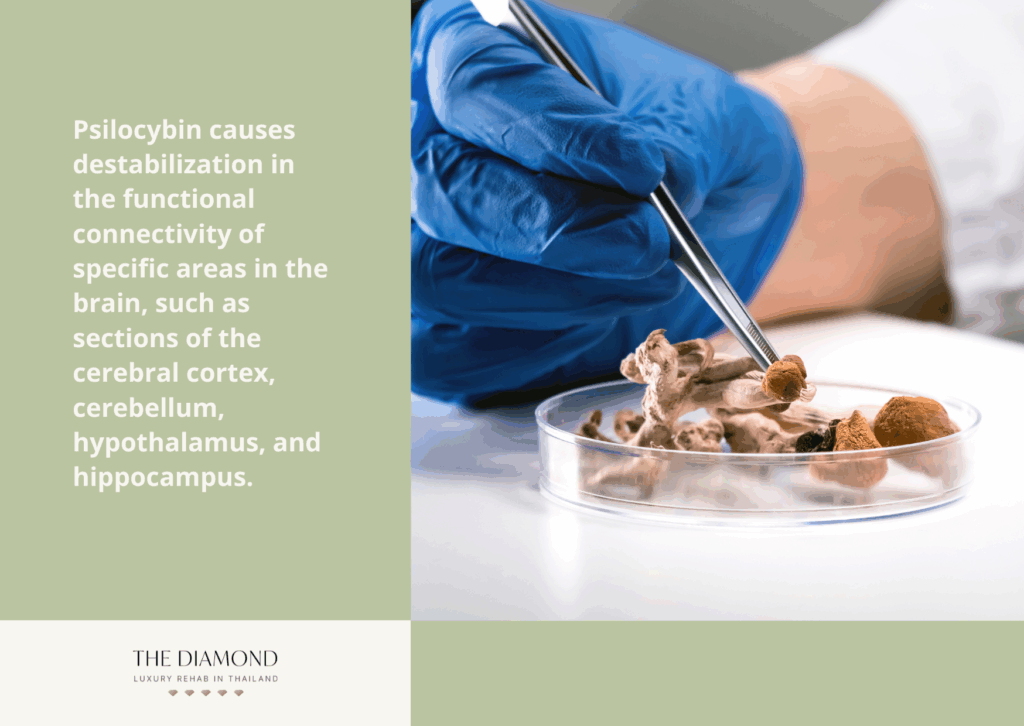
Psilocybin causes destabilization in the functional connectivity of specific areas in the brain, such as sections of the cerebral cortex, cerebellum, hypothalamus, and hippocampus, according to a 2024 article by Siegel et al., published in the journal Nature, titled “Psilocybin desynchronizes the human brain.”Functional connectivity refers to how different areas of the brain interact with one another and synchronize their functions. However, the effects of psilocybin are not produced by the substance itself, according to a February 2023 release by the American Society for Microbiology titled “Psilocybin and Mental Health: The Magic in the Mushrooms.” They are triggered by its metabolite, psilocin, which is the active form of the substance.
To understand how drugs impact the brain, it is critical to consider the specific receptors they activate. Psilocin stimulates the serotonin 5-HT2a receptors located on the cortical pyramidal cells. These are the computational units of the brain. They help synthesize varied stimuli to form a holistic picture of reality. Psilocybin affects not only specific cells in the brain but also changes the wider brain dynamics through its action on the serotonin 5-HT2a receptors that produces a dampening effect on the brain. In particular, the activation of these receptors by psilocybin lowers the energy required by the brain to transition between one activity state to another. A brain on psilocybin is thus able to move between different activity states fluidly.
The most noticeable changes induced by psilocybin are observed in an area of the brain that comprises the default mode network (DMN). This region is typically activated when an individual is not focusing on a task, such as when daydreaming. The default mode network is implicated in the formation of one’s sense of self, space, and time. By scrambling the signals in this region, psilocybin alters cognitive capabilities and one’s ability to perceive what is real.
Can psilocybin mushrooms be abused?
Yes, psilocybin mushrooms can be abused even though it has insignificant reinforcing effects and has not been observed to produce physical withdrawal. It has been found to be abused mostly by younger individuals. Psilocybin is classified as a Schedule I substance under the US Controlled Substances Act, indicating that it has high abuse potential, as noted by the Department of Justice and the Drug Enforcement Administration in their April 2020 Drug fact Sheet titled “Psilocybin.”
According to this classification, psilocybin has no approved medical use. Authors Johnson et al., in their 2018 article titled “The Abuse Potential of Medical Psilocybin According to the 8 Factors of the Controlled Substances Act” published in the journal Neuropharmacology note that psilocybin will be removed from Schedule I if a therapeutic product containing psilocybin is approved by the Food and Drug Administration (FDA). Then it will be rescheduled after assessing its abuse potential.
Is psilocybin use dangerous?
No, psilocybin use is typically not dangerous if it is taken in controlled doses and under medical supervision, according to a January 2024 web release by the National Institute on Drug Abuse titled “Psilocybin (Magic Mushrooms).” Psilocybin is mildly toxic, so it does not cause potentially fatal side effects like heart attacks or breathing trouble. It has been found from studies that psilocybin has the lowest toxicity among 20 psychoactive compounds and exhibits a typically safe physiological profile for varied populations, as noted by Justin C. Strickland and Matthew W. Johnson in the chapter titled “Behavioral Pharmacology of Drug Abuse: Current Status” from the 2022 book “Advances in Pharmacology.”
However, it is possible for the mind-altering effects of this substance to cause an individual to engage in behaviors that harm themselves or others physically. For instance, an individual under the influence of psilocybin loses their ability to think clearly and drives dangerously. It is possible for psilocybin to trigger potentially dangerous side effects in individuals with specific pre-existing health conditions. For instance, the typical side effects of psilocybin mushrooms like elevated blood pressure and heart are potentially dangerous for individuals with cardiac issues.
Psilocybin use is potentially dangerous in individuals with pre-existing mental health conditions like schizophrenia and bipolar disorder that make them vulnerable to psychosis and suicidal ideation. Authors Kim et al., in their 2025 article titled “The many faces of psilocybin-related psychosis: A case series” published in the journal Psychiatry Research Case Reports mention case studies where frequent and intermittent psilocybin use induced dangerous effects like increased paranoia, clinically severe suicide attempts, and prolonged psychosis in patients in a dual diagnosis treatment facility. Authors Barber et al., in their 2022 article titled “A Case of Prolonged Mania, Psychosis, and Severe Depression After Psilocybin Use: Implications of Increased Psychedelic Drug Availability” published in The American Journal of Psychiatry report the case of an individual with a history of depression developing paranoia and psychosis after ingesting psilocybin mushrooms. The condition progressed to major depressive disorder with symptoms like anhedonia, severe depression, insomnia, feelings of worthlessness, fatigue, impaired concentration, and suicidal ideation.
The U.S. Centers for Disease Control and Prevention warns that it is possible for products containing psychoactive compounds like magic mushroom extract to contain illegal substances, adulterants, and contaminants that are harmful. These products include chocolates, gummy candies, and other snacks.
Can you overdose on psilocybin mushroom?
Yes, you can overdose on psilocybin mushroom. However, overdosing incidents are typically not fatal because the psilocybin concentration in the mushroom is low. The estimated fatal dose of psilocybin is 6 g of the drug substance, which is equivalent to consuming about 10 kg of fresh mushroom. So, fatally overdosing on psilocybin is unrealistic and an unlikely incident, according to a 2022 article by Kopra et al., published in the Journal of Psychopharmacology, titled “Adverse experiences resulting in emergency medical treatment seeking following the use of magic mushrooms.”
Psilocybin overdosing is associated with symptoms like stomach pain, nausea, dizziness, and shivering. Overdosing incidents that require medical intervention are typically rare and non-severe with the majority of cases involving psychological symptoms. In a small percentage of cases, overdosing on psilocybin has the potential to trigger severe psychiatric symptoms like suicidal ideation that increases the likelihood of the individual harming themselves.
What are the effects of psilocybin mushroom?
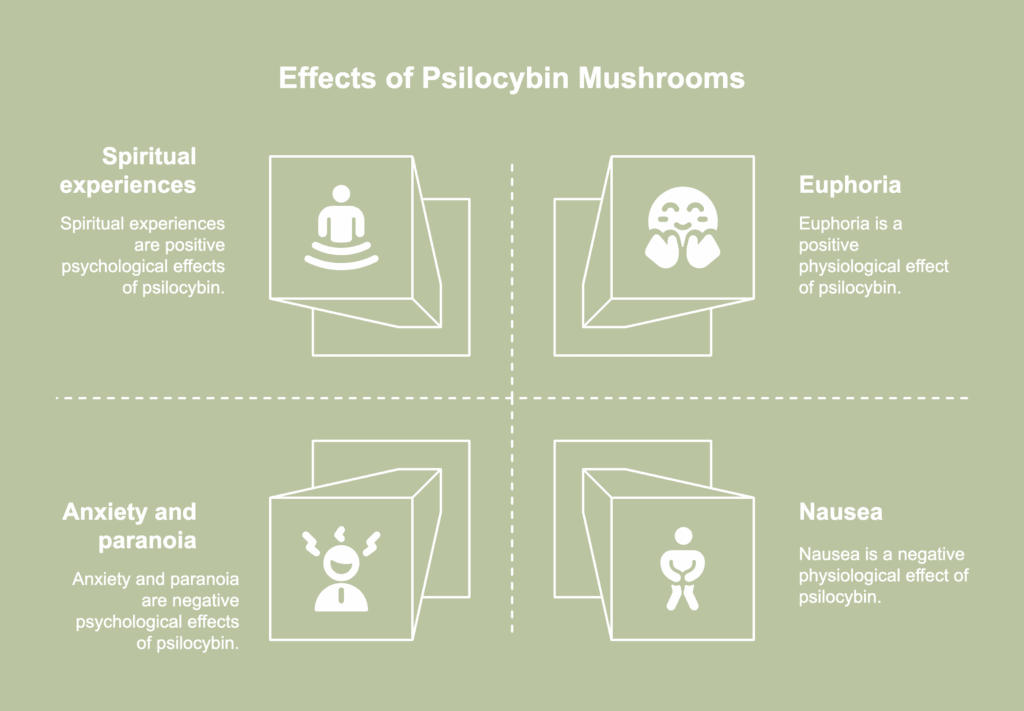
The effects of psilocybin mushrooms are listed below.
- Hallucinations: The symptoms manifest as altered perception. There is a shift in how an individual perceives reality, such as seeing colors, shapes, and objects, hearing sounds or conversations that are not real, and losing their sense of space and time . Authors Leptourgos et al., in their 2020 article titled “Hallucinations Under Psychedelics and in the Schizophrenia Spectrum: An Interdisciplinary and Multiscale Comparison” published in the journal Schizophrenia Bulletin explain that psilocybin produces these hallucinations by altering several neural networks. These changes include enhanced early sensory activity and reduced processing in associative sensory regions. A prominent change is the breakdown of the functional connection between the DMN, which is active during the resting stage, and the central executive network (CEN), which is activated when the brain focuses on a task. The reduced coherence of the resting-state DMN occurs simultaneously with its co-activation with the CEN. This phenomenon of increased instability of specific network-dynamics is believed to trigger the confusion between externally and internally produced mental stimuli.
- Distorted thoughts and perceptions: Psilocybin temporarily disturbs the normal functioning of a region in the brain linked to introspective thinking, such as remembering and daydreaming. Impaired functioning in this network produces the mind-altering effects of psilocybin, according to a July 2024 news release by Washington University in St. Louis titled “Psilocybin generates psychedelic experience by disrupting brain network” written by Tamara Schneider. The distortion of thoughts and perceptions manifest as feelings of derealization and depersonalization. Derealization describes a state where an individual feels as if their physical environment is not real. Depersonalization describes a state where an individual experiences a dream-like sensation of being detached from their physical surroundings.
- Loss of ego: This state is described as losing one’s sense of self. There is a breakdown of the boundaries between the self and the world. Researchers use the phrase “oceanic self-boundlessness” to describe this state. According to authors Smigielski et al., in their 2019 article titled “Psilocybin-assisted mindfulness training modulates self-consciousness and brain default mode network connectivity with lasting effects” published in the journal NeuroImage, this effect is triggered by psilocybin causing a breakdown of the brain’s default mode network. The DMN comprises the self-referential processing areas of the medial prefrontal and posterior cingulate cortices that are believed to foster a sense of self.
- Spiritual experiences: It has been shown that medium to high doses of psilocybin, typically less than 25 mg, administered in a controlled and supportive environment produce mental states that resemble what individuals experience during religious exaltations, mystical-type experiences, and deep meditative states, according to a 2022 article by Franz X. Vollenweider and John W. Smallridge published in the journal Pharmacopsychiatry, titled “Classic Psychedelic Drugs: Update on Biological Mechanisms.” The symptoms include bliss, increased insightfulness, and feeling connected and one with the world around.
- Euphoria: Psilocybin induces euphoric feelings and a sense of wellbeing within 5-30 minutes of ingesting the substance. It is believed that psilocybin generates these pleasurable feelings by increasing the concentration of dopamine in the striatal region (Vollenweider and Smallridge, 2022).
- Elevated heart rate and blood pressure: These are dose-dependent and transient effects that typically do not require medical intervention, as noted by Agnieszka Wsół in a 2023 article titled “Cardiovascular safety of psychedelic medicine: current status and future directions” published in the journal Pharmacological Reports. These effects are produced due to psilocybin activating the serotonin receptors in the heart and increasing the rate at which the heart beats and contracts, according to a 2024 article by Neumann et al., published in the journal Frontiers in Pharmacology, titled “Effects of hallucinogenic drugs on the human heart.”
- Nausea: Studies suggest that nausea is a dose-dependent and mild adverse side effect of psilocybin administration. The incidence of nausea is 22% at high doses of psilocybin, 7% at a moderate dose, and 1% with low doses, according to the findings of one study reported by Yerubandi et al., in a 2024 article titled “Acute Adverse Effects of Therapeutic Doses of Psilocybin–A Systematic Review and Meta-Analysis” published in the journal JAMA Network Open.However, in all the cases mentioned in the study, nausea was resolved without medical intervention.
- Diarrhea: Serotonin 5-HT receptors have a significantly high expression in the gastrointestinal tract. It is believed that adverse effects of psilocybin administration, such as gastric upset, are caused by the drug activating these receptors, according to a 2024 article by Felicia Reed and Claire J. Foldi published in the journal Trends in Pharmacological Sciences, titled “Do the therapeutic effects of psilocybin involve actions in the gut.”
- Headache: The incidence of headaches caused by psilocybin administration ranges from 2% to 66% and is regarded as a statistically significant adverse reaction to the substance (Yerubandi et al., 2024). However, these headaches are of mild to moderate intensity and transient in nature.
- Dizziness: Dizziness is a statistically significant adverse effect of psilocybin administration with an incidence rate of 6% at high doses, 1% with moderate doses, and none at low doses (Yerubandi et al., 2024). The issue typically resolves within 24-48 hours without medical intervention.
- Altered muscle coordination: The symptoms include impaired muscle coordination, muscle weakness, muscle spasms and tremors, and enhanced reflexes.
- Altered cognitive functioning: Psilocybin administration has been observed to induce mixed effects on cognitive capabilities. Macrodoses of psilocybin tend to produce impairment of cognitive and creative capabilities within minutes and hours of administration while microdoses enhance cognitive performance and creativity, according to a 2023 article by Bonnieux et al., published in the Journal of Psychopharmacology, titled “Psilocybin’s effects on cognition and creativity: A scoping review.” Psilocybin administration has been found to improve memory types like associative learning and semantic associations, according to a 2024 article by Meshkat et al., published in the journal Psychiatry and Clinical Neurosciences, titled “Impact of psilocybin on cognitive function: A systematic review.” In other studies, psilocybin has been shown to improve executive functioning, working memory, and focused attention, especially in individuals with treatment-resistant depression.
- Anxiety and paranoia: It has been found that psilocybin in markedly increased doses, such as 30mg/70kg, induces feelings of fear and paranoia (Vollenweider and Smallridge, 2022). Psilocybin elevates sensory and emotional arousal, facilitates a release of emotions, and alters cognitive functioning. The authors believe that these effects magnify and manifest as psychosis-like responses in specific circumstances when the dose of psilocybin is increased. Beside paranoia, these responses include anxiety, panic, faulty thinking, and illusion of grandeur.
Can psilocybin be used in addiction treatment?
Yes, psilocybin can be used in addiction treatment and has been shown to produce positive outcomes like decreased substance use and reduced cravings, according to a 2023 article by Zafar et al., published in the journal Frontiers in Psychiatry, titled “Psychedelic therapy in the treatment of addiction: the past, present and future.”Authors Pim B. van der Meer et al., in their 2023 article titled “Therapeutic effect of psilocybin in addiction: A systematic review” published in the journal Frontiers in Psychiatry refer to experiments where the administration of psilocybin to substance-using populations produced multiple beneficial outcomes. In a population of individuals with alcohol use disorder, the administration of psilocybin alongside psychosocial treatment decreased the number of heavy drinking days significantly.
In another study, psilocybin therapy delivered alongside cognitive-behavioral therapy has shown promising results in attaining abstinence in individuals with problematic tobacco use habits. At 26-week follow-up, 80% of the subjects reported seven-day point prevalence of abstaining from smoking. This number was 67% at 52-week follow-up and 60% when follow-up was done after 16 months.
It is believed that psilocybin has the potential to support addiction treatment through its interaction with the trace amine-associated receptor (TAAR), according to a 2022 article by Michiel van Elk and David Bryce Yaden published in the journal Neuroscience and Bio behavioral Reviews, titled “Pharmacological, neural, and psychological mechanisms underlying psychedelics: A critical review.” When activated by psilocybin, the TAAR exerts a dampening effect on dopaminergic activity and influences an individual’s sensitivity to stress and reward. Additionally, psilocybin has the potential to support addiction treatment by alleviating the symptoms of depression.Depression is a known risk factor of addiction relapse.
Psilocybin is believed to have the potential to treat the root causes of psychiatric illnesses, instead of merely alleviating their symptoms, and thus, promote lasting recovery, according to a 2022 article by Smausz et al., published in the Journal of Psychopharmacology, titled “Neural mechanisms underlying psilocybin’s therapeutic potential – the need for preclinical in vivo electrophysiology.” The substance resets the brain’s neural, cognitive, and affective connections, thereby inducing novel insights and enabling emotional release. In the context of addiction treatment, expressing deep-seated and suppressed emotions enables an individual to process trauma and move past it. The emergence of novel insights frees individuals from their habitual negative thinking patterns and allows them to re-examine their story and rebuild their sense of self in a more positive and empowering way.