

Addiction support groups: definition, types, benefits, and focus


Table of content
- What are addiction support groups (recovery support groups?)
- What are the types of addiction support groups?
- What are the benefits of addiction support groups?
- How effective are addiction support groups?
- What should I consider when choosing an addiction support group?
- How important are support groups in addiction recovery?
- What do addiction support groups focus on?

Addiction support groups are assemblies where individuals grappling with addiction convene to exchange experiences and provide reciprocal encouragement. Addicts and those pursuing recovery benefit from the emotional support, peer assistance, and accountability offered by these groups.
The types of addiction support groups include Alcoholics Anonymous (AA), Narcotics Anonymous (NA), Pills Anonymous (PA), SMART Recovery, Cocaine Anonymous (CA), Gamblers Anonymous (GA), Celebrate Recovery, Women for Sobriety (WFS), LifeRing Secular Recovery, and Al-Anon.
The benefits of addiction support groups include substance use reduction, emotional support, accountability, reduced isolation, improved engagement in treatment, practical advice and coping strategies, personal growth, and social and community benefits.
Addiction support groups primarily focus on providing an atmosphere of safety for people to share their stories, learn from one another, and increase self-confidence in their recovery.
What are addiction support groups (recovery support groups?)
Addiction support groups, otherwise known as recovery support groups, are scheduled gatherings where people battling addiction get together to talk about their struggles, victories, and experiences in a non-judgmental and encouraging environment.
Those in recovery find social and emotional support in these groups, where they meet others going through the same things and get words of encouragement. They are typically led by peers, who share similar experiences with substance use disorder, or by professionals trained in addiction recovery.
Providing a regular network of encouragement aims to build a sense of accountability, lessen feelings of isolation, and foster long-term rehabilitation. In several instances, these organizations employ organized programs, like as 12-step frameworks or cognitive behavioral techniques, to facilitate individuals’ recovery journeys.
What are the types of addiction support groups?
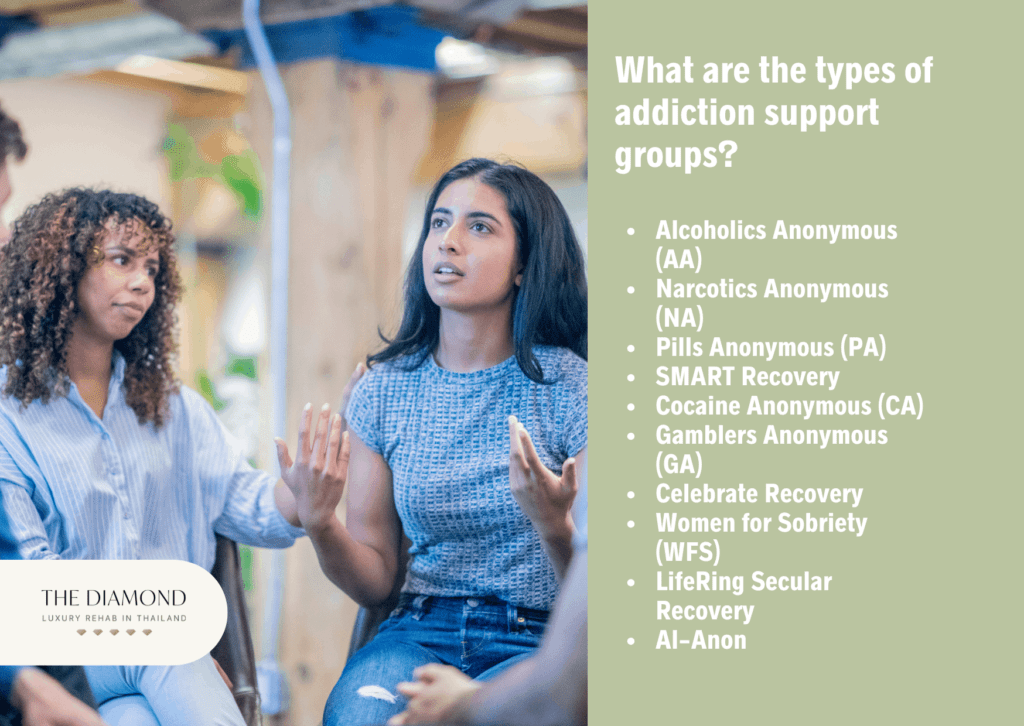
Types of addiction support groups are any number of structured groups that assist people with diverse addictions by providing individualized care according to their need. The different types of addiction support groups are listed below.
- Alcoholics Anonymous (AA): One of the most well-known 12-step groups was established in 1935 to aid people in their recovery from alcoholism: Alcoholics Anonymous (AA). Through following a set of guidelines known as the 12 Steps, it encourages abstinence from alcohol and places a strong emphasis on spiritual development. A 2022 article by Marcin Wnuk titled, “The Beneficial Role of Involvement in Alcoholics Anonymous for Existential and Subjective Well-Being of Alcohol-Dependent Individuals? The Model Verification” found that participation in AA meetings results in an enhancement in existential well-being, which in turn improves subjective well-being. In particular, those who discovered a deeper sense of purpose and optimism in their lives through AA reported higher levels of life satisfaction and positive emotions.
- Narcotics Anonymous (NA): Narcotics Anonymous (NA), established in 1953, is a 12-step program based on the AA model, but it focuses on helping individuals addicted to drugs, including narcotics, stimulants, and other substances. Personal accountability and mutual support among members are key tenets of NA’s program for achieving and maintaining total drug sobriety.
- Pills Anonymous (PA): A 12-step organization called Pills Anonymous (PA) was developed for those in recovery from prescription drug addiction, specifically with regard to painkillers and certain mood-altering pharmaceuticals. Founded in 1972, it follows the same guiding principles as AA and NA, emphasizing sobriety through peer support and the 12 Steps. Members of PA are free to share their experiences with prescription drug abuse in a secure and encouraging setting.
- SMART Recovery: SMART Recovery (Self-Management and Recovery Training) is a science-based support group that provides an alternative to 12-step programs. To manage addiction, it promotes self-empowerment, rational thinking, and coping methods through cognitive behavioral therapy (CBT). Unlike 12-step groups, SMART does not rely on spirituality but emphasizes personal responsibility and self-management. According to a 2023 study by Kelly et al., titled, “An investigation of SMART Recovery: protocol for a longitudinal cohort study of individuals making a new recovery attempt from alcohol use disorder,” preliminary evidence indicates that SMART Recovery possibly offers comparable advantages to AA in terms of alcohol consumption reduction; however, it remains understudied in comparison to AA.
- Cocaine Anonymous (CA): Cocaine Anonymous is a 12-step program specifically for individuals recovering from cocaine addiction, though members with other substance use issues are welcome. Established in 1982, it follows the same 12 Steps as AA and NA, promoting complete abstinence and personal growth through spiritual principles.
- Gamblers Anonymous (GA): Gamblers Anonymous is a 12-step program designed for people who want to overcome their addiction to gambling. To help one overcome obsessive gambling, GA stresses the need of integrity, responsibility, and peer support. There are meetings at different sites that give people struggling with gambling addiction continuous help.
- Celebrate Recovery: Celebrate Recovery is a Christ-centered 12-step support group aimed at helping individuals recover from addiction, compulsive behaviors, and emotional struggles. Worship, group discussion, and step-based work are all part of the program’s structured framework. People in recovery from a variety of addictions, such as those to food, gambling, alcohol, and drugs, are welcome in the group. 76% of the 91 participants in a 2013 study by Brown et al., titled, “Spirituality and Confidence to Resist Substance Use Among Celebrate Recovery Participants” deemed Celebrate Recovery more beneficial for their individual needs.
- Women for Sobriety (WFS): Women for Sobriety is a recovery support group designed specifically for women battling alcohol and drug addiction. Since its start in 1976, it has provided a non-12-step program aimed at giving women the tools they need to improve their self-esteem, grow emotionally, and become independent. The “New Life Program,” a set of affirmations prepared and distributed by WFS, is designed to assist women in making positive mental and behavioral changes.
- LifeRing Secular Recovery: LifeRing Secular Recovery is a non-religious support group for individuals overcoming addiction to alcohol or drugs. A nonreligious alternative to 12-step programs, it encourages members to rely on themselves and their own resilience while they work through their addiction. A 2018 paper by Zemore et al., titled, “A Longitudinal Study of the Comparative Efficacy of Women for Sobriety, LifeRing, SMART Recovery, and 12-step Groups for those with AUD” revealed that positive recovery results were substantially correlated with active participation in LifeRing, including volunteering, facilitating sessions, having a regular group or close relationships, and regularly attending meetings.
- Al-Anon: Al-Anon is a support group for family members and loved ones of individuals struggling with alcoholism. It was established in 1951 and offers coping mechanisms, advice, and emotional support to people impacted by someone else’s drinking. Like AA, Al-Anon uses a 12-step program that helps members concentrate on their own health rather than attempting to regulate the addict’s behavior. A 2016 study from The American Journal of Drug and Alcohol Abuse titled, “Al-Anon Newcomers: Benefits of Continuing Attendance for Six Months” found that regular participants of Al-Anon reported improved spiritual life, increased involvement in life’s important issues, and an overall higher quality of life. They additionally stood a better chance of achieving their obligations at work or school and were less likely to experience verbal or physical abuse from the drinker.
Are there support groups for family members?
Yes, there are support groups like Al-Anon, Nar-Anon, and Families Anonymous that are especially made for family members of people who are battling addiction. These organizations give loved ones a secure environment where they get to express their experiences, feelings, and difficulties as well as direction on how to manage the effects of addiction on their family dynamics.
Al-Anon, for instance, is a well-known support group that assists friends and family of alcoholics by giving them the means to concentrate on their own healing and welfare instead of attempting to regulate the addict’s actions.
As another example, Nar-Anon provides a 12-step program that is comparable to Narcotics Anonymous in order to assist those who have been affected by the drug addiction of a loved one.
Focusing on mutual support and shared experiences, Families Anonymous additionally supports family members of those battling a variety of addictions. Self-care, emotional restoration, and the establishment of healthy boundaries are prioritized by these organizations to assist family members in overcoming the obstacles of addiction.
Are there online support groups?
Yes, there are online support groups for those battling addiction such as Women for Sobriety (WFS), Alcoholics Anonymous (AA), Narcotics Anonymous (NA), and SMART Recovery. Often making it simpler for those in remote places or with hectic schedules to engage in recovery, these groups offer a practical, easily available means for individuals to receive assistance from the comfort of their own homes.
Women for Sobriety (WFS), a program specifically for women, offers online meetings that focus on emotional growth, self-esteem, and sobriety through its “New Life Program.” Alcoholics Anonymous (AA) and Narcotics Anonymous (NA) provide virtual meetings through various platforms as well, allowing members to continue working through the 12 Steps with peer support regardless of location.
SMART Recovery has meetings and forums online where individuals engage in structured cognitive-behavioral-based discussions to help manage their addiction. Through allowing members to share stories, get encouragement, and pursue long-term recovery in a digital format, these online support groups help to create community and connection.
What are the benefits of addiction support groups?

Benefits of addiction support groups describe the positive outcomes individuals experience by participating in organized recovery meetings. The benefits of addiction support groups are listed below.
- Substance use reduction: Through group discussions and peer feedback, members are motivated to stay committed to abstaining from addictive substances. The accountability and shared success stories within the group act as powerful incentives to avoid relapse. A 2016 article by Kathlene Tracy and Samantha P. Wallace titled, “Benefits of peer support groups in the treatment of addiction” confirmed that higher rates of abstinence and decreased substance use were linked to peer support groups.
- Emotional support: Addiction support groups provide a space where individuals are able to share their struggles with others who understand the challenges of addiction. A secure space for members to be vulnerable and release their feelings is created when they express themselves freely in a group. Strength and resilience in the face of adversity are developed through time through the provision of emotional support.
- Accountability: Regular participation in support groups encourages accountability as members commit to attending meetings and staying focused on their recovery goals. The group dynamic fosters a sense of responsibility, with peers offering gentle reminders to remain dedicated to the path of sobriety. Knowing that others are aware of their progress or setbacks helps individuals stay motivated and on track.
- Reduced isolation: Addiction often causes individuals to withdraw from their social circles, leading to a sense of isolation. Support groups give people a much-needed feeling of community by bringing them together with others who have gone through similar things. This helps break this cycle. Members develop deep connections via consistent engagement, which helps them fight the loneliness brought on by addiction.
- Improved engagement in treatment: Being a part of a group reinforces the value of consistent engagement in therapy or other treatment programs by motivating participants to continue being involved in their recovery. Group talks show the advantages of continuous treatment and inspire one to follow recommended recovery strategies. Particularly for individuals with high recidivism rates, peer support groups were successful in increasing participants’ involvement in treatment, as per a 2016 paper from Substance Abuse and Rehabilitation titled, “Benefits of peer support groups in the treatment of addiction.” Higher attendance at outpatient appointments for mental health and substance misuse treatment was observed in programs that included peer mentorship and support.
- Practical advice and coping strategies: Members of addiction support groups share practical advice and coping strategies that help manage triggers, cravings, and stressful situations. Through discussions, individuals learn from the experiences of others who have successfully navigated similar challenges. These shared techniques include stress management, relaxation methods, or ways to avoid environments that encourage relapse.
- Personal growth: Support groups give members chances for introspection and personal growth, therefore enabling them to face fundamental problems fueling their addiction. Emotional and psychological development take place in a group context when members are encouraged to reflect on and make sense of their own ideas, actions, and connections. Through usually taking part, members boost their self-esteem, form better habits, and discover more about themselves.
- Social and community benefits: Addiction support groups foster social connections and create a sense of community among members who share similar experiences. In a paper titled, “Benefits of peer support groups in the treatment of addiction” published in the September 2016 issue of the journal Substance Abuse and Rehabilitation, participants reported feeling more connected to the community and receiving better social support from family and friends. Recovery requires a sense of connection and belonging, which peer support groups helped to create.
How effective are addiction support groups?
Addiction support groups demonstrate significant efficacy, as indicated by a 2016 study by Kathlene Tracy and Samantha P. Wallace titled, “Benefits of peer support groups in the treatment of addiction” referencing the Recovery Association Project’s (RAP) Recovery Community Services Program, a peer recovery initiative operational from 2003 to 2007, which revealed that 86% of participants reported abstinence from alcohol or drugs 30 days post-service, as confirmed in a 6-month follow-up.
Moreover, a 2008 study by Boisvert et al., titled, “Effectiveness of a peer-support community in addiction recovery: participation as intervention” revealed that participants who were part of the peer-support community experienced a significant decrease in relapse rates.
Substance use relapse rates were high before the PSC (peer-support community) program was put in place; on average, 18.5% of residents relapsed each month. Relapse rates decreased to an average of 6.16% per month following the implementation of the PSC program, suggesting a significant decrease in the risk of relapsing.
What should I consider when choosing an addiction support group?
When choosing an addiction support group, one must consider the type of addiction the group addresses, the support group’s philosophy and structure, its format, logistical considerations, and the individual’s comfort with the group dynamics.
First, the type of addiction the group addresses is crucial—certain groups, like Alcoholics Anonymous (AA), focus on alcohol addiction, while others, such as Narcotics Anonymous (NA) or SMART Recovery, cater to drug or behavioral addictions.
The support group’s philosophy and structure must additionally be evaluated; for example, 12-step programs are spiritually based, while others, like SMART Recovery, emphasize science-based approaches.
It’s essential to assess the group format—whether it is peer-led or professionally facilitated—and whether the environment feels supportive and non-judgmental. Additionally, logistical considerations like meeting location, frequency, and whether online or in-person meetings are available must be factored in to ensure consistency in participation.
Lastly, an effective recovery experience is greatly influenced by the person’s comfort level with the group dynamics, including size and interaction level.
How do I prepare for a support group?
To prepare for a support group, start by understanding the group’s format and guidelines, as each group has different structures and rules. Reflect on your personal goals for attending—whether it’s to share your experiences or to listen and gain insight from others.
It’s helpful to arrive with an open mind, ready to engage respectfully and support others, while being prepared to speak if you feel comfortable. Finally, remember to bring any materials or resources the group is likely to suggest, such as a journal for note-taking, and ensure you attend with a focus on confidentiality and mutual respect for all participants.
How often should I attend group meetings?
You should attend group meetings at least once a week, especially during the initial stages of recovery, to establish a consistent support network and reinforce commitment to sobriety.
Certain individuals find it beneficial to attend more frequently—several times a week—particularly if they are facing heightened challenges or triggers. It’s essential to assess personal needs and circumstances; for instance, those who are newly sober or experiencing difficulties are likely to benefit from increased participation, while those further along in their recovery often choose to attend less frequently.
Regular attendance promotes accountability, strengthens bonds with other members, and strengthens the sense of community, therefore consistency is essential. In the end, a more successful recovery process is significantly influenced by creating a schedule that suits you while allowing for flexibility to boost attendance at difficult periods.
How important are support groups in addiction recovery?

Support groups play a crucial role in addiction recovery because they provide the company and understanding that addiction sufferers need to get better. Helping people feel less alone and stigmatized, they provide a supportive environment where people freely discuss their struggles, triumphs, and worries with others who get it.
Sobriety is more likely to endure when people are held accountable and supported by a community of others going through the same things. In addition, members frequently impart useful coping mechanisms and insights to one another, equipping them to deal with stress and reactivity.
In fact, a 2023 study by Islam et al., titled, “The Importance of Social Support in Recovery Populations: Toward a Multilevel Understanding,” found that greater participation in mutual help organizations (MHO), such as AA, is linked to enhanced recovery outcomes, including increased rates of abstinence and better quality of relationships.
In addition, when people are more active in the 12-step programme, they tend to have wider social networks, more high-quality friendships within those networks, and more overall social support.
What do addiction support groups focus on?
Addiction support groups primarily focus on creating a safe space where people are able to tell their stories, learn from each other, and gain trust in themselves and their recovery process. Peer support is emphasized in these groups, as participants interact with others going through similar struggles and offer support and hope.
The second chapter of a 2005 publication titled, “Substance Abuse Treatment: Group Therapy” from the Substance Abuse and Mental Health Services Administration added that as people recover from substance abuse, support groups help participants improve their interpersonal skills and enhance their capacity to control their thoughts and emotions.
Another important emphasis of peer organizations is education since different groups provide insights on addiction as a disease, teach members about triggers, the effects of drugs, and techniques to prevent relapse.
A person’s emotional resilience and comprehension of their sober path are both enhanced through participation in a support group, which encourages openness, honesty, and vulnerability.