
Sex addiction: signs, causes, types, effects, and treatment


Sex addiction is a compulsive pattern of engaging in sexual activities or behaviors despite negative consequences or a lack of satisfaction. Loss of control, obsession with sexual fantasies and an inability to curtail or quit the behavior—even when it interferes with day-to-day activities—are typical indications.
The signs of sex addiction include preoccupation with sexual thoughts or activities, compulsive masturbation, engaging in sexual behaviors despite negative consequences, loss of control over sexual impulses, increased risk-taking in sexual behavior, guilt or shame following sexual activities, habitual spending on sexual experiences or services, sexual involvement with multiple partners and difficulty forming meaningful relationships.
The causes of sex addiction are genetic predispositions, altered neurochemical activity, trauma or abuse, neurological damage or disorders and side effects of certain medications.
The types of sex addiction are compulsive sexual encounters, pornographic fixation, excessive self-stimulation, persistent erotic fantasizing and exhibitionistic or voyeuristic urges.
The effects of sex addiction include strained or broken relationships, legal issues, financial problems, decline in job performance, sexually transmitted infections (STIs), suicidal ideation and sexual dysfunction.
Treatment options for sex addiction include cognitive behavioral therapy (CBT), support groups, medications, family and couples therapy and inpatient or residential treatment programs.
What is sex addiction?
Sex addiction, otherwise known as hypersexuality or compulsive sexual behavior disorder (CSBD), refers to a pattern of overwhelming sexual thoughts, urges, fantasies or behaviors consuming an individual’s attention.
The condition drives excessive involvement in sexual activities and disrupts personal, social or professional functioning. Sexual addiction develops as a way to escape emotional distress or underlying psychological issues. Repeated attempts to achieve sexual gratification strengthen the compulsive cycle and hinder impulse control.
Is sex addiction real?
Yes, sex addiction is real. The condition remains debated among researchers and clinicians, yet growing evidence shows it is an emerging psychiatric disorder and a clinically significant condition for certain individuals.
The World Health Organization (WHO) has included compulsive sexual behavior disorder (CSBD) in the International Classification of Diseases, 11th revision (ICD-11), identifying it as an impulse control disorder, according to a 2020 review by Grubbs et al., titled “Sexual addiction 25 years on: A systematic and methodological review of empirical literature and an agenda for future research.”
The inclusion demonstrates a shared understanding among experts on how certain individuals experience repetitive sexual impulses or temptations causing distress or impairment. Sufferers struggle to manage such behaviors despite repeated efforts to regain control.
Ongoing concerns over diagnostic reliability, cultural and moral influences and skepticism within psychiatry resulted in the exclusion of hypersexual disorder from the Diagnostic and Statistical Manual of Mental Disorders, Fifth Edition (DSM-5).
However, research in the years following the decision has rapidly expanded, contributing to the clinical recognition of specific forms of uncontrolled sexual behavior.
What is hypersexuality?
Hypersexuality is a medical condition marked by excessive and unwanted sexual arousal or behaviors disrupting emotional balance and daily functioning. Unlike a healthy or heightened sex drive, hypersexuality involves an obsessive focus on sexual activity.
The term hypersexual disorder was once proposed as a diagnosis in the DSM-5 to classify cases marked by recurrent, distressing sexual impulses. However, the condition was not accepted due to limited empirical support and ongoing debate over whether the condition reflects an addiction or simply a variation of normal sexual behavior. Although not officially included, the concept remains widely recognized in mental health research.
What is nymphomania?
Nymphomania is a mental disorder historically described in women who experience an unusually heightened sexual desire that was once considered abnormal. With origins in outdated medical and social viewpoints, the term nymphomania was frequently and erroneously used to pathologize female sexuality.
Over time, professionals began to criticize the label for reflecting moral and cultural bias rather than scientific accuracy. Many of the behaviors once classified under nymphomania are now understood through modern concepts such as hypersexuality or compulsive sexual behavior.
The diagnosis often carried stigma, portraying women as deviant or unstable for expressing natural sexual urges. In the past, women diagnosed with nymphomania were subjected to degrading and inhumane treatments.
Contemporary psychiatry rejects the term, recognizing sexual drive varies greatly among individuals. Such progress allows for more balanced understanding and compassionate care for both female and male individuals experiencing similar patterns.
What is compulsive sexual behaviour disorder (CSBD)?
Compulsive sexual behaviour disorder (CSBD) is a psychiatric disorder involving persistent, intrusive sexual patterns continuing even when harmful effects on one’s wellbeing are evident. The behavior tends to be repetitive, driven more by compulsion than genuine satisfaction.
According to a July 2025 review by Zhu et al., titled “Evaluation and treatment of compulsive sexual behavior: current limitations and potential strategies,” the World Health Organization (WHO) officially included compulsive sexual behavior disorder (CSBD) in the 11th Revision of the International Classification of Diseases (ICD-11).
In the classification, CSBD involves a continuing inability to manage intense, repetitive sexual urges or actions lasting at least six months, resulting in marked distress or disruption of essential psychosocial functioning.
Is sex addiction a mental illness?
Yes, sex addiction is a mental illness. It is a legitimate condition recognized within clinical research. Various professionals view sexual addiction as a mental health disorder because the compulsive patterns involved often resemble those seen in impulse control conditions.
The World Health Organization acknowledges this issue through the inclusion of compulsive sexual behavior disorder (CSBD) in the ICD-11. While not universally accepted as a formal mental illness, scientific evidence links the condition to neurobiological dysfunction.
Affected persons tend to experience shame and a persistent struggle to limit sexual activity despite consequences. Certain experts argue it functions more as a behavioral compulsion than a form of addiction. Regardless of terminology, the effects remain significant for those affected.
How common is sex addiction?
Sex addiction is relatively common, affecting 4.84% of a diverse sample of 82,243 participants from 42 countries in a 2023 study by Bőthe et al., titled “Compulsive sexual behavior disorder in 42 countries: Insights from the International Sex Survey and introduction of standardized assessment tools.”
Using the CSBD-19 scale (score ≥50 out of 76), the group was classified as high-risk, with national rates ranging from 1.6% to 16.7%. Those identified showed higher engagement in related behaviors such as masturbation and casual sex.
Only 13.7% of high-risk individuals sought treatment, and 32.8% reported barriers like unaffordability. The 4.84% prevalence aligns with or slightly surpasses earlier estimates from national studies conducted in the United States, Germany, Hungary and Poland.
What is the difference between sex addiction and porn addiction?
The difference between sex addiction and porn addiction lies in the nature of the behavior and the level of interpersonal involvement. Sex addiction involves an overpowering urge to pursue sexual encounters with others, such as casual relations or repeated use of sexual services.
In contrast, porn addiction centers on compulsive consumption of explicit material for arousal, leading to desensitization and reduced interest in real-life intimacy. Both conditions share repetitive and distressing patterns, but sex addiction revolves around direct physical engagement, while pornography addiction remains limited to solitary interaction with digital or visual content.
What are the signs of sex addiction?

Signs of sex addiction are the observable cues indicating an individual is grappling with compulsive sexual behavior. The signs of sex addiction are listed below.
- Preoccupation with sexual thoughts or activities: A person finds intimate thoughts dominating the mind to the point of distraction. Daily tasks begin to suffer as mental focus shifts constantly toward sexual ideas or anticipation of sexual activity. Such a fixation interferes with productivity and a stable state of mind. The person feels trapped in a cycle of recurring fantasies becoming increasingly intrusive and disruptive.
- Compulsive masturbation: Frequent and prolonged masturbation begins to consume significant time and focus. The behavior shifts from a normal sexual expression to a repetitive coping tool for stress or emptiness. Overindulgence leads to fatigue, frustration and decreased interest in real intimacy. Over time, satisfaction fades while dependence on the act increases.
- Engaging in sexual behaviors despite negative consequences: People continue pursuing sexual experiences even after facing serious consequences such as conflict, regret, mental health issues or damaged relationships. The inability to stop persists regardless of awareness of the repercussions. The behavior turns into a coping mechanism for emotional distress or boredom. Patterns of self-sabotage eventually emerge, deepening one’s sense of loss of control.
- Loss of control over sexual impulses: Attempts to reduce or manage sexual behavior usually fail, even with strong motivation to change. The person feels defeated by urges overriding logic or restraint. Impulses surface at inappropriate times, creating tension and embarrassment. The individual loses the ability to distinguish between healthy desire and compulsive need as a result.
- Increased risk-taking in sexual behavior: Risky choices begin to replace caution, often involving unsafe practices or anonymous partners. Despite awareness of danger, the urge to chase excitement outweighs the fear of harm. High-risk sexual behavior (HRSB) refers to actions increasing vulnerability to sexually transmitted infections (STIs), such as unprotected intercourse, multiple partners or intercourse with an intravenous drug user (IVDU), according to a 2019 review article by Nishtha Chawla and Siddharth Sarkar titled “Defining “High-risk Sexual Behavior” in the Context of Substance Use.”
- Guilt or shame following sexual activities: Emotional discomfort follows moments of sexual gratification. Feelings of regret intensify as awareness of harmful patterns grows. The emotional burden fuels further compulsive activity as a temporary escape. Instead of relief, the aftermath becomes a source of mental exhaustion.
- Habitual spending on sexual experiences or services: Regular visits to escort services or similar environments become a compulsive pattern driven by feelings of emptiness. The experience provides temporary gratification but deepens disconnection from authentic relations. Financial strain additionally develops as more resources are devoted to sustaining the habit.
- Sexual involvement with multiple partners: Certain persons seek multiple partners to satisfy escalating needs for novelty and validation. Emotional connection rarely develops, leaving a persistent sense of emptiness. Such encounters tend to blur boundaries and reduce intimacy’s meaning. A 2023 report by Dendup et al., titled “Multiple Sexual Partners and Its Associated Factors among Bhutanese Adolescents: Findings from 2016 Global School-Based Student Health Survey” found an association between multiple sexual partners and factors such as being male, older adolescence, living in school residences, truancy, limited parental supervision and substance use.
- Difficulty forming meaningful relationships: Frequent focus on sexual gratification often limits the capacity to form meaningful attachments. Emotional distance prevents the person from maintaining lasting connections. Relationships lose depth, leaving both parties feeling disconnected. Emotional detachment perpetuates loneliness despite frequent sexual contact.
How does a sexual addict feel?
A sexual addict feels trapped in a constant internal conflict between strong sexual appetite and regret. Intense urges dominate rational thought, creating a loop of impulsive behavior followed by intense emotions.
Moments of satisfaction are usually brief, quickly replaced with guilt weighing heavily on the mind. Shame follows closely, intensifying feelings of unworthiness and isolation. Many feel remorse for hurting loved ones or neglecting responsibilities, yet struggle to break free from compulsive patterns.
Psychological upset grows stronger as relationships deteriorate and self-esteem diminishes. Anxiety, depression and frustration accompany the sense of being out of control.
What are the causes of sex addiction?
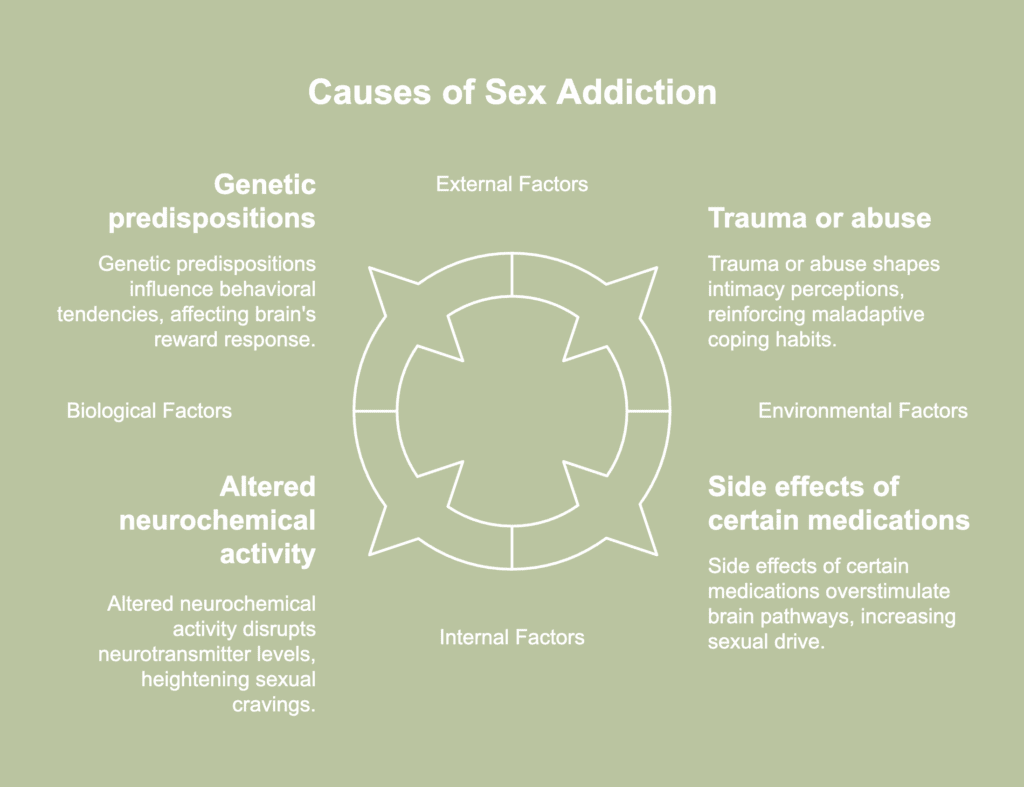
Causes of sex addiction describe the factors pushing a person into engaging in sexually excessive or inappropriate behavior. The causes of sex addiction are listed below.
- Genetic predispositions: Inherited traits influence behavioral tendencies, including compulsive sexual urges. Certain genetic markers affect how the brain responds to pleasure and reward, making sexual stimulation more reinforcing. According to a 2022 paper by Chatzittofis et al., titled “Neurochemical and Hormonal Contributors to Compulsive Sexual Behavior Disorder,” individuals with CSBD show altered DNA, particularly in how certain gene regions are marked. These markings, known as DNA methylation, act as genetic switches that turn genes on or off. The corticotropin-releasing factor (CRF) gene, responsible for managing stress, showed fewer methylation marks in individuals with CSBD. Such molecular changes disrupt stress-regulation pathways, fostering the onset and persistence of compulsive sexual behavior.
- Altered neurochemical activity: Disruptions in neurotransmitter levels, particularly dopamine and serotonin, contribute to heightened sexual cravings and compulsive patterns. When brain chemistry becomes imbalanced, the reward system starts overvaluing sexual stimulation as a coping mechanism for stress or dissatisfaction. Such irregularities distort judgment and weaken impulse regulation, reinforcing repetitive behaviors.
- Trauma or abuse: Exposure to sexual, physical or psychological trauma shapes how a person perceives intimacy and safety. Various people develop compulsive sexual patterns as an unconscious response to pain, seeking control or distraction through sexual gratification. The mind tends to associate sexual activity with relief, reinforcing maladaptive coping habits. Without intervention, unresolved trauma perpetuates cycles of dependency and distress.
- Neurological damage or disorders: Injuries or medical conditions affecting regions of the brain involved in decision-making and inhibition, such as the frontal lobe, trigger compulsive sexual tendencies. Damage to such areas disrupts the ability to regulate impulses and assess consequences appropriately. Parkinson’s disease was the most extensively researched neurological disorder connected with hypersexuality (HS) (55.6% of studies), followed by dementia (12.7%), restless legs syndrome (7.4%) and traumatic brain injury (4.9%), according to a 2024 paper by Tayim et al., titled “Hypersexuality in neurological disorders: A systematic review.”
- Side effects of certain medications: Certain prescriptions, including dopamine agonists for Parkinson’s disease or antidepressants, sometimes provoke increased sexual drive as an unintended reaction. Such drugs alter brain chemistry, overstimulating pathways linked to arousal and reward. In numerous instances, the heightened libido evolves into persistent urges becoming difficult to manage. Adjusting or discontinuing the medication under medical supervision usually restores balance and reduces sexual behavior.
Who is most affected by sex addiction?
Anyone can be affected by sex addiction, although research indicates it occurs more frequently in men than women. The condition often presents alongside co-occurring psychological disorders as well, complicating both diagnosis and treatment.
In a 2018 study by Shimoni et al., titled “The contribution of personality factors and gender to ratings of sex addiction among men and women who use the Internet for sex purpose,” sex addiction was reported in 95 of 186 males and 25 of 81 females, supporting the hypothesis of men displaying stronger patterns of addictive sexual behavior online.
Researchers interpreted the difference through evolutionary and social factors, suggesting men pursue multiple partners due to minimal parental investment, increasing receptiveness to casual encounters.
Women tend to be more discerning, lowering vulnerability to compulsive sexual conduct. Findings highlight men’s greater openness and women’s higher neuroticism, indicating personality traits play a role in shaping gender-related addiction tendencies.
Persons struggling with anxiety or depression are more vulnerable due to difficulties managing impulses and emotions. Those exposed to trauma or neglect during early life stages additionally display higher susceptibility to compulsive sexual behavior later on.
Social isolation, low self-esteem and repeated exposure to explicit content reinforce unhealthy coping mechanisms. Cultural factors and access to sexual material further influence how the addiction manifests across populations. Despite gender variations, the condition affects people from all backgrounds, regardless of age, socioeconomic status or education level.
What are the effects of sex addiction?
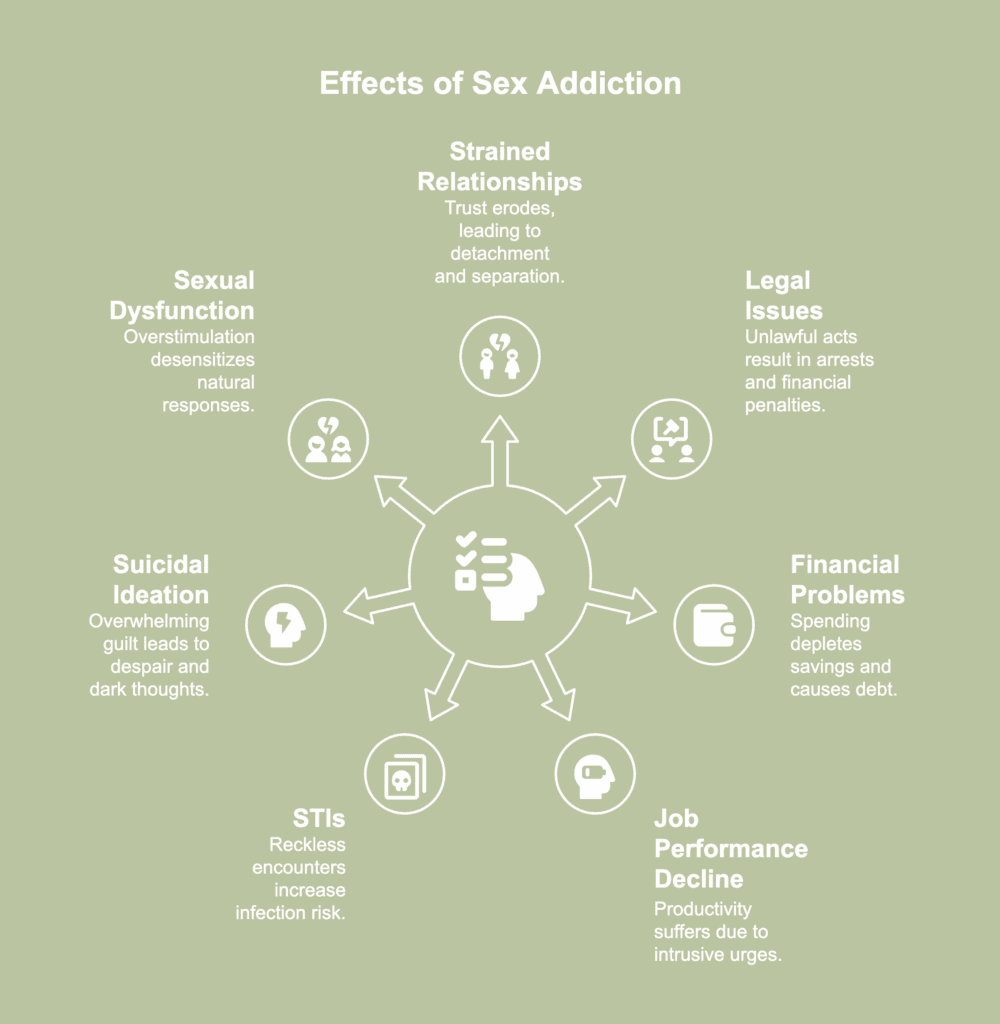
Effects of sex addiction pertain to the adverse outcomes arising from an individual’s obsessive sexual behavior. The effects of sex addiction are listed below.
- Strained or broken relationships: Sexual addiction inflicts deep harm on relationships, especially once infidelity or neglect of a partner’s needs occurs. Trust weakens as secrecy and deception become routine, replacing honesty with concealment. The preoccupation with sexual pursuits fosters growing detachment, leaving the partner feeling rejected and undervalued. Affected couples eventually separate once the bond becomes too damaged to repair.
- Legal issues: Compulsive sexual conduct sometimes leads to unlawful acts such as solicitation or public indecency. Legal consequences include arrest, court proceedings or heavy financial penalties. Reputations crumble as word spreads through workplaces or communities. The long-term aftermath includes loss of employment and ongoing public scrutiny.
- Financial problems: Uncontrolled spending on pornography, escort services or sexual venues quickly depletes savings and generates debt. Bills and obligations get ignored as resources shift toward maintaining one’s addiction to sex. The mounting financial strain fosters tension with family members or partners. Sex addicts often face eviction, loan defaults or complete financial ruin as a result.
- Decline in job performance: Productivity declines as intrusive urges interfere with focus and decision-making. Missed deadlines and poor attendance draw the attention of supervisors, diminishing trust and credibility. Colleagues begin to notice lapses in professionalism or sudden changes in behavior. Dismissal or career stagnation eventually becomes inevitable when the condition is left untreated.
- Sexually transmitted infections (STIs): Reckless encounters expose people to infections such as human immunodeficiency virus (HIV) or syphilis. Ignoring protection or engaging with multiple partners heightens vulnerability to serious illness. A 2021 study by Ni et al., called “The role of sexual compulsivity in unprotected intercourse among STI patients in Shanghai, China” revealed sexual compulsivity (SC) served as a significant indicator of unprotected intercourse (UI) with casual sexual partners among sexually active STI patients, with male participants showing a stronger association.
- Suicidal ideation: Overwhelming guilt and remorse frequently pushes a sex addict toward despair and hopelessness. Many withdraw from friends and family, believing recovery is impossible. Feelings of self-disgust intensify with each relapse, fuelling darker thoughts. Findings of a 2021 study by Valenciano-Mendoza et al., titled “Prevalence of Suicidal Behavior and Associated Clinical Correlates in Patients with Behavioral Addictions” highlighted the complex connection between behavioral addictions and suicidal behavior, revealing individuals struggling with sex addiction exhibited the highest rate of suicide attempts at 9.1%.
- Sexual dysfunction: Constant overstimulation through compulsive behavior desensitizes the body’s natural response to intimacy. Genuine arousal with a partner becomes increasingly difficult, creating frustration and tension in relationships. The partner feels inadequate, intensifying avoidance and withdrawal. Physical and psychological barriers to intimacy become entrenched, further feeding the addictive cycle.
What are the different types of sex addiction?

Different types of sex addiction encompass the diverse forms and patterns of problematic sexual behavior individuals suffer from. The different types of sex addiction are listed below.
- Compulsive sexual encounters: An individual driven by uncontrollable urges for sexual contact engages in impulsive encounters, disregarding personal boundaries or consequences. The behavior involves risky situations or multiple partners, creating instability and strain in personal connections. Pleasure-seeking becomes the primary focus, overshadowing interpersonal connection or responsibility.
- Pornographic fixation: An obsessive reliance on pornographic material gradually interferes with daily responsibilities and relationships. The person devotes increasing time to viewing explicit content, chasing stronger stimulation to achieve the same satisfaction. Real-life intimacy loses appeal as fantasy becomes dominant, distorting perception of normal sexual relationships.
- Excessive self-stimulation: Compulsive masturbation develops into a harmful pattern where affected people experience urges to engage in the act repeatedly, even in inappropriate or risky settings. The act stems from a desire to escape stress or unpleasant feelings.
- Persistent erotic fantasizing: An individual trapped in an unending stream of sexual thoughts struggles to focus on routine tasks. The imagination dominates mental space, shaping desires seemingly impossible to satisfy. Such fantasies intensify urges, resulting in secrecy or reckless behavior. The boundary between thought and action blurs, deepening internal turmoil.
- Exhibitionistic or voyeuristic urges: Certain people feel an uncontrollable drive to expose themselves publicly or secretly observe others during intimate moments without consent. This practice is called exhibitionism. Exhibitionism is linked to deep-seated insecurities, unresolved trauma or certain personality disorders such as narcissism or antisocial tendencies, according to a paper called “Exhibitionism Explored: Insights into the Deviant Act” published by Bhambhani et al., in 2024. The behavior functions as an unhealthy outlet for inner distress, offering fleeting feelings of control or validation. The authors highlighted distorted thinking patterns—including the denial of harm or the belief the act causes no real damage—as key factors sustaining the behavior.
What are the sex addiction treatment options?

Sex addiction treatment options describe a variety of therapeutic methods intended to assist individuals in regaining control over sexual behaviors. The most commonly used sex addiction treatment options are listed below.
- Cognitive behavioral therapy (CBT): CBT helps individuals recognize distorted thoughts fueling hypersexuality. The approach remains among the most effective therapeutic approaches for CSBD. Across the reviewed studies in a July 2025 paper by Zhu et al., called “Evaluation and treatment of compulsive sexual behavior: current limitations and potential strategies,” CBT for CSBD most often incorporated psychoeducation, motivational interviewing, goal setting, self-awareness training, self-regulation, skill-building in problem-solving and coping, mindfulness, relapse prevention and elements of acceptance and commitment therapy.
- Support groups: Support groups like Sex Addicts Anonymous (SAA) create a confidential space for participants to share experiences without judgment. Listening to others’ recovery stories helps reduce shame and isolation while reinforcing motivation to change. Group settings promote mutual understanding, offering structure and encouragement from peers facing similar struggles.
- Medications: Certain prescribed drugs assist in managing chemical imbalances or coexisting mental health conditions contributing to hypersexuality. According to a 2020 study by Malandain et al., titled “Pharmacotherapy of Sexual Addiction,” selective serotonin reuptake inhibitors (SSRIs) remain the primary antidepressants for addressing sexual addiction due to proven effectiveness in conditions such as depression and obsessive-compulsive disorder. Mood stabilizers like lithium and valproic acid assist persons with bipolar disorder or heightened impulsivity. Antiandrogens, hormonal agents that suppress testosterone production to lessen libido and compulsive urges, are prescribed in severe or resistant cases, particularly those involving paraphilic behaviours.
- Family and couples therapy: Family and couples therapy restore trust and communication among loved ones affected by sexual compulsivity. Guided discussions allow partners and relatives to express pain, confusion or resentment in a safe setting. Therapists help clarify boundaries and rebuild bonds damaged by betrayal or secrecy. Such collaboration encourages healing and supports healthier interpersonal dynamics moving forward.
- Inpatient or residential treatment programs: Residential care provides a structured setting forming a crucial part of addiction treatment, removing daily triggers and external pressures. Participants receive intensive therapy, medical support and educational sessions designed for comprehensive recovery. Living in a monitored setting enables deeper self-reflection and consistent reinforcement of positive habits. Graduates leave with stronger coping tools and a renewed sense of stability.
How to stop sex addiction?
Stopping sex addiction requires a clear plan, steady commitment and professional guidance. Seeking therapy allows people to uncover hidden triggers and replace harmful habits with constructive ones.
Learning about how compulsive sexual behavior develops fosters insight and strengthens motivation for change. Avoiding environments or situations provoking temptation plays a major role in preventing relapse.
Various recovery programs include abstinence in addiction treatment to help restore self-control and reset self-defeating behavioral patterns. Building a strong support network provides much needed encouragement throughout recovery.
Engaging in exercise, creative pursuits or mindfulness practices helps redirect focus and reduce stress. Lastly, addressing coexisting issues like substance dependence or psychological disorders enhances overall progress.
Is sex addiction treated in rehab?
Yes, sex addiction is treated in rehab. Numerous sex addiction treatment centers provide specialized care for individuals struggling with the condition. Such facilities offer evidence-based therapies designed to help patients understand underlying causes and rebuild healthier relationships.
Treatment typically includes cognitive behavioral therapy and group sessions focused on accountability and emotional recovery. In a rehab setting, patients benefit from structured routines and a supportive community encouraging consistent progress.
Residential care allows for intensive focus away from everyday temptations or stressors. Certain programs additionally integrate holistic approaches like mindfulness and physical wellness to promote balance.
How is sex addiction diagnosed?
Sex addiction is diagnosed by a psychiatrist or psychologist through a detailed assessment of the individual’s psychological condition. The evaluation explores sexual behaviors, thoughts and motivations, focusing on the frequency, intensity and influence on daily functioning.
The clinician additionally reviews the person’s medical history, including any medication or supplements impacting mood or impulse control. Although the Diagnostic and Statistical Manual of Mental Disorders, Fifth Edition (DSM-5) excludes compulsive sexual behavior disorder, the condition is recognized in the International Classification of Diseases, 11th Revision (ICD-11).
Professionals use diagnostic standards for compulsive sexual behavior disorder (CSBD) to determine if the symptoms indicate an addiction. Diagnosis requires evidence of persistent difficulty managing sexual impulses despite clear negative outcomes, leading to distress or disruption in personal, occupational or social life.