

Alcohol moderation management: definition, benefits, and effectivity



Alcohol moderation management is a harm reduction technique to help problem drinkers who are not dependent on alcohol reduce their intake of alcohol to safe levels by becoming aware of their drinking patterns and striving to engage in mindful consumption. It takes a radically different approach to address problematic alcohol-use patterns than the conventional abstinence-based recovery models.
The benefits of alcohol moderation management are making addiction treatment accessible and attractive to specific sections of alcohol users and enhancing their engagement with the therapeutic process. This approach decreases the need for treatment resources and has the potential to be used as a reinforcer in treatment.
The health and socio-economic benefits of alcohol moderation management include improved sleep and vitality, decreased risk of developing specific physical ailments and mental health conditions, improved socio-economic conditions and psychosocial functionality, increased self-esteem, and reduced risk of alcohol-induced harm to self and others.
Alcohol moderation management is effective in helping with alcohol addiction by preventing problematic drinking behaviors from blowing up into alcohol use disorder.
What is alcohol moderation management?
Alcohol moderation management is a type of harm reduction approach to help problem drinkers reduce the amount of alcohol they consume or give it up entirely. As an alternative to the abstinence approach to address problem drinking habits, alcohol moderation management aims to promote mindful and responsible drinking behaviors. It is suitable for individuals who are not physiologically dependent on alcohol and have not been diagnosed with moderate or severe alcohol use disorder.
As an addiction harm reduction approach, alcohol moderation management is based on the philosophy of honoring the dignity and rights of individuals with problematic alcohol-use behavior by meeting them where they are, instead of enforcing abstinence. The overarching goal of this treatment approach is to improve the physical and mental health of problem drinkers by offering them a structured yet flexible method of reducing alcohol intake.
What is the difference between alcohol moderation management and abstinence?
The difference between alcohol moderation management and abstinence is in the pattern of alcohol consumption that is permitted in each of these types of strategies to reduce alcohol consumption. Alcohol moderation management is an intervention based on the principle of harm reduction. It focuses on minimizing the harmful effects of drinking and promoting safer alcohol consumption practices. This approach aims to reduce alcohol usage to low and safe levels, which are typically amounts that lessen harm. On the other hand, abstinence, in the context of alcohol consumption, is grounded in the practice of teetotalism. It focuses on giving up drinking alcohol entirely. Moderate drinking has been found to be more reinforcing than abstinence as a treatment approach, according to a 1972 article by Bigelow et al., published in the journal Behaviour Research and Therapy, titled “Abstinence or moderation? Choice by alcoholics.” Abstinence is a more challenging treatment goal to aim for than alcohol moderation management. However, it provides more health-related benefits compared to moderate drinking, including a decreased risk of death.
Alcohol moderation management is feasible when an individual with a problematic drinking pattern has not yet exhibited physiological dependence on alcohol. This approach is safe for individuals who do not have alcohol addiction and those whose drinking patterns do not adversely impact their physical, social, and/or mental health. On the other hand, abstinence in addiction treatment is advised for individuals for whom alcohol moderation management is unsustainable, such as those with alcohol use disorder.
Specifically, this approach is suitable for those who binge drink or drink heavily; exhibit impaired performance at home, work, or school because of their drinking habits; and have faced legal or financial problems stemming from their alcohol use. Individuals who spend significant amounts of time drinking or experiencing hangovers; those who are unable to reduce the amount of alcohol they consume; and those who hurt themselves or their loved ones due to or under the influence of alcohol benefit from practicing abstinence.
What are the benefits of alcohol moderation management?
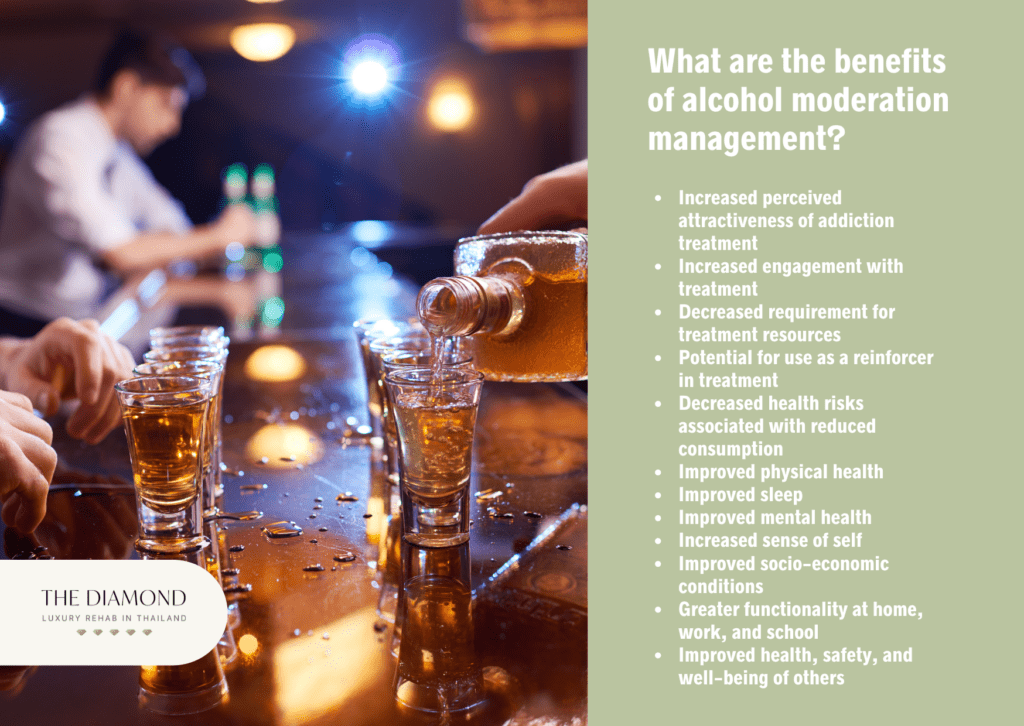
The benefits of alcohol moderation management are listed below.
- Increased perceived attractiveness of addiction treatment: Abstinence is hard to achieve. It takes many years of substance use relapse and multiple treatment regimens to attain and sustain abstinence, according to a 2023 article by Rolová et al., published in the Journal of Substance Use, titled “Factors associated with abstinence in addiction inpatient treatment cohort: a five-year follow-up.”Alcohol moderation management is based on a flexible and patient-centered treatment approach that is not driven by the challenging goal of abstinence. Thus, it is likely to attract more individuals with alcohol use problems to strive for behavioral change, according to a 2022 article by Eddie et al., published in the journal Alcoholism: Clinical and Experimental Research, titled “Abstinence versus moderation recovery pathways following resolution of a substance use problem: Prevalence, predictors, and relationship to psychosocial well-being in a U.S. national sample.” When more individuals with substance use issues perceive a specific treatment and recovery approach as attractive and attainable and choose to seek it, the overarching goal of improving public health is served.
- Increased engagement with treatment: Abstinence is challenging to attain and sustain compared to reducing substance use to safe levels. When the therapeutic regimen does not emphasize abstinence as a goal, patients are more inclined to engage with the treatment and recovery process (Eddie et al., 2022). It has been found that specific populations with lower substance use severity resolve their problematic substance-use behaviors and achieve physical and mental well-being by moderating their dosage of the substance.
- Decreased requirement for treatment resources: Abstinence-based substance use treatment is strict and usually requires the mobilization of significant resources. These include treatment being provided in a residential facility, a highly structured treatment regimen, the presence of a therapeutic community, and the provision of behavioral therapy (Rolová et al., 2023). Additionally, significant social support in the aftercare phase, active and regular participation in aftercare support programs, highly developed coping skills on the part of the patient, a high degree of self-efficacy, and strong spirituality are believed to be powerful predictors of sustained abstinence. This makes abstinence challenging to sustain. Alcohol moderation management, in comparison, is easier to undertake, and therefore, patients are more inclined to be attracted to and engage with this treatment method.
- Potential for use as a reinforcer in treatment: Authors Bigelow et al., in their 1972 article titled “Abstinence or moderation? Choice by alcoholics” published in the journal Behaviour Research and Therapy describe the results of an experiment on individuals with chronic alcohol use issues. The subjects were provided with the choice to drink moderately or abstain from drinking to be rewarded with the opportunity to take part in enriching social and recreational activities. A large number of the subjects chose to drink moderately. This indicates that alcoholics prefer to drink in moderation rather than abstain from alcohol entirely. So, the authors suggest that alcohol moderation management has the potential to act as a reinforcer in alcohol addiction treatment programs, thereby increasing the number of individuals who choose to seek therapy.
- Decreased health risks associated with reduced consumption: Abrupt abstinence is associated with considerable health risks if undertaken without medical supervision. In contrast, alcohol moderation management typically does not carry these risks. However, individuals with alcohol dependence should consult with a medical professional before attempting to reduce their regular dosage.
- Improved physical health: The short-term benefits of cutting down on alcohol include lowering of blood pressure and blood sugar and less accumulation of fat around the liver. Alcohol moderation management improves physical health by lowering the risk of developing cancer, heart and liver diseases, stroke, and diabetes. There is increased absorption of essential nutrients like vitamins B1 and B12, zinc, and folic acid. By cutting down alcohol consumption, men are able to improve sperm quality, thereby increasing fertility.
- Improved sleep: Regular drinking is known to disrupt the natural sleep cycle and reduce the quality of sleep. Individuals wake up feeling less refreshed after a night of drinking and are low on energy throughout the day. Cutting back on alcohol allows individuals to sleep deeply and wake up feeling energetic.
- Improved mental health: According to the Centers for Disease Control and Prevention(CDC) in their October 2024 release titled “Drinking Less Matters,” cutting down on alcohol improves how an individual feels by reducing hangovers, improving decision-making abilities, lowering their risk of developing anxiety and depression or reducing the severity of existing symptoms, and reducing the risk of developing dementia and learning difficulties.
- Increased sense of self: Low-risk substance use is associated with enhanced self-esteem, improved quality of life, greater functionality, increased happiness, and reduced mental distress(Eddie et al., 2022). Being able to reduce one’s consumption of alcohol is an indication of self-mastery and being able to control, modulate, and direct one’s behaviors consciously. A sense of self-mastery increases self-esteem in an individual who had earlier led a life dictated by their impulsive and compulsive substance use behaviors and felt they were the victims of their circumstances. Alcohol moderation management allows them to feel more in control of their life and environment. Additionally, mastery is positively associated with improved adaptation to life’s stressors and enhanced psychological well-being.
- Improved socio-economic conditions: Cutting down on alcohol consumption as part of alcohol moderation management improves interpersonal relationships and helps save money, according to the Health Service Executive, the publicly funded healthcare system in Ireland, in their web publication titled “Benefits of cutting down or giving up alcohol” last reviewed on 23 September 2022. For instance, drinking less translates into having more time and opportunity to spend time with one’s loved ones and bond over activities that do not involve the use of alcohol. Improved interpersonal relations mean there are fewer arguments among loved ones and less mental stress. Drinking less saves money that the individual is then able to spend on fruitful pursuits like taking a vacation with their loved ones, paying for enriching experiences like going to a sporting or cultural event, or saving tens of thousands of dollars by paying a mortgage earlier.
- Greater functionality at home, work, and school: Improved physical, mental, and cognitive health and increased levels of vitality translate to greater functionality at home, work, and school. Reduced issues at work, for instance, improve employability and enhance career prospects.
- Improved health, safety, and well-being of others: Alcohol impairs judgment, lowers inhibitions, increases impulsivity, and slows reaction times. These effects are known to lead to faulty decision-making and risky behaviors. Alcohol moderation management practiced by an individual has far-reaching positive consequences for their loved ones and those who come into contact with them. For instance, drinking less is associated with fewer instances of alcohol-impaired driving and alcohol-fueled violent confrontations (CDC, 2024). By cutting down on alcohol, an individual is able to serve as a positive role model for the youngsters around them. According to the CDC, children and teenagers who grow up in households where one or more members have substance use issues tend to have a higher risk of experiencing adverse childhood events.
How to practice alcohol moderation management?
To practice alcohol moderation management, start by tracking your alcohol usage. Maintain a diary and record the number of drinks you consume in a day. While you are recording this, add information like the nature of the drink you had and the serving size, the time spent drinking, the occasion or the physical setting where you consumed alcohol, and your feelings at that time. These bits of information will help you identify your drinking triggers. This exercise is to make you more mindful of your drinking patterns. Next, think back and list all the instances when drinking caused problems. These will include problems at work, school, or home, financial difficulties, and relationship troubles caused by your drinking habits. Only reflect on these instances and record them. Do not be judgmental or ashamed. Now, use this list to create another list of the benefits you will derive by reducing alcohol intake. Place this list where you will see it often. This list will motivate you to stick to the drinking limits you set for yourself.
An alcohol moderation management program starts with a 30-day period of abstinence. However, you must consult with a healthcare professional before stopping alcohol abruptly. If you are not confident about being able to stay sober for 30 days, start slow. Do not drink alcohol for a few days and then extend this period of abstinence to a week and then more. These periods of abstinence will allow you to become aware of your drinking limits and triggers and prepare for the next phase where you will drink in moderation.
Create realistic drinking goals for moderation management. Designate a few days in the week when you will not drink. For other days, set limits on the number of drinks you will permit yourself to have. Create a strategy to limit your alcohol intake. Avoid environments and social settings where heavy or binge drinking is likely. Learn to say a firm but polite “no” to loved ones and/or acquaintances who pressurize you to drink more than you intend to. Do not offer excuses so that you send a clear message to them that you want to live your life intentionally and be accountable for your choices.
Consume non-alcoholic drinks, such as water, mocktails, kombucha, virgin mojitos, and soda with lime juice or fresh fruit, between alcoholic beverages. Incorporate breaks of, for example, an hour, between alcoholic drinks. Consume food and drink water before and during drinking to keep yourself full.
Study individuals in your life who are moderate drinkers. Learn their strategies for restricting alcohol consumption. Figure out which strategies will work for you, and then practice these. Let your loved ones know about your moderate drinking goals so that they are able to support you on your journey. Learn how to control urges to drink more than the limit you have set for yourself. Talk with yourself, a trusted confidante, or a healthcare professional so that these urges are not repressed. Talk about your urges, accept them non-judgmentally, and let them go so that they do not overwhelm you. Consult with a healthcare professional if you want to consider taking medications that support moderate drinking, such as naltrexone. These medications work by reducing the pleasurable effects of alcohol and dampening cravings.
Look at your list of alcohol triggers to determine if you tend to drink when mentally stressed. If so, find alternative relaxation techniques to practice to alleviate stress. These include deep breathing, physical exercise, yoga, meditation, mindfulness exercises, and progressive muscle relaxation. Consider therapy to address issues like mental stress. If you tend to drink when bored, find enjoyable hobbies and activities that do not involve the consumption of alcohol.
Can alcoholics practice controlled drinking?
No, alcoholics cannot practice controlled drinking. An alcoholic is an individual who craves alcohol and is unable to control their drinking. It is a medical condition characterized by alcohol dependence and withdrawal.Controlled drinking is ineffective for individuals who are physically dependent on alcohol. These individuals end up drinking more than they intend to when they start a drinking session.
Alcoholism is a disease of the brain. Alcohol causes lasting changes in the neural circuitry of the brain that cause alcoholics to relapse, according to a release by the National Institute on Alcohol Abuse and Alcoholism, titled “Understanding Alcohol Use Disorder” last updated in January 2025. Evidence-based treatments like behavioral therapies, medications, and/or mutual support groups have been shown to help alcoholics attain and sustain sobriety. Authors Henssler et al., in their 2021 article titled “Controlled drinking-non-abstinent versus abstinent treatment goals in alcohol use disorder: a systematic review, meta-analysis and meta-regression” published in the journal Addiction, suggest that controlled drinking, if supported by specific behavioral therapies, has the possibility of treating alcohol use disorder in cases where abstinence is not feasible.
What is considered controlled drinking?
Controlled drinking is considered to be a harm reduction approach for helping individuals with problematic alcohol use behavior to limit their consumption of the substance to safe levels and/or give up the practice altogether. The controlled drinking approach is effective for individuals who have not yet become dependent on alcohol. Unlike the abstinence-only addiction treatment approach, controlled drinking, also known as moderate drinking, aims to meet alcohol users where they are.
There is no coercion to aim for abstinence or enter a treatment program. Instead, individuals are encouraged to create goals and establish personal drinking limits. The overarching aim of controlled drinking is to reduce the harms associated with heavy alcohol use, such as an overdose; improve the physical and mental health of the individuals; and motivate them to seek help before their problem drinking habits progress to full-blown addiction.
How much alcohol consumption is considered controlled drinking?
Limiting alcohol consumption to two drinks or less in a day for healthy men and one drink or less in a day for healthy women is considered controlled drinking or drinking in moderation. These guidelines have been developed by the U.S. Department of Health and Human Services and the U.S. Department of Agriculture and are contained in the publication Nutrition and Your Health: Dietary Guidelines for Americans, which is updated every five years. A drink is equivalent to 12 fluid ounces of regular beer (5 percent alcohol), 5 fluid ounces of wine (12 percent alcohol), or 1.5 fluid ounces of 80-proof distilled spirits (40 percent alcohol), such as gin, whiskey, rum, and vodka. One drink has an alcohol content of 0.6 fluid ounces. These values indicate a “safe” or “low-risk” pattern of alcohol consumption. Consumption below these levels is typically considered to be not associated with negative health consequences, according to a 1999 article by Mary C. Dufour published in the journal Alcohol Research & Health, titled “What Is Moderate Drinking? Defining “Drinks” and Drinking Levels.”
Is alcohol moderation management effective in helping with alcohol addiction?
Yes, alcohol moderation management is effective in helping with alcohol addiction by preventing problematic drinking behavior from progressing to full-blown alcoholism. Complete abstinence is not a pre-requisite to achieving addiction recovery, according to a 2022 article by Eddie et al., published in the journal Alcoholism: Clinical and Experimental Research, titled “Abstinence versus moderation recovery pathways following resolution of a substance use problem: Prevalence, predictors, and relationship to psychosocial well-being in a U.S. national sample.” Yet, the current clinical landscape is dominated by treatment approaches that focus on abstinence as the final goal. Abstinence is challenging to achieve and sustain. As an alternative to abstinence-based addiction treatment, alcohol moderation management attracts and engages more individuals and enhances the demographic reach of effective addiction interventions.
Controlled drinking is a practical treatment goal for sections of problem drinkers, according to a 2006 article by Ana Kosok published in the International Journal of Drug Policy, titled “The Moderation Management programme in 2004: What type of drinker seeks controlled drinking?” Alcohol addiction treatment programs that offer controlled drinking as a therapeutic intervention in a non-judgmental environment are likely to attract problem drinkers who want to reduce their alcohol intake without giving up drinking altogether. Alcohol moderation management has been found to reduce levels of drinking and the severity of alcohol-related problems, according to authors Hester et al., in their 2011 article titled “ModerateDrinking.com and Moderation Management: Outcomes of a randomized clinical trial with non-dependent problem drinkers” published in the Journal of Consulting and Clinical Psychology. It has also been found that a large number of program participants eventually chose the goal of abstinence after a period of practicing moderation.
Hester et al., additionally point out that problem drinkers who are not dependent on alcohol are a large but under-served population group. Their numbers are increasing and there is a need to provide interventions specifically tailored to them. Alcohol moderation management serves this demographic and creates an opportunity to provide them with early access to help. This supports public health initiatives to address the issue of alcohol addiction. The National Institutes of Health in a January 2024 news release titled “Reduced drug use is a meaningful treatment outcome for people with stimulant use disorders” recommends that substance use disorder treatments should be evaluated on the basis of outcomes like reduced adverse health effects and improved psychosocial functioning stemming from transitioning from high- to low-risk substance use. As a result, a reduction in the number of heavy drinking days is already recognized as a desirable clinical goal for developing medications for alcohol addiction treatment.
How can I determine if alcohol moderation management is suitable for me?
To determine if alcohol moderation management is suitable for you, first, ensure that abstinence will not work for you, either because you are unwilling to give up alcohol completely or are unsure if you will be able to sustain the practice. Next, determine the severity of your drinking problem. Alcohol moderation management is ideal for individuals who have not yet become physiologically dependent on alcohol or have alcohol use disorder. Consult a healthcare professional who will assess your drinking patterns and provide a formal diagnosis based on the criteria outlined in the Diagnostic and Statistical Manual of Mental Disorders, 5th edition (DSM-5).
Consider carrying out a trial run to determine if this treatment approach and its methodology work for you. Do an online search to find an in-person meeting in your locality or sign up for a virtual or telephonic meeting.Alcohol moderation management is suitable for you if you have a sincere desire to cut down on drinking. Reflect on your intentions and the level of commitment you are willing to exhibit. This harm-reduction method works when an individual is confident of their abilities to restrict their alcohol consumption and follow through with the drinking limits they set for themselves.
So, determine if you are strong-willed and are able to restrain yourself even when there are temptations around, such as during a social drinking session where your peers are drinking heavily or when there is alcohol present in your home. A few moderation management programs require individuals to go through a 30-day abstinence period. During this period, they learn to identify and manage drinking triggers, develop healthy coping strategies that do not involve the use of alcohol, and hacks to manage controlled drinking in the future. Think carefully to determine if you will be able to handle a period of abstinence. Examine your schedule and responsibilities to find out how to incorporate the program sessions into your routine. Consider whether web-based assessments and interventions will suit your routine.