
Narcissism and addiction: link, dual diagnosis, and treatment



Narcissism is characterized by grandiose feelings, excessive self-love, and an exaggerated sense of self-perception. Pathological narcissism is associated with narcissistic personality disorder, which is characterized by features like feelings of grandiosity and invulnerability, attention-seeking behaviors, lack of empathy, strong desire for approval and admiration, arrogant behavior, sense of entitlement, and exploitativeness.
Narcissism is caused by a complex interaction between environmental, genetic, cultural, and neurobiological factors and parenting style. Narcissism and addiction have often been found to co-occur. Although the etiology of narcissistic personality disorder is not clear yet, there is no evidence to suggest that addiction directly causes narcissism. However, short- and long-term substance abuse triggers the manifestation of narcissistic traits and/or aggravates those that are already present in an individual.
The common traits in individuals with both narcissism and addiction include feeling invincible, lacking empathy, harboring a superiority complex, experiencing low or unstable self-esteem, reacting defensively when criticized, exhibiting poor emotional regulation mechanisms, showing denial, and displaying persistence with specific behaviors despite their adverse outcomes.
The treatments for narcissism and addiction dual diagnosis are detoxification; psychotherapy involving techniques like cognitive behavioral therapy, dialectical behavior therapy, group therapy, family therapy, contingency management, and motivational enhancement therapy; medications; residential treatment programs; and support groups.
What is narcissism?
Narcissism is defined as excessive love of oneself or egocentrism, according to the APA Dictionary of Psychology published by the American Psychological Association (APA) and last updated on 15 November 2023. Pathologically, exaggerated narcissism is a dominant trait of narcissistic personality disorder, according to a 2021 article by Kastner-Bosek et al., published in the Journal of Experimental Psychopathology, titled “Addicted to Self-esteem: Understanding the neurochemistry of narcissism by using cocaine as a pharmacological model.” However, narcissism is not implicitly pathological, as authors Mitra et al., clarify in the StatPearls [Internet] release titled “Narcissistic Personality Disorder” that was last updated on 1 March 2024. Narcissistic traits are a normal part of human psychological development.
According to the fifth edition of the Diagnostic and Statistical Manual of Mental Disorders (DSM-5), narcissistic personality disorder is classified as a cluster B personality disorder characterized by over-emotional, dramatic, and/or erratic behaviors. According to Kastner-Bosek et al., narcissistic personality disorder is characterized by features or symptoms associated with impaired personality functioning related to identity and self-direction, dysfunctional interpersonal dynamics that manifest as a lack of empathy and/or an inability to form intimate connections, and pathological personality traits like attention-seeking behaviors and feelings of grandiosity. Narcissism is often found to co-occur with substance use disorder.
What is the link between narcissism and addiction?
The link between narcissism and addiction is evident in the significant role self-esteem plays in mediating the behavioral traits that these two conditions share. Fragile or unstable self-esteem is a core trait and driver of narcissism, according to a 2021 article by Kastner-Bosek et al., published in the Journal of Experimental Psychopathology, titled “Addicted to Self-esteem: Understanding the neurochemistry of narcissism by using cocaine as a pharmacological model.”
On the other hand, negative self-perception has been shown to have a significant causative effect on the development of substance use disorder, according to a 2020 article by Yan et al., published in the Journal of Drug Issues, titled “Self-Perception and Relative Increases in Substance Use Problems in Early Adulthood.” Authors Kastner-Bosek et al., describe narcissism as an “addiction to self-esteem.” While narcissists focus excessively on self-image, addicts display heightened responses to drug cues. However, while narcissism and addiction often occur co-morbidly, they do not go hand in hand.
How often do narcissism and addiction co-occur?
The co-occurrence rates of narcissism and addiction are 11.8% when the prevalence of narcissistic personality disorder–characterized by narcissism–with any form of substance abuse is considered, and 40.6% when the prevalence of a substance use disorder with narcissism is taken into account, according to a 2008 article by Stinson et al., published in the Journal of Clinical Psychiatry, titled “Prevalence, Correlates, Disability, and Comorbidity of DSM-IV Narcissistic Personality Disorder: Results from the Wave 2 National Epidemiologic Survey on Alcohol and Related Conditions.”
The prevalence of narcissism with any type of substance use disorder is 13.6% in men and 9.2% in women. The prevalence of a substance use disorder with narcissism is 46.9% in men and 31.3% in women. About 22% of people diagnosed with narcissistic personality disorder were found to have alcohol use disorder. Narcissistic personality disorder and alcoholism co-occur more frequently than other substance use disorders and narcissistic personality disorder.
Can addiction cause narcissism?
No, addiction cannot cause narcissism directly. However, substance use has been shown to trigger the development of narcissistic traits or magnify those that are already present, especially when alcohol and cocaine abuse are involved, according to a 2021 article by Kastner-Bosek et al., published in the Journal of Experimental Psychopathology, titled “Addicted to Self-esteem: Understanding the neurochemistry of narcissism by using cocaine as a pharmacological model.” The authors note that there are significant behavioral and neurochemical parallels between short- and long-term cocaine abuse and narcissism. The molecular actions of cocaine that cause dysregulation in dopamine signaling and alteration of serotonergic mechanisms underlie the addiction-like features and emotive traits of narcissism. There are neuroimaging parallels between cocaine use and narcissism. Cocaine use is associated with changes in brain function, structure, and connectivity in, for instance, multiple cortical areas that are involved in the manifestation of narcissistic traits.
Cocaine use induces behavioral effects like a boost in self-confidence, enhanced feelings of being in control of one’s actions, and elevation in mood and energy levels. The substance reduces avoidance behavior and makes an individual more inclined to indulge in approach and risk-taking actions. Additionally, narcissism is characterized by heightened confidence and self-esteem, increased approach behavior and a tendency to pursue rewards instead of avoiding undesirable outcomes, a bias toward risk-taking, and an increase in impulsiveness.
Can narcissism cause addiction?
Yes, narcissism can cause addiction, according to a 2022 article by Riegel et al., published in the journal Frontiers in Psychiatry, titled “Self-reported narcissistic traits in patients with addiction through the lens of the ICD-11 model for personality disorders.” According to Emanuel Jauk and Raoul Dieterich in their 2019 article titled “Addiction and the Dark Triad of Personality” published in the journal Frontiers in Psychiatry, unstable and/or low self-esteem is a core mechanism that underlies the development and/or aggravation of addictive behaviors in people with narcissism.
There are two manifestations of narcissism: the grandiose and the vulnerable subtypes. Grandiose narcissism is characterized by confident, fearless, and approach-dominant behaviors. The vulnerable subtype is characterized by timid, fearful, and neurotic behaviors. However, it is generally agreed that these two aspects co-exist and manifest in varying degrees in response to environmental factors, social context, and the predisposition of the individual, according to a 2021 article by Kastner-Bosek et al., published in the Journal of Experimental Psychopathology, titled “Addicted to Self-esteem: Understanding the neurochemistry of narcissism by using cocaine as a pharmacological model.” Both subtypes of narcissism have a strong need for approval and consequently, feel compelled to project a pretentious self-image.
According to Jauk and Dieterich (2019), grandiose narcissism is a predictor of problem drinking behavior. Multiple publications suggest that individuals with grandiose narcissism are fundamentally insecure even though they project a confident exterior. These individuals experience feelings of shame if grandiosity is accompanied by vulnerability. Increased feelings of shame, which characterizes vulnerable narcissism, has been shown to trigger addictive behaviors like problem drinking, according to a 2019 article by Bilevicius et al., published in the journal Addictive Behaviors, titled “Vulnerable narcissism and addiction: The mediating role of shame.”
Jauk and Dieterich (2019) mention that narcissistic individuals exhibit a trait known as “devaluing,” which reflects their lack of interest in others who do not provide the approval they seek and simultaneously feeling ashamed of themselves for seeking others’ admiration. The belief that narcissism mediates addiction is explained by this trait of “devaluing.” Avoiding others who do not provide them with the admiration they desire leads narcissists to substitute “real” others for an “ideal” experiential state that drug use induces.
What are the common traits in individuals with both narcissism and addiction?

The common traits in individuals with both narcissism and addiction are listed below.
- Feeling invulnerable: A feeling of invincibility is a component of narcissism, where the individual believes that they have no flaws and are incapable of doing any wrong. A study on male subjects has shown that a strong sense of invincibility is associated with alcohol use, according to a 2021 article by Kennedy et al., published in the Journal of Drug Issues, titled “A Preliminary Study Examining Self-Reported Invincibility, Alcohol Problems, and the Nonmedical Use of Prescription Stimulants in College Students.” A feeling of invincibility or that nothing will go wrong makes a person prone to recklessly abusing substances.
- Lacking empathy: Narcissism is characterized by impairment in interpersonal functioning that manifests as a lack of empathy, according to a 2021 article by Kastner-Bosek et al., published in the Journal of Experimental Psychopathology, titled “Addicted to Self-esteem: Understanding the neurochemistry of narcissism by using cocaine as a pharmacological model.” According to a 2023 article by Stewart S. Cox and Carmela M. Reichel published in the journal Pharmacology Biochemistry and Behavior, titled “The Intersection of Empathy and Addiction,” people who abuse alcohol and stimulants or are polydrug users exhibit diminished empathy. They tend to devalue the repercussions of their actions on the well-being of their loved ones. The authors of this paper suggest that a lack of empathy mediates substance abuse, lending further credence to the belief that narcissism has the possibility to trigger the development of addiction.
- Projecting a feeling of superiority: The APA Dictionary of Psychology published by the American Psychological Association, last updated on 19 April 2018 defines superiority complex as an exaggerated sense of oneself and one’s abilities that masks an underlying feeling of insecurity or an inferiority complex. Individuals manifesting grandiose narcissism have a heightened sense of self but, at the same time, are prone to experiencing feelings of vulnerability and shame, according to Emanuel Jauk and Raoul Dieterich in their 2019 article titled “Addiction and the Dark Triad of Personality” published in the journal Frontiers in Psychiatry. Those with vulnerable narcissism experience intense feelings of shame that they attempt to overcompensate by exhibiting a superiority complex. Authors Blatt et al., in their 1984 article titled “Psychodynamic theories of opiate addiction: New directions for research” published in the journal Clinical Psychology Review mention that guilt, shame, a feeling of worthlessness, and a tendency to be self-critical are common in people with opiate addiction. It is common for them to adopt an attitude of arrogance or project a sense of superiority to hide their deeper feelings.
- Experiencing low or fluctuating self-esteem: According to Jauk and Dieterichin their 2019 article, narcissism is associated with fluctuating and/or unstable self-esteem. While vulnerable narcissists have low self-esteem, grandiose narcissists have a high degree of self-esteem but one that is unstable. According to a 2011 article by Hamid Reza Alavi published in the journal Addiction & Health, titled “The Role of Self-esteem in Tendency towards Drugs, Theft, and Prostitution,” people with addiction tend to have a low sense of self-esteem.
- Exhibiting denial: People with narcissistic tendencies use denial to manipulate reality and avoid taking responsibility for their actions. They employ tactics like justification, negation, dismissal, minimization, and reversal of the victim-offender role by shifting blame onto the victim. People with addiction commonly exhibit denial, which takes the form of underestimating the amount of substance they have taken, the duration of their addiction, and the impact their addictive behaviors have on their health and functioning.
- Behaving defensively when scrutinized: Jauk and Dieterich (2019) note that narcissism is characterized by the tendency to “devalue,” which is manifested as a lack of interest in or avoidance of people who do not provide them with the approval they seek. Narcissists are hyper-sensitive to disapproval, rejection, and criticism. They are known to react with fury to criticism and even reject interpersonal relationships because of their overt sensitivity to refusal and criticism, according to a 2022 article by Priyadhersini et al., published in the International Journal of Modern Developments in Engineering and Science, titled “Narcissism and Self-Esteem as a Perspective to Substance Use in Young Adults.” Denial is a common defense mechanism in people with addiction that leads to defensive behavior. These individuals tend to rationalize their behavior, shift the blame onto others, downplay the negative consequences of their addictive disorder, and/or avoid discussing their problem behavior.
- Exhibiting persistence: According to Mitra et al., in the StatPearls [Internet] release titled “Narcissistic Personality Disorder” that was last updated on 1 March 2024, individuals with narcissistic personality disorder are quite persistent when it comes to seeking a reward, such as a higher accomplishment or a praiseworthy social status. They tend to maintain the behaviors that they believe will help them attain their goals even when faced with fatigue, limited reinforcement, and frustration. Similarly, a hallmark of addiction is the addict’s persistence in drug taking despite its negative consequences, according to a 2023 article by McNally et al., published in the journal Molecular Psychiatry, titled “Pathways to the persistence of drug use despite its adverse consequences.”
- Displaying dysfunctional emotional regulation: Vulnerable narcissism is associated with maladaptive emotional regulation mechanisms, such as suppressing emotions, denying emotional responses, facing difficulties controlling impulses, and lacking emotional clarity, according to a 2020 article by Loeffler et al., published in the journal Frontiers in Psychology, titled “The Association Between Vulnerable/Grandiose Narcissism and Emotion Regulation.” People with substance use disorders experience difficulties in regulating emotions, according to a 2023 article by Stellern et al., published in the journal Addiction, titled “Emotion regulation in substance use disorders: a systematic review and meta‐analysis.” For instance, when an individual experiences a powerful negative emotion, the consequent arousal requires a safe and healthy outlet, especially if the person is unable to lessen the intensity of the emotion. However, people who lack appropriate or adequate emotion regulation strategies choose to use substances to regulate the negative emotion.
Are all addicts narcissists?
No, all addicts are not narcissists. Narcissistic personality disorder, which is marked by narcissistic traits, is believed to be caused by a complex interplay of environmental, cultural, genetic, neurobiological factors, and parenting style. Although the etiology of narcissism is yet unclear, there is no evidence to suggest that addiction will always cause the development of narcissism. However, people with narcissism and addiction share similar character and neurobiological traits and abuse of alcohol and cocaine has been shown to trigger the development of narcissistic traits or exacerbate already existing ones, according to a 2021 article by Kastner-Bosek et al., published in the Journal of Experimental Psychopathology, titled “Addicted to Self-esteem: Understanding the neurochemistry of narcissism by using cocaine as a pharmacological model.”
Who is most likely to develop both narcissism and addiction?
Individuals who have either narcissism or addiction are most likely to develop the other condition. Individuals who have experienced negative childhood events, such as physical, sexual, and emotional abuse, rejection, and lack of support, and those with a “risk-positive personality style” are most likely to develop both narcissism and addiction.
According to Emanuel Jauk and Raoul Dieterich in their 2019 article titled “Addiction and the Dark Triad of Personality” published in the journal Frontiers in Psychiatry, unstable or low self-esteem associated with narcissism is a major predictive factor for the development of addiction. Considering that narcissism and addiction share behavioral similarities, it is proposed that the presence of specific personality traits in an individual is likely to lead to the development of both narcissism and addiction.
For instance, according to Emanuel Jauk and Philipp Kanske in their 2021 article titled “Can neuroscience help to understand narcissism? A systematic review of an emerging field” published in the journal Personality Neuroscience, narcissism is a “risk-positive personality style” that manifests in potentially self-destructive and health-harming behaviors like abusing substances. Narcissistic individuals are known to display increased approach-oriented behavior that makes them pursue rewards instead of avoiding undesirable outcomes, according to a 2021 article by Kastner-Bosek et al., published in the Journal of Experimental Psychopathology, titled “Addicted to Self-esteem: Understanding the neurochemistry of narcissism by using cocaine as a pharmacological model.”
It is universally recognized that adverse childhood experiences raise the risks of developing long-term physical and mental health disorders. For instance, the degree of substance abuse, particularly the use of cocaine, is strongly correlated with levels of childhood abuse, according to a 2010 article by Khoury et al., published in the journal Depression and Anxiety, titled “Substance use, childhood traumatic experience, and Posttraumatic Stress Disorder in an urban civilian population.” Negative childhood experiences are significantly correlated with the development of feelings of grandiosity and seeking external validation excessively, according to a 2022 article by Montoro et al., published in the journal Behavioral Sciences, titled “Narcissistic Personality and Its Relationship with Post-Traumatic Symptoms and Emotional Factors: Results of a Mediational Analysis Aimed at Personalizing Mental Health Treatment.” So, individuals who have experienced adverse childhood events have an increased likelihood of developing both addiction and narcissism.
What are the addiction types associated with narcissism?
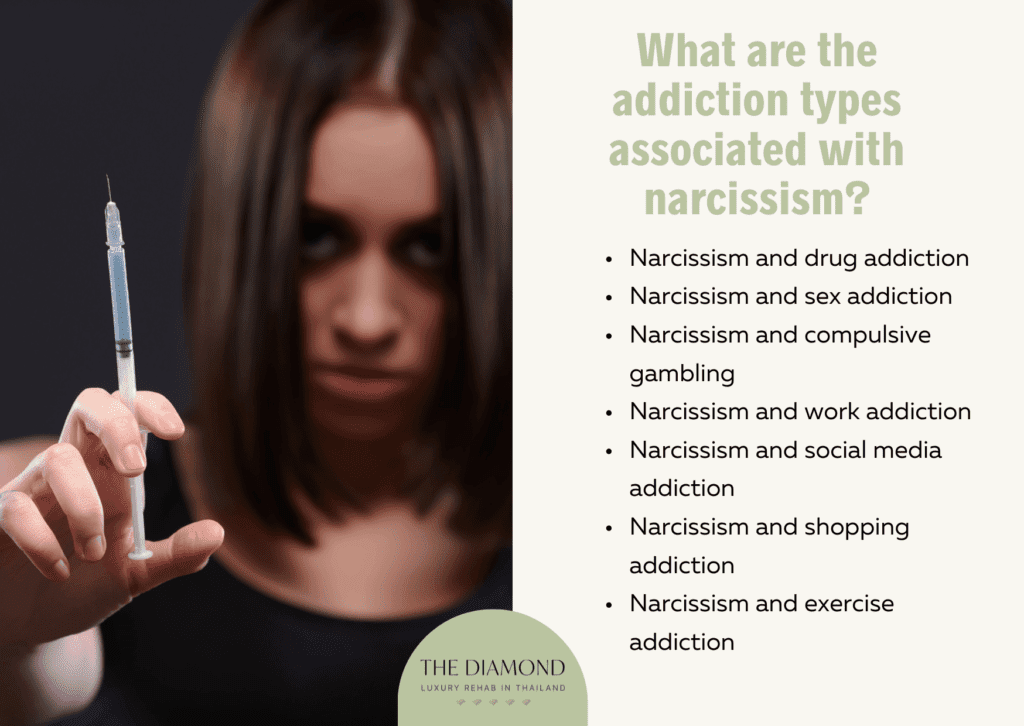
The addiction types associated with narcissism are listed below.
- Narcissism and drug addiction
- Narcissism and sex addiction
- Narcissism and compulsive gambling
- Narcissism and work addiction
- Narcissism and social media addiction
- Narcissism and shopping addiction
- Narcissism and exercise addiction
1. Narcissism and drug addiction
There is a positive association between narcissism and drug addiction, according to a 2016 article by Mowlaie et al., published in the journal Personality and Individual Differences, titled “Pathological narcissism, brain behavioral systems and tendency to substance abuse: The mediating role of self-control.” The authors suggest that the positive association is mediated by the narcissistic tendency to ignore the future repercussions of their behaviors and instead, focus on gaining immediate rewards and gratification. Narcissists lack empathy and tend to carry on abusing drugs even if the adverse consequences of their actions on their loved ones are apparent. Higher levels of behavioral activation system (BAS) are associated with addictive behaviors. The grandiose aspects of narcissism tend to trigger the BAS, which then leads to drug use and eventually, drug addiction. The aggressive and competitive interpersonal lifestyle of narcissists gives rise to their addictive behaviors. Because narcissism as a trait is not socially agreeable, narcissists do not care about social acceptance. They tend to ignore social controls and engage in dangerous and socially aberrant behaviors like taking drugs.
2. Narcissism and sex addiction
There is a positive correlation between narcissism and sex addiction, according to a 2022 article by Christine Rhodes and Yasuhiro Kotera published in the Journal of Concurrent Disorders, titled “Study Protocol: Psychoeducation on Attachment and Narcissism as Treatment of Sex Addiction.” The authors suggest that an anxious attachment style mediates the relationship between adverse childhood experiences and sex addiction with narcissism directly predicting the development of sex addiction. Anxious attachment has its roots in inconsistent and/or a lack of caregiving in childhood that manifests as a strong and ever-present desire for reassurance and an intense fear of abandonment. Individuals with such attachment styles tend to rely on others for validation and feel insecure in relationships. Fear of being abandoned or rejected drives them to indulge in compulsive sexual behaviors.
Additionally, narcissism is characterized by a sense of entitlement that is associated with increased tendencies toward living a hedonistic life and pursuing pleasure-seeking and self-gratifying activities, according to a 2023 article by Grubbs et al., published in the Journal of Research in Personality, titled “Pornography and pride: Antagonism drives links between narcissism and perceived addiction to pornography.” The authors note that hedonistic motivations are the principal driving factors in pornography use, a manifestation of sex addiction.
3. Narcissism and compulsive gambling
Narcissism is positively correlated with compulsive gambling, according to Emanuel Jauk and Raoul Dieterich in their 2019 article titled “Addiction and the Dark Triad of Personality” published in the journal Frontiers in Psychiatry. Authors Guyonne Rogier and Patrizia Velotti in their 2018 article titled “Narcissistic Implications in Gambling Disorder: The Mediating Role of Emotion Dysregulation” published in the Journal of Gambling Studies point to the mediating role of emotional dysregulation in narcissistic individuals developing gambling disorder. According to Lakey et al., in their 2007 article titled “Probing the link between narcissism and gambling: the mediating role of judgment and decision-making biases” published in the Journal of Behavioral Decision Making, narcissistic traits like over-confidence, risk-taking tendencies, and excessive focus on instant gratification to the detriment of future rewards are powerful mediators of gambling addiction.
4. Narcissism and work addiction
There is a positive association between narcissism and work addiction, according to a 2022 article by Kızıloğlu et al., published in the International Journal of Mental Health and Addiction, titled “Work Addiction and Its Relation with Dark Personality Traits: A Cross-sectional Study with Private Sector Employees.” In the professional sphere, narcissists have a strong desire to be praised, demonstrate their superiority and dominance over others, and rise to a position of power. These tendencies trigger individuals to display work addiction. Being praised and admired for their work and rising to powerful positions serve as validation for a narcissist’s fragile self-image. These individuals feel compelled to work excessively not only to boost their feelings of self-worth but also to avoid the negative emotions associated with failure, such as guilt and anxiety, according to a 2020 article by Falco et al., published in the International Journal of Environmental Research and Public Health, titled “Is Narcissism Associated with Heavy Work Investment? The Moderating Role of Workload in the Relationship between Narcissism, Workaholism, and Work Engagement.”
5. Narcissism and social media addiction
There is a positive relationship between narcissism and social media addiction, according to a 2018 article by Singh et al., published in the journal Personality and Individual Differences, titled “Grandiosity on display: Social media behaviors and dimensions of narcissism.” Both sub-types of narcissism have a significant correlation with self-promoting social media behaviors like posting selfies frequently. Additionally, narcissistic traits are associated with increased hours spent on social media networks, greater status update frequency, more friends and followers, and increased frequency of activities like engaging with others’ posts. Among the sub-types, grandiose narcissism is most associated with social media addiction. Narcissism is characterized by feelings of grandiosity and an excessive need for approval and admiration. Narcissists display attention-seeking behaviors, engage in exhibitionism, and have an exaggerated perception of their physical image. On the other hand, social media platforms provide the ideal environment to fulfill these narcissistic goals, according to a 2020 article by Silvia Casalea and Vanessa Banchi published in the journal Addictive Behavior Reports, titled “Narcissism and problematic social media use: A systematic literature review.” These networks provide greater control over the image narcissists choose to project compared to face-to-face interactions, let people reach a larger audience and obtain highly visible rewards in the form of likes and comments, and advertise their online self and receive feedback throughout the day. Narcissistic traits lead naturally to the act of posting selfies whose underlying motivations are self-promotion and creating a positive impression.
6. Narcissism and shopping addiction
Grandiose narcissism is associated with shopping addiction, according to Emanuel Jauk and Raoul Dieterich in their 2019 article titled “Addiction and the Dark Triad of Personality” published in the journal Frontiers in Psychiatry. Narcissists have an overwhelming need to validate and advertise their inflated sense of self, and one of the ways they choose to do so is by making purchases. Narcissists tend to score high on materialism. Flaunting material possessions and displaying wealth promote a person’s perceived status, maintain a grandiose self-image, and aid positive impression management, according to a 2015 article by Cai et al., published in the journal Frontiers in Psychology, titled “Narcissism predicts impulsive buying: phenotypic and genetic evidence.” They tend to purchase frequently, in sizeable quantities and usually buy exclusive, symbolic, and personalized products that they believe fit their “unique” selves. On the other hand, shopping addiction among vulnerable narcissists is a compensatory behavior that stems from a feeling of emptiness, according to a 2015 article by Gadi Zerach published in the International Journal of Mental Health and Addiction, titled “The Mediating Role of Emptiness and Materialism in the Association Between Pathological Narcissism and Compulsive Buying.”
7. Narcissism and exercise addiction
There is a positive correlation between narcissism and exercise addiction, according to a 2014 article by Bruno et al., published in the Journal of Addiction, titled “Unraveling Exercise Addiction: The Role of Narcissism and Self-Esteem.” In a 2021 article published in the International Journal of Environmental Research and Public Health, titled “Narcissism and Exercise Addiction: The Mediating Roles of Exercise-Related Motives,” authors Zeigler-Hill et al., suggest that issues related to social recognition and competition motivate narcissists to over-indulge in exercise. These individuals tend to focus on interpersonal rewards and hence, associate increasing levels of exercise as a means of outperforming others, for example, at the gym, thereby, demonstrating their dominance and superiority over them. The authors mention that narcissistic vulnerability mediates exercise addiction. Individuals with vulnerable narcissism tend to rely on external factors like physical appearance to enhance their sense of self-worth. Body image- and appearance-related issues compel them to engage excessively in exercising.
How is the dual diagnosis of narcissism and addiction determined?
The dual diagnosis of narcissism and addiction is determined by a licensed mental health professional, usually a psychiatrist or a psychologist, after conducting a thorough patient evaluation. They ask the patients questions about the symptoms of the different conditions to understand their onset and how they have evolved over time. To make an accurate diagnosis, professionals conduct clinical, physical, and mental status examinations. Authors Mitra et al., in the StatPearls [Internet] release titled “Narcissistic Personality Disorder” that was last updated on 1 March 2024 suggest that narcissistic personality disorder should ideally be diagnosed when no acute psychiatric process is occurring simultaneously to minimize the chances of overlapping symptoms being misdiagnosed.
To make a diagnosis of narcissistic personality disorder, professionals are guided by the nine criteria outlined by the Diagnostic and Statistical Manual of Mental Disorders, Fifth Edition (DSM-5), according to a 2015 publication by Caligor et al., published in The American Journal of Psychiatry, titled “Narcissistic Personality Disorder: Diagnostic and Clinical Challenges.”
According to DSM-5, narcissistic personality disorder is characterized by a pervasive pattern of feelings of grandiosity manifested in behaviors and/or fantasies, a need for admiration and approval, and a lack of empathy. These behaviors are evident by early adulthood and are manifested in varied contexts. These are the important aspects of narcissistic pathology and are indicated by five (or more) of the following nine criteria: pervasive feelings of grandiosity; fantasies of unlimited power, brilliance, beauty, and/or ideal love; feeling of being special and unique; an intense need for approval and admiration from others; a sense of entitlement; an exploitative nature; lack of empathy; envy; and arrogant behavior.
The criteria for diagnosing substance addiction include cravings, unsuccessful attempts to cut use, continued use despite adverse consequences, indulging in the problematic behavior more than intended, and impaired functioning due to the behavior. Behavioral addiction is similar to substance addiction except that in the former, the person is addicted to a behavior or the feeling of euphoria triggered by indulging in the relevant behavior.
What are the treatments for narcissism and addiction dual diagnosis?
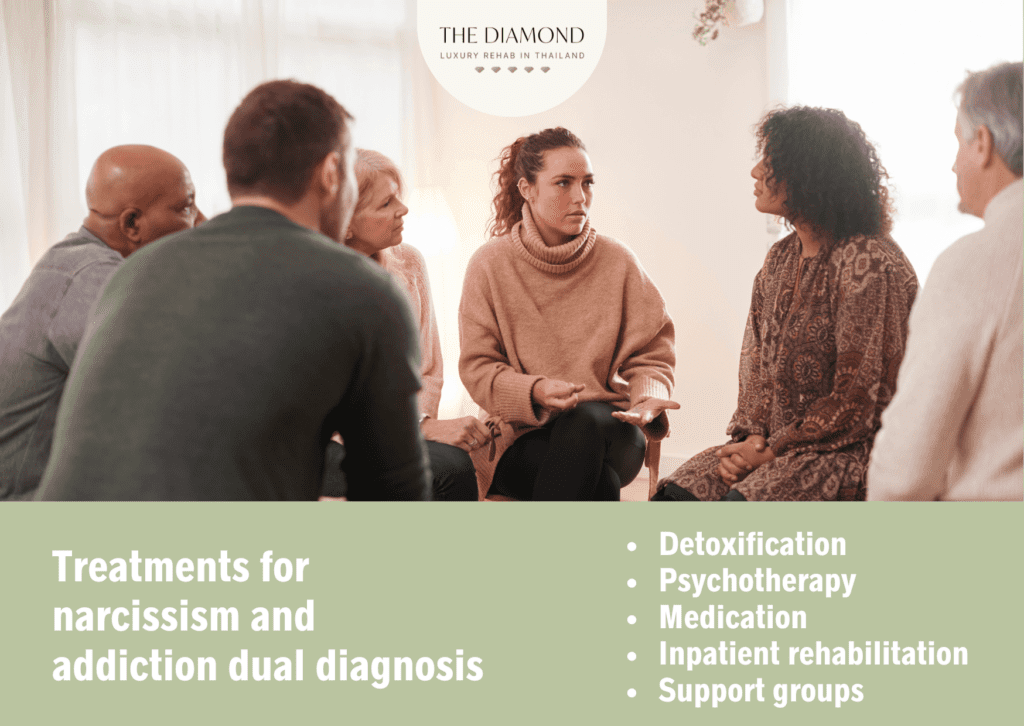
The treatments for narcissism and addiction dual diagnosis are listed below.
- Detoxification: This is the first stage of treatment when substance use is involved with narcissism. It involves stopping the use of the substance and getting rid of the toxins from the body. Detoxification usually takes place in an inpatient setting where the patient is monitored by a team of professionals to manage withdrawals, if any.
- Psychotherapy: Narcissism and addiction dual diagnosis must be treated simultaneously because both conditions feed off each other. The ideal course of action is to follow an integrated treatment approach, which has been proven to be consistently more effective than treating the conditions separately, according to the National Institute on Drug Abuse (NIDA) in their February 2018 publication titled “Common Comorbidities with Substance Use Disorders Research Report:What are the treatments for comorbid substance use disorder and mental health conditions?“Cognitive behavioral therapy (CBT), dialectical behavior therapy, group therapy, and couples or family therapy are commonly used forms of psychotherapy for treating narcissistic personality disorder. Behavioral therapies like CBT, contingency management, motivational enhancement therapy, and family therapy are regarded as effective treatments for addiction, according to the NIDAin their July 2011 publication titled “Drugs, Brains, and Behavior: The Science of Addiction:Treatment and Recovery.“
- Medication: When substance use is involved with narcissism, medication is often provided to manage withdrawal symptoms and reduce cravings for substances. Medications are provided to reduce the frequency and severity of mental health symptoms like anxiety and depression that have the potential to aggravate narcissistic traits and/or hamper recovery from addiction.
- Inpatient rehabilitation: Inpatient rehabilitation helps people with dual diagnosis by helping them heal in a safe and supportive environment free of addiction cues. Inpatient rehab or residential treatment provides patients with continuous supervision and mental healthcare and is ideal for those with severe addiction.
- Support groups: Support groups provide an environment where patients are able to share their struggles, find inspiration and learn from others, locate resources, and gain self-esteem and a sense of purpose by helping others.