

Is addiction genetic (hereditary)?



Genetic predisposition influences addiction risk in an individual by altering the normal functioning of their brain’s reward system after initial exposure to drugs; interacting with environmental variables to heighten risks; and contributing to the development of behavioral and personality traits that predict substance initiation and problematic use.
Individual differences in genetic makeup contribute to the vulnerability, development, maintenance, and relapse of addiction disorder. Genes contribute to addiction by altering the way the brain’s reward circuitry–the primary system implicated in substance use disorder–works, and increasing an individual’s risk of developing a psychiatric disorder, which, in and of itself, is an addiction trigger.
Genes interact with the environment to increase an individual’s vulnerability to addiction; impart personality traits like impulsivity and disinhibition that provoke drug-seeking behaviors; and pass on the variations linked with addiction to subsequent generations. Differences in individual genetic makeup thus determine response to addiction treatment. Understanding how genes influence addiction is critical to developing targeted and thus, more effective, prevention and treatment methodologies.
Can addiction be genetic?

Yes, addiction can be genetic. An analysis of genomic data of more than a million people has uncovered that addiction disorders, irrespective of the substance abused, have shared genetic markers, according to a 2023 article by Hatoum et al., published in the journal Nature Mental Health, titled “Multivariate genome-wide association meta-analysis of over 1 million subjects identifies loci underlying multiple substance use disorders.” For instance, the genes OPRM1, DRD2, DRD4, BDNF and SL6A4 have been found to be associated with two or more addiction disorders, according to a 2021 article by Lopez-Leon et al., published in the journal Neuroscience & Biobehavioral Reviews, titled “Molecular genetics of substance use disorders: An umbrella review.”
Studies on twins suggest that both substance-specific genes and those that contribute to the integrity and functionality of the common pathways implicated in the vulnerability to and development of addiction disorders and other psychiatric illnesses increase the susceptibility of an individual to substance use disorders, according to a 2012 article by Francesca Ducci and David Goldman published in the journal Psychiatric Clinics of North America, titled “The Genetic Basis of Addictive Disorders.” For example, the ALDH2 and ADH1B genes exert substance-specific influences and are implicated in alcohol addiction. Variations associated with the DRD2 and ANKK1 genes are associated with substance abuse via mechanisms that are also implicated in externalizing behaviors, such as impulsivity and disinhibition, that have been linked to addictive behaviors, according to a 2012 article by Agrawal et al., published in the journal Translational Psychiatry, titled “The genetics of addiction—a translational perspective.”
Inter-individual differences in genetic makeup lead to heterogeneity of response to drug exposure, as evident from the fact that all individuals who experiment with substances of abuse do not develop addiction. The individual differences in genetic makeup also influence drug pharmacodynamics and pharmacokinetics. In other words, individual genetic makeup determines the response to addiction treatment, according to a 2009 article by Haile et al., published in The American Journal of Drug and Alcohol Abuse, titled “Pharmacogenetic Treatments for Drug Addiction.”
A greater understanding of the genetic factors that protect or predispose an individual to addiction contributes to research in and the development of targeted, multi-directional, and more effective prevention and treatment methodologies, according to a 2019 blog post by Maria Mavrikaki, titled “Your genes and addiction” published by the Harvard Medical School.
What role do genes play in addiction?
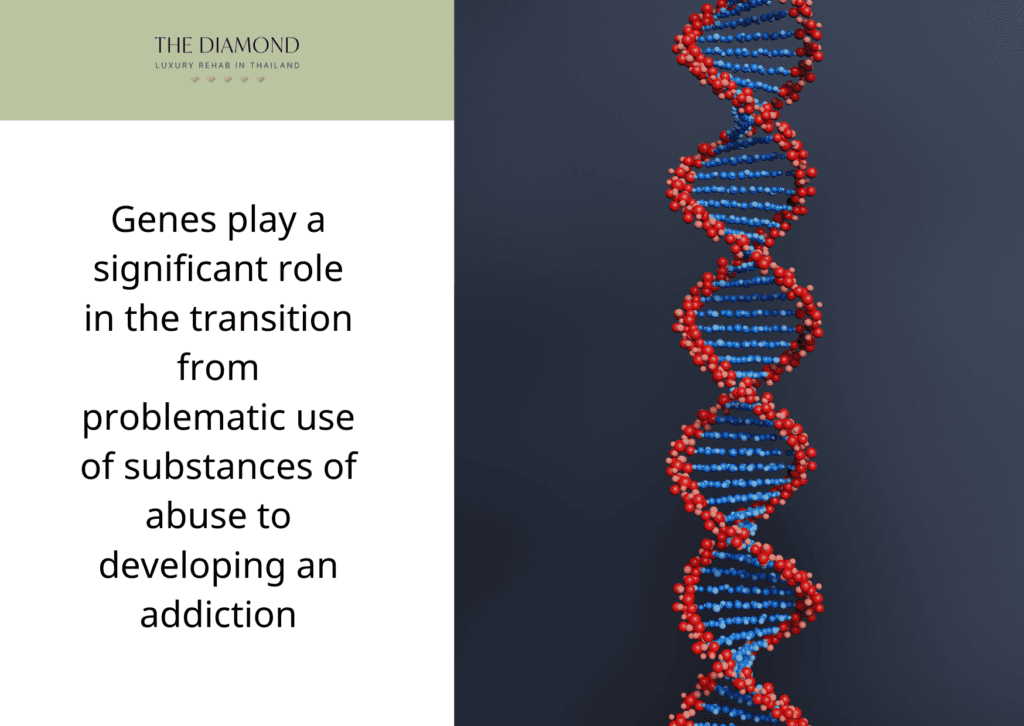
Genes play a significant role in the transition from problematic use of substances of abuse to developing an addiction, according to a 2012 article by Francesca Ducci and David Goldman published in the journal Psychiatric Clinics of North America, titled “The Genetic Basis of Addictive Disorders.” The genetic makeup of an individual contributes to the development of addiction by influencing how the brain’s reward circuitry works, interacting with environmental factors to increase vulnerability, and increasing the risk of developing a psychiatric condition or disorder that in turn, raises the likelihood of developing an addiction. Genes impart specific psychological and personality traits that induce drug-seeking behaviors; increase susceptibility via gene-gene additivity; and transfer genetic variations to subsequent generations that increase addiction risks.
There are multiple studies that support the association between specific genetic variations and the development of addiction, according to a 2022 article by Alhammad et al., published in the journal Cureus, titled “Family, Individual, and Other Risk Factors Contributing to Risk of Substance Abuse in Young Adults: A Narrative Review.” According to the authors, variations in the brain-derived neurotrophic factor (BDNF) gene, OPRM1, OPRD1, and OPRK1 are associated with increased vulnerability to addiction. The dopaminergic-mesolimbic system or the brain’s reward circuitry is the primary system involved in the development of addiction. The presence of specific genetic variations leads to fewer dopamine receptors in this region of the brain, a development associated with impaired dopamine transmission and signaling. Dysfunction of the dopamine system is one of the most significant risk factors for addiction, according to a 2009 article by Dreher et al., published in the journal PNAS, titled “Variation in dopamine genes influences responsivity of the human reward system.”
Drug addiction is an archetypal gene by environment disorder, as noted in a 2019 article by Lisa R. Goldberg and Thomas J. Gould published in the European Journal of Neuroscience, titled “Multigenerational and transgenerational effects of paternal exposure to drugs of abuse on behavioral and neural function.” Genes interact with environmental factors to contribute to an individual’s risk of developing substance use disorder after their initial exposure to drugs. For instance, in individuals who are genetically susceptible to addiction, easy accessibility and repeated exposure to substances of abuse trigger long-lasting neural changes that promote drug-seeking behaviors, which eventually develop into an addiction, according to Ducci and Goldman (2012).
Gene-gene additivity or gene x gene interaction refers to the action of multiple genes that work together and produce a cumulative effect to affect a trait. For instance, additive genes in the CHRNA5–CHRNA3–CHRNB4 nicotinic acetylcholine receptor cluster and the TTC12–ANKK1–DRD2 cluster are associated with an increased risk of nicotine addiction. The serotonin 3B receptor (HTR3B) and serotonin transporter (SLC6A4) genes are associated with alcohol addiction comorbid with other substance use disorders. In contrast, variations in the ADH1B (Arg48) and ALDH2 (Lys487) genes are additive and impart a protective effect against alcoholism (Ducci and Goldman, 2012).
Addiction also shares genetic bases with externalizing behaviors, according to a 2022 article by Barr et al., published in the journal Translational Psychiatry, titled “Parsing genetically influenced risk pathways: genetic loci impact problematic alcohol use via externalizing and specific risk.” Externalization refers to a tendency toward exhibiting uninhibited and/or dysregulated behaviors, which manifest as personality traits like impulsivity, sensation seeking, and antisocial behaviors. Impulsivity is a behavioral trait that contributes to an increased risk of developing stimulant dependence, according to a 2010 article by Ersche et al., published in the journal Biological Psychiatry, titled “Drug Addiction Endophenotypes: Impulsive Versus Sensation-Seeking Personality Traits.”
Having a multitude of antisocial traits is a strong predictor of developing substance use disorder, according to a 2015 article by Maia Szalavitz published in the journal Nature, titled “Genetics: No more addictive personality.” There is also substantial evidence of intergenerational transmission of the genetic risks associated with externalizing behaviors and disorders, which contributes to the heritability of addiction, according to a 2022 article by Kuo et al., published in the journal Development and Psychopathology, titled “The role of parental genotype in the intergenerational transmission of externalizing behavior: Evidence for genetic nurturance.”
How do genetics affect the brain’s reward system?

Genetics affect the brain’s reward system, also called the mesolimbic system, primarily by creating a hypo-dopaminergic dysfunctional state, according to a 2021 article by Popescu et al., published in the journal Experimental and Therapeutic Medicine, titled “Understanding the genetics and neurobiological pathways behind addiction (Review).” This state is characterized by a decrease in the number of dopamine receptors. For instance, individuals with the dopamine receptor D2 gene (DRD2) Taq1A (rs1800497) variant are at an increased risk of developing addiction compared to those who do not possess this genetic variation. The A1 form of this variant is associated with having fewer D2 receptors (Popescu et al., 2021).
Having fewer dopamine receptors contributes to the development of addiction in two ways. Firstly, having fewer of these receptors tends to make an individual impulsive, a trait that is associated with reduced self-control and escalating and compulsive drug-taking behaviors, according to a 2015 article by Nora D. Volkow and Marisela Morales published in the journal Cell, titled “The Brain on Drugs: From Reward to Addiction.”
Secondly, having fewer dopamine receptors is associated with “anhedonia,” which is a condition characterized by low mood and inability to feel pleasure from activities that were once enjoyable. Anhedonia is a core symptom of depression. Drugs of abuse like opioids, alcohol, nicotine, cannabinoids, and psychostimulants are known to trigger a release of dopamine that floods the reward pathway. The symptoms of depression compel individuals to abuse substances in an attempt to feel pleasure. They are especially vulnerable to abusing drugs when feeling impulsive and additionally, have low self-control.
Dopamine transmission is regulated by several receptors. Genetic variations in dopamine transmission influence how brain regions associated with the anticipation and reception of rewards respond, according to a 2009 article by Dreher et al., published in the journal PNAS, titled “Variation in dopamine genes influences responsivity of the human reward system.” The dopamine system is associated with high-order cognitive functions, such as mediating the reward value of substances of abuse, which contribute to the efficient processing of reward-linked information. A dysfunctional reward system contributes to individual variations in reward-seeking behaviors, such as approach and consummatory responses, which predict vulnerability to developing addiction.
Dreher et al., (2009)note that interindividual genetic differences produce abnormalities in catecholamine neurotransmission. Besides dopamine, catecholamines also include norepinephrine that has been implicated in critical aspects of dopamine signaling and the development and maintenance of addiction, according to a 2006 article by David Weinshenker and Jason P. Schroeder published in the journal Neuropsychopharmacology, titled “There and Back Again: A Tale of Norepinephrine and Drug Addiction.”The noradrenergic system synthesizes, stores, and releases norepinephrine. Genetic variations in noradrenergic pathways influence norepinephrine synthesis and signaling that, in turn, play a key part in aspects of drug addiction like primary reward. The interplay between the noradrenergic and dopaminergic systems has been linked to the key effects of norepinephrine on drug reward. Norepinephrine has also been found to contribute to the reinforcement of drug-seeking behavior with possible implications for triggering relapses.
How much do genes influence addiction?
Genes have a moderate to high degree of influence on the development of addiction. An individual’s genetic makeup accounts for about 40-60 percent of their risk for developing addiction, according to a publication by the Genetic Science Learning Center of the University of Utah, titled “Genes and Addiction.” Family, twin, and adoption studies reveal that an individual’s risk for developing substance use disorder is directly proportional to the degree of genetic relationship with a relative with an addiction, according to a 2009 article by L. Bevilacqua and D. Goldman published in the journal Clinical Pharmacology & Therapeutics, titled “Genes and Addictions.” However, the heritability of addictions differs across substances, ranging from 0.39 for hallucinogens to 0.72 for cocaine.
Genetics contributes about 75 percent to an individual’s risk of starting to smoke tobacco, 60 percent to their risk of getting addicted, and 54 percent to their ability to quit, according to a June 2008 feature published in the Monitor on Psychology by the American Psychological Association, titled “Genes matter in addiction.”
What is the addiction gene?
There is no single addiction gene, as clarified in this publication by the Genetic Science Learning Center of the University of Utah, titled “Genes and Addiction.” Addiction is a complex disorder and is influenced by variations in multiple genes and by the interactions of these genes with environmental factors. After analyzing genomic data collected from more than a million individuals, scientists have identified multiple genes that are commonly implicated in the development of several addiction disorders, as mentioned in a 2023 article by Hatoum et al., published in the journal Nature Mental Health, titled “Multivariate genome-wide association meta-analysis of over 1 million subjects identifies loci underlying multiple substance use disorders.” The finding that different substance use disorders share genetic risk variants points to the workings of common mechanisms that underlie addictive disorders. For instance, a multivariate genome-wide association meta-analysis across ancestries and multiple substance use disorders reports that the PDE4B gene, associated with dopamine regulation, is implicated in the development of several addictions. Hatoum et al., (2023) also note the role of metabolic and receptor genes in the development of addiction.
However, the presence of some specific genetic variations has been shown to significantly increase the risk of developing an addiction to a particular substance. For instance, the A1 form of the dopamine receptor gene DRD2 influences how drugs affect the brain’s reward mechanism and is commonly found in individuals with alcohol, opioids, and cocaine addictions. A few variations of the mu opioid receptor gene OPRM1 are more commonly found in individuals with opioid addiction. In contrast, other variations of this gene are associated with an increased risk of developing alcohol dependence. Individuals with two copies of a specific form of CHRNA5 gene have double the risk of developing nicotine dependence than those who have two copies of a different form of the same gene. Specific genetic variations are known to confer protection against particular addictions.
For example, the presence of even one form of the alcohol dehydrogenase 2 (ALDH2*2) gene offers significant protection against alcohol dependence, according to a 2007 article by Howard J. Edenberg published in the journal Alcohol Research & Health, titled “The Genetics of Alcohol Metabolism: Role of Alcohol Dehydrogenase and Aldehyde Dehydrogenase Variants.”
How do genetics and environment interact in addiction?
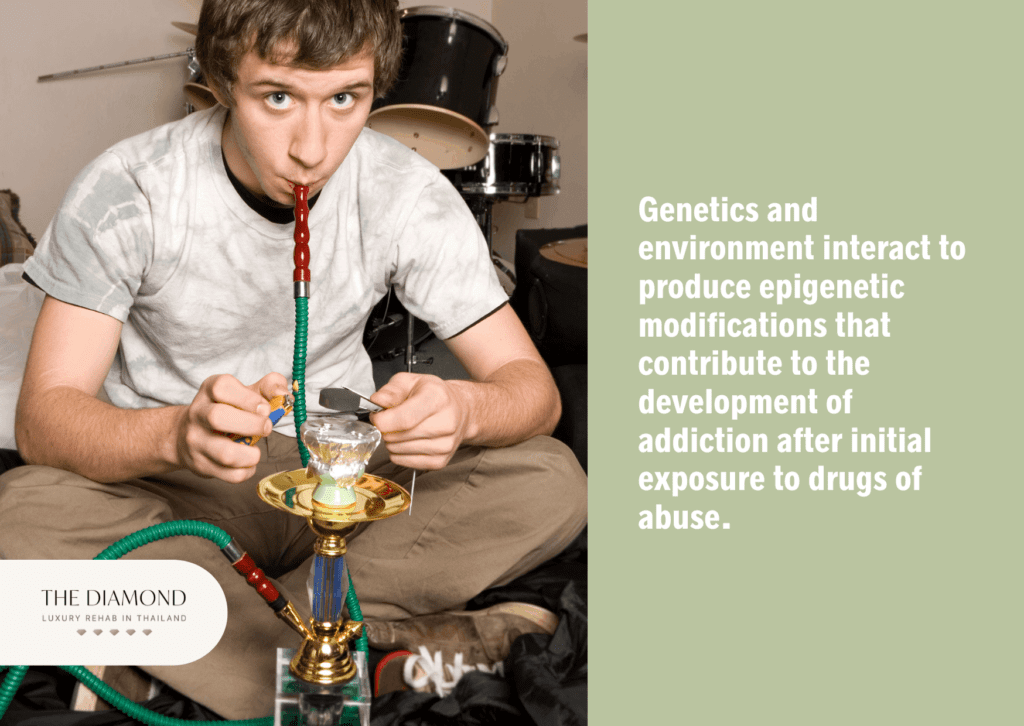
Genetics and environment interact to produce epigenetic modifications that contribute to the development of addiction after initial exposure to drugs of abuse, according to a 2019 article by Lisa R. Goldberg and Thomas J. Gould published in the European Journal of Neuroscience, titled “Multigenerational and transgenerational effects of paternal exposure to drugs of abuse on behavioral and neural function.” Epigenetics is defined as alterations in gene expression without any change occurring in the DNA sequence.
As explained in a 2019 blog titled “Your genes and addiction” published by the Harvard Medical School and authored by Maria Mavrikaki, an environmental factor like stress triggers the release of steroid hormones called glucocorticoids. These hormones cause epigenetic changes in the brain’s reward circuitry that is closely associated with the development of addiction. Stress is also linked to relapse during alcohol or drug recovery by the same mechanism. Exposure to drugs is known to cause epigenetic modifications in the sperm or ova. According to authors Goldberg and Gould (2019), it is possible that these epigenetic alterations are passed on to subsequent generations, a phenomenon that explains why addiction is heritable and why having a close relative with addiction increases the risk of an individual developing addiction.
Genetic and environmental factors modulate each other. For example, childhood trauma and lower education levels are believed to influence genes associated with metabolizing alcohol and the regulation of dopamine and serotonin, the neurotransmitters involved in the workings of the brain’s reward circuitry, according to a 2021 article by Popescu et al., published in the journal Experimental and Therapeutic Medicine, titled “Understanding the genetics and neurobiological pathways behind addiction (Review).” Often environmental factors magnify the risk of a genetically susceptible individual developing an addiction to a degree much more than genetics alone would predict, according to a 2022 publication by Rutgers, The State University of New Jersey, titled “Rutgers Researchers Delve Deep Into the Genetics of Addiction” and authored by Andrew Smith.
For instance, environmental factors like living with parents with addiction increase the risk of the child developing a substance use disorder because they have not only inherited specific addiction-related genes from their parents but also live in a risky environment where there is easy access to substances of abuse, an increased likelihood of experiencing severe trauma, inadequate parental supervision, loose or non-existent parental-child bond, and less communication.
On the other hand, there are instances where the impact of genes decreased in adolescent twins who smoked when parental supervision increased, according to a 2007 article by Dick et al., published in the Journal of Abnormal Psychology, titled “Parental monitoring moderates the importance of genetic and environmental influences on adolescent smoking.”