
Environmental factors of addiction


Table of content
- 1. Family and home environment
- 2. Access to substances
- 3. Peer influence
- 4. Community and neighborhood
- 5. Cultural and media influence
- 6. Barriers to treatment
- What role does the environment play in addiction development?
- How do environmental and genetic factors influence the risk of developing addiction?
- How important is the environment in addiction recovery?
Environmental factors of addiction describe the outside elements that affect a person’s propensity to acquire addictive behaviors. Addiction risk is elevated by environmental risk factors, which influence attitudes, behaviors, and access to substances.
For example, growing up in a household where substance abuse is prevalent or in a community where drugs are readily available normalizes addictive behaviors, making it more likely for individuals to experiment with or rely on substances.
The development of effective prevention and intervention strategies is contingent upon the comprehension of the ways in which surroundings contribute to addiction. Addiction is less likely in places that are targeted by prevention initiatives that work to improve social support networks, limit drug availability, and encourage healthy lifestyles.
Through customizing these strategies to the unique environmental risk factors that individuals encounter, a more comprehensive and effective approach to addiction is achieved.
The environmental factors of addiction are listed below.
- Family and home environment
- Access to substances
- Peer influence
- Community and neighborhood
- Cultural and media influence
- Barriers to treatment
1. Family and home environment

Family and home environment denotes the social and physical conditions of an individual’s upbringing, encompassing the shared behaviors, relationships, and values among family members. The attitudes, behaviors, and likelihood of addiction that an individual may exhibit are greatly influenced by their surroundings.
A history of substance use within the family normalizes addictive behaviors, making it more likely for children to adopt similar habits. If substance use is openly accepted or ignored, it becomes part of the household’s culture, increasing the risk for younger members to experiment with or develop dependencies.
Additionally, parenting style greatly influences addiction risk. Permissive or neglectful parenting, where boundaries are either too loose or nonexistent, tend to result in children engaging in risky behaviors without consequences.
In fact, a 2005 article by Marian Jêdrzejczak titled, “Family and Environmental Factors of Drug Addiction among Young Recruits” emphasized that drug addiction was more prone to develop in households where alcohol was consumed, particularly by the father.
In the sample of 559 recruits, 46.3% indicated that alcohol was frequently misused within their families. Within households affected by drug addiction, the mother consistently held more authority (54.4%) than the father (22.6%). The fathers in these homes frequently exhibited disengagement, which adversely affected the stability of the family.
2. Access to substances
Access to substances refers to the availability and ease with which individuals are able to obtain addictive substances such as drugs, alcohol, or tobacco. When substances are readily accessible, either through social networks, local markets, or even within the home, the likelihood of experimentation and continued use increases significantly.
Having easy access to these substances reduces the obstacles to attempting them, particularly in settings where drug use is accepted or uncontrolled. Regular exposure and availability cause habitual usage over time, which develops into addiction.
According to a 2021 paper by Nawi et al., titled, “Risk and protective factors of drug abuse among adolescents: a systematic review,” youth accessibility was influenced by the substance’s low cost and the presence of drug vendors in close proximity to schools.
The review added that perceived drug accessibility was additionally associated with the enforcement programs of the authorities in one study. An increase in marijuana use was predicted in the succeeding assessment period by the youth’s perception of a lax community enforcement of laws regarding drug use at all-time points.
3. Peer influence
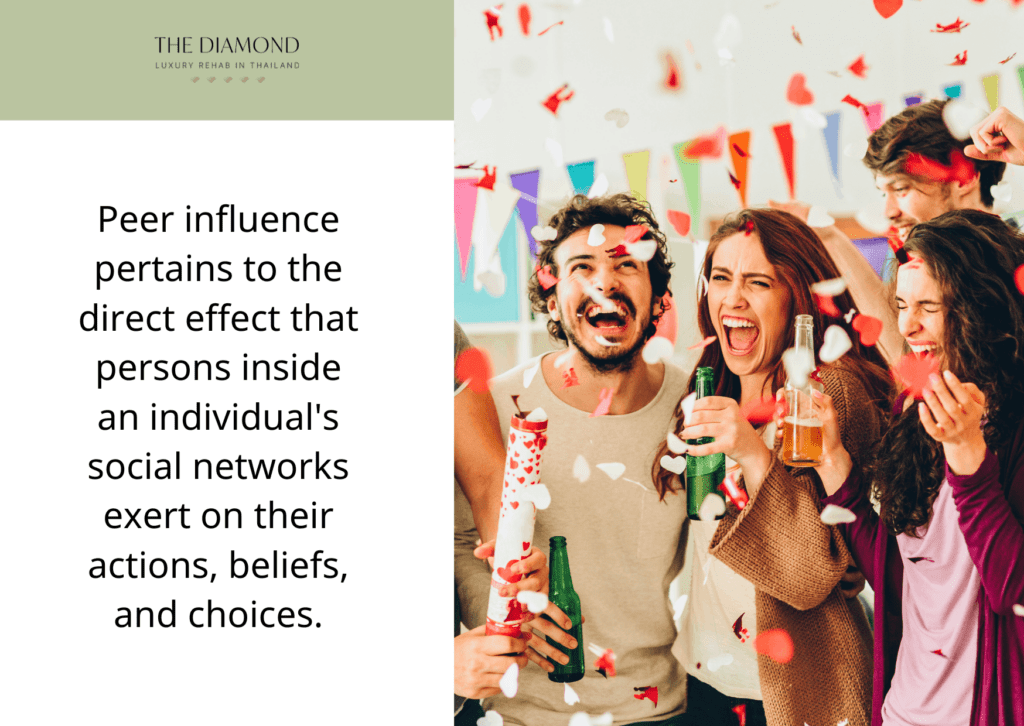
Peer influence pertains to the direct effect that persons inside an individual’s social networks exert on their actions, beliefs, and choices. Peer pressure is one way that this effect frequently leads to addiction, as people feel pressured to use drugs in order to fit in, stay welcomed by their friends, or get accepted by their peers.
Results of a 2013 study by Alice Yuen Loke and Yim-wah Mak titled, “Family Process and Peer Influences on Substance Use by Adolescents” indicated that peer influence exerted a major effect on drug use, as teenagers who had friends who habitually smoked or drank were far more prone to participate in these activities. Peer invitations to smoke or drink significantly heightened the probability of engaging in substance use.
4. Community and neighborhood
Community and neighborhood refer to the larger social and physical environments where individuals live, encompassing the people, institutions, and resources present in a specific area. Due to their influence on drug availability, social norms, and support networks, these environments contribute to addiction.
In communities or neighborhoods where drug use is prevalent or where substance abuse is seen as common, individuals are more likely to be exposed to addictive behaviors.
Additionally, areas with limited access to education, healthcare, or recreational activities tend to leave residents with fewer opportunities for positive engagement, increasing the likelihood of turning to substances as a coping mechanism.
5. Cultural and media influence
Cultural and media influence pertains to the effects of prevalent cultural norms, values, and portrayals in media on the behavior and attitudes of individuals. Cultural attitudes towards substances, such as the acceptance or glamorization of alcohol or drug use, contribute to addiction by normalizing these behaviors.
In cultures where substance use is widely accepted or even celebrated, individuals feel less stigma or concern about engaging in such behaviors. Media influence, through movies, advertisements, and social media, often reinforces these cultural attitudes by portraying substance use as fashionable, fun, or a way to cope with stress.
This exposure often desensitizes individuals to the risks associated with addiction, making them more likely to experiment with or rely on substances. Digital platforms, particularly social media, offer more avenues for risky behavior to be marketed and normalized, according to a 2017 paper by Dan Romer and Megan Moreno titled, “Digital Media and Risks for Adolescent Substance Abuse and Problematic Gambling.”
Social media posts on Facebook and Twitter, for example, that discuss alcohol consumption, have the power to shape young people’s opinions on drinking. Posts frequently present drinking in a favorable light, which strengthens peers’ ideas of normative behavior.
6. Barriers to treatment

Barriers to treatment are the difficulties that keep people from participating in or finishing addiction treatment programs. When people encounter such difficulties, they often put off or refrain from getting treatment, which causes their addiction to get worse over time.
A 2022 study from the journal Substance Abuse: Research and Treatment titled, “Barriers and Facilitators to Substance Use Disorder Treatment: An Overview of Systematic Reviews” revealed the barriers to substance use disorder (SUD) treatment.
Barriers at the individual level encompass incorrect beliefs regarding treatment, perceived anxieties (such as fear of imprisonment or stigma), personal characteristics (such as low self-esteem or inadequate coping mechanisms), and psychiatric comorbidities.
Social-level barriers include stigma, insufficient social support, familial challenges (such as a lack of supporting family), adverse peer influence, and difficulties within the therapy team (such as strained relationships between patients and practitioners).
The most prevalent obstacles at the structural level are inadequate treatment provider services (such as lengthy waiting lists and a lack of suitable services for mental illness), financial constraints, legal obstacles (such as restrictive policies and implications for child custody), and policy issues (such as exclusionary strategies and a lack of focus on vulnerable populations).
The study underlined that since structural barriers are the most common, it is crucial to overcome them. Comprehensive strategies that incorporate a range of treatment programs, competent management, and encouraging policies are necessary for effective addiction treatment.
What role does the environment play in addiction development?
The environment plays a significant role in addiction development through influencing exposure to specific dangers and behaviors. There is a direct correlation between the availability of drugs, peer pressure, community norms, family dynamics, and the chance of participating in addictive behaviors.
Environments where substance use is normalized or where stress and instability are prevalent create conditions that make individuals more vulnerable to addiction. Moreover, environments characterized by restricted availability of support systems, healthcare, or leisure activities contribute to the inclination of persons to resort to drug use as a coping mechanism.
How do environmental and genetic factors influence the risk of developing addiction?
Environmental and genetic factors play a key role in influencing the risk of developing addiction. Certain people are more prone to addictive behaviors due to genetic predispositions that alter how their brains react to substances or how rapidly they establish dependence.
For example, a family history of addiction indicates a genetic vulnerability that increases the likelihood of substance use disorders. On the environmental side, risk factors for addiction such as exposure to substance use in the family, peer pressure, and the availability of drugs or alcohol in the community are prevalent.
Findings of a 2012 study by Kendler et al., titled, “Genetic and Familial Environmental Influences on the Risk for Drug Abuse: A National Swedish Adoption Study” revealed that adopted children whose biological parents had a history of drug abuse (DA) were shown to be considerably more vulnerable to drug misuse.
Moreover, there was a higher risk of DA for biological siblings of adopted children with the condition. Due to common social and familial experiences, adoptive siblings of adopted children with DA exhibited an elevated risk, indicating a major environmental influence.
The risk of DA was further increased by a number of unfavorable environmental characteristics in the adoptive household, including parental criminal behavior, alcoholism, divorce, and mental health concerns.
There was a substantial gene-environment interaction on drug abuse risk, with people with a higher genetic susceptibility to DA being more affected by unfavorable environmental factors. This implies that people who are genetically vulnerable are more sensitive to harmful environmental factors.
Research has demonstrated that certain genetic variations, such as OPRM1, DRD4, and 5HTTLPR, interact with environmental factors, including parental monitoring and peer substance use, to impact substance use, as per a 2015 study from the Current Addiction Reports titled, “Genetic and Environmental Interplay in Adolescent Substance Use Disorders.”
The paper further stated that evidence from twin studies indicates that the heritability of substance dependency varies from 0.30 to 0.70 among different substances. The impact of genetic predisposition to addiction is capable of being moderated by the environment. For example, it has been shown that smoking is less heritable when public health regulations are stringent.
How important is the environment in addiction recovery?
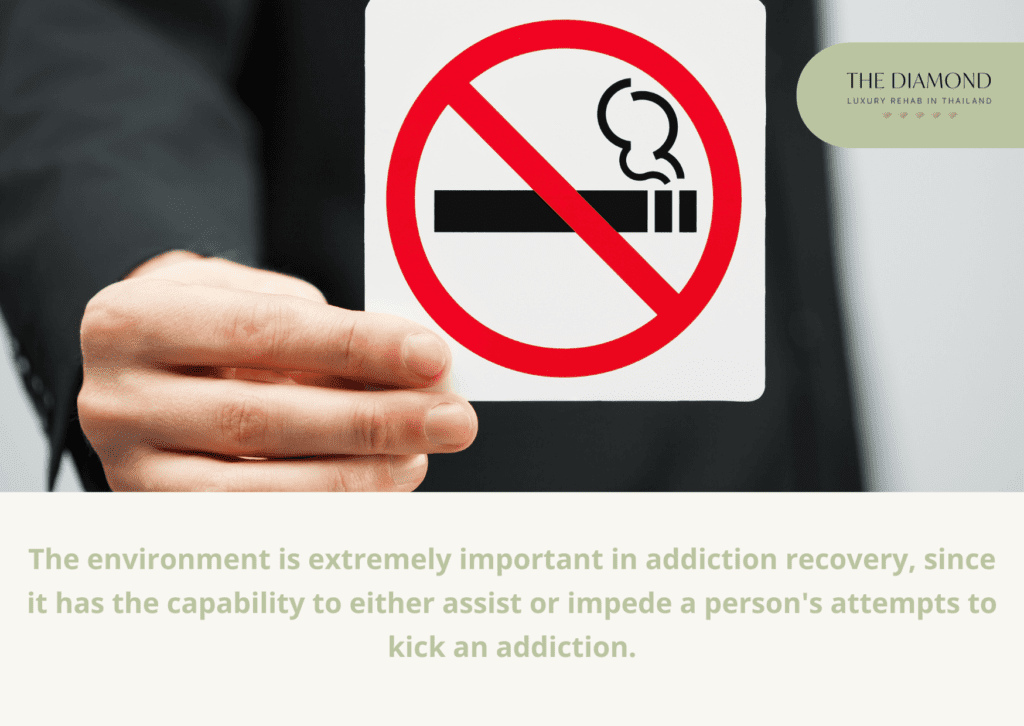
The environment is extremely important in addiction recovery, since it has the capability to either assist or impede a person’s attempts to kick an addiction. Recovery outcomes are considerably enhanced in a supportive, stable environment that offers access to resources for therapy, good relationships, and emotional support.
On the other hand, returning to environments where substance use is prevalent or where stress and instability exist triggers relapses, making it harder to stay on track. People in recovery are better able to overcome obstacles, stay motivated, and develop new coping mechanisms when they are part of an encouraging environment. Long-term addiction recovery and the prevention of setbacks necessitate the establishment of a safe and supporting environment.
A 2024 article by Katie Witkiewitz and Jalie A. Tucker titled, “Whole person recovery from substance use disorder: a call for research examining a dynamic behavioral ecological model of contexts supportive of recovery” argued in favor of a more comprehensive, dynamic behavioral ecological model that incorporates individual, environmental, social, and policy-level factors.
Ultimately, recovery pathways are significantly influenced by broader environmental contexts, including family, community, neighborhoods, and government policies. The study introduced a dynamic behavioral ecological model, which underscores the fact that recovery is a non-linear process that involves interactions between the environment and individual behavior over time.
This model recognizes that recuperation processes are not static but rather evolve in response to changing contexts, accounting for feedback loops and emergent behaviors that result from the interaction between individuals and their dynamic environments.