

Conduct disorder (CD): definition, symptoms, causes, risk factors, categories, and treatment

Table of content
- What is conduct disorder (CD)?
- What are the symptoms of conduct disorder?
- What are the causes of conduct disorder?
- What are the risk factors for conduct disorder?
- What are the categories of conduct disorder?
- What are the treatment options for conduct disorder in children?
- What is the difference between oppositional defiant disorder and conduct disorder?

Conduct disorder (CD) is a disorder indicated by aggressive, violent, destructive, and deceptive behaviors. Usually developing in childhood or adolescence, it causes major difficulties in social, academic, and home environments. Patients with CD don’t feel guilt or remorse for their actions.
The symptoms of conduct disorder include aggression toward people or animals, property damage, chronic lying and stealing, refusal to follow rules, lack of empathy, impulsive actions, and disregard for expectations.
The causes of conduct disorder are genetic predisposition, brain damage, trauma or neglect, inconsistent or harsh parenting, association with delinquent peers, socioeconomic challenges, and school problems.
The risk factors for conduct disorder include being male, impulsiveness, low IQ, antisocial parents, and family instability.
The categories of conduct disorder are the childhood-onset type, adolescent-onset type, and unspecified-onset type.
Treatment options for conduct disorder in children include cognitive behavioral therapy (CBT), family therapy, parent training programs, social skills training, and medication.
What is conduct disorder (CD)?
Conduct disorder (CD) is a multifaceted emotional and behavioral condition marked by a consistent pattern of actions that go against legal and social expectations as well as other people’s rights.
A variety of behaviors showing anger, disobedience, and a disrespect for authority figures or social boundaries are indicative of the illness. Since CD causes frequent disputes with peers, caretakers, or authority figures, it has a substantial influence on a person’s capacity to establish healthy relationships and succeed in academic or occupational contexts.
Since untreated cases frequently develop into more severe kinds of antisocial conduct in adulthood, the illness is regarded as serious.
What is the prevalence of conduct disorder (CD)?
The lifetime prevalence rate of conduct disorder in the general population ranges from 2% to 10% and is stable across various racial and ethnic groups, according to a publication titled, “Conduct Disorder” last updated in 2023 by Mohan et al.,
The report further stated that children diagnosed with conduct disorder are frequently classified as having antisocial personality disorder in adulthood. Conduct disorder is more prevalent in boys than in girls, with a ratio varying from 4:1 to 12:1. The early development of conduct disorder throughout childhood potentially results in a poorer prognosis for the condition.
The incidence of conduct disorder was estimated differently in other research. A 2018 study titled, “Understanding the Demographic Predictors and Associated Comorbidities in Children Hospitalized with Conduct Disorder” published in the journal Behavioral Sciences found that conduct disorder impacts roughly 9.5% of children in the United States, with a prevalence of 12% in males and 7.1% in females. The median age of onset is 11.6 years, and the global prevalence is estimated at 3.2%.
What are the symptoms of conduct disorder?
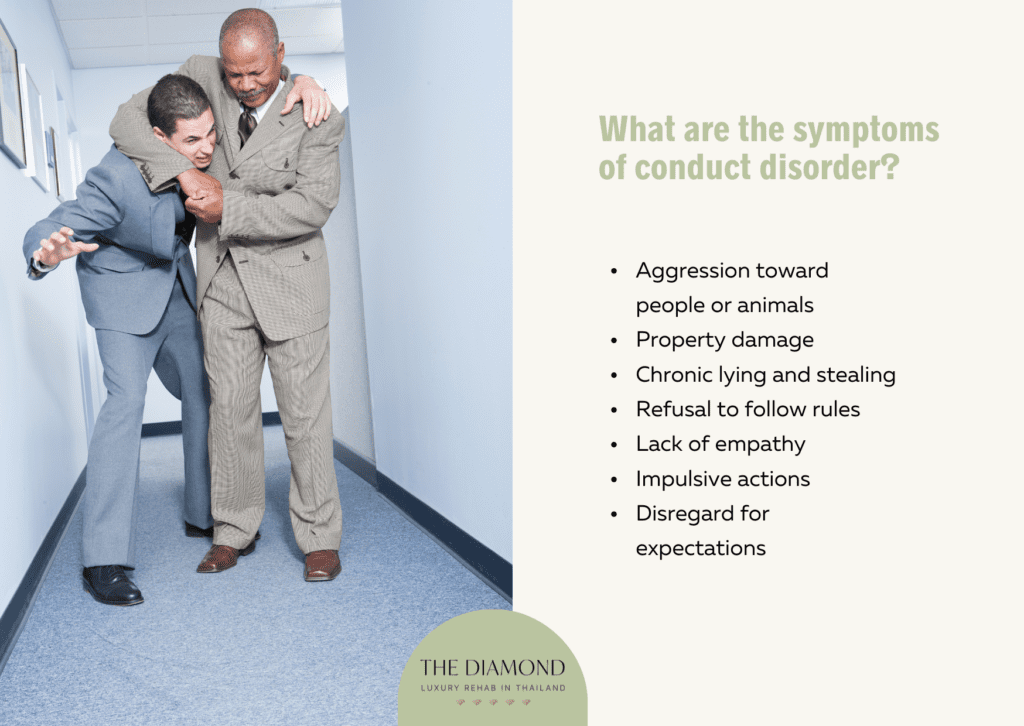
Symptoms of conduct disorder are the particular emotional and behavioral patterns people with the disorder tend to display. The symptoms of conduct disorder are listed below.
- Aggression toward people or animals: This symptom involves physical or verbal hostility, often leading to harm or intimidation of others. Bullying, starting fights, and mistreating animals are a few examples. Besides making social relations extremely difficult, the violent behavior has major repercussions, including legal problems or suspensions from school.
- Property damage: Affected individuals exhibiting this behavior intentionally destroy or deface objects, disregarding the value or ownership. Examples include writing graffiti, starting fires, and smashing objects. This disrespect for other people’s property is a sign of more serious behavioral problems. Such behaviors eventually damage interpersonal relationships and result in serious consequences like expulsion or legal action.
- Chronic lying and stealing: Persistent dishonesty or theft characterizes this symptom, with actions driven by personal gain or avoidance of punishment. Breaking into homes, taking valuable items, or creating false stories to manipulate situations are common examples. The repeated betrayal of trust damages relationships and isolates the individual.
- Refusal to follow rules: This involves a consistent pattern of ignoring or breaking rules, such as truancy, staying out without permission, or running away from home. Early signs often appear as defiance toward parental or school authority, growing more severe with time. Such actions demonstrate frustration or rebellion, often caused by underlying emotional struggles.
- Lack of empathy: Individuals with CD show little concern for the feelings or well-being of others, often acting with indifference to harm caused. This absence of compassion is evident in actions that hurt others emotionally or physically without guilt or remorse. The Diagnostic and Statistical Manual of Mental Disorders, Fifth Edition (DSM-5) lists callous-unemotional (CU) traits as a specifier for conduct disorder (CD), as per a 2019 article by Milone et al., titled, “Empathy in Youths with Conduct Disorder and CallousUnemotional Traits.” Youths with CD frequently exhibit CU features, which include superficial emotions, a lack of empathy, and a disdain for social standards. Affective empathy is much lower in young people with CD and high CU characteristics.
- Impulsive actions: Impulsivity involves acting without considering the consequences, leading to reckless or risky behaviors. A 2008 study by Van der Meere et al., titled, “Impulsive Responses In Children with Conduct Disorder and Borderline Intellectual Functioning” revealed that children with CD have poor response inhibition, which shows up as an inability to stop early reactions to stimuli. Children with CD have issues with impulse control, which is associated with hostility and violent behavior; these problems are stable and not responsive to therapy.
- Disregard for expectations: Ignoring societal norms or expectations, such as behaving disrespectfully or violating boundaries, is a frequent characteristic. People with CD usually defy societal conventions or authority, putting their needs above rules or expectations. In social, academic, or family environments, this kind of behavior usually results in conflict. Ignorance of expectations results in alienation and major repercussions including institutional or legal action.
What is it like having a conduct disorder?
Having conduct disorder involves dealing with ongoing behavioral issues that interfere with relationships, overall wellbeing, and academic success. Extreme frustration, rage, or disobedience are common emotions causing people to act in ways that are harmful to others or go against social standards.
Since dishonest or violent actions sour relationships with friends and family, trust issues are common. Constantly disobeying rules or boundaries leads to confrontations with authority along with recurrent disciplinary or legal issues.
Emotional difficulties such as impulsivity or a lack of empathy make conversations even more difficult and make people feel alone or misinterpreted. Such obstacles make daily life challenging and usually call for expert help to acquire better habits and coping strategies.
How is conduct disorder diagnosed?
Conduct disorder is diagnosed through an extensive assessment by a trained mental health professional, which frequently includes behavioral observations, interviews, and feedback from parents, teachers, or other caregivers.
With an emphasis on persistent rule-breaking, aggressiveness, deceitfulness, or property destruction, the diagnostic process assesses behavioral patterns to see if they fit the DSM-5 criteria.
For such actions to be considered more serious than ordinary misbehavior in children, the professional takes into account their frequency, intensity, and length of time. A thorough examination of the person’s social, academic, and familial history aids in ruling out further mental health issues or external factors possibly responsible for the actions.
What are the causes of conduct disorder?
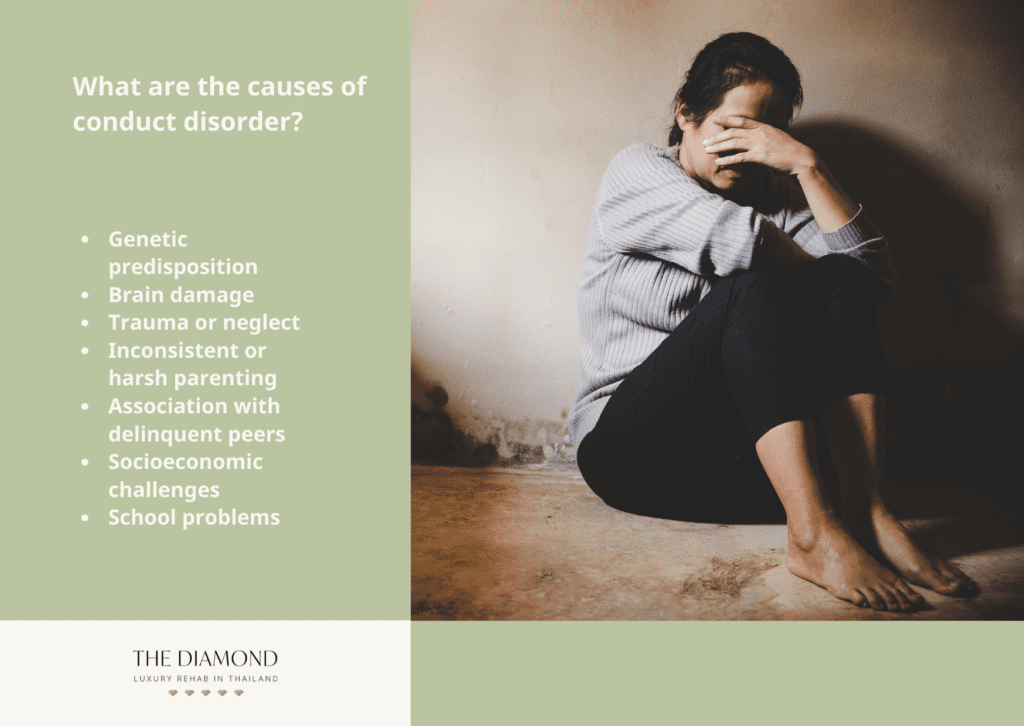
Causes of conduct disorder are the fundamental elements triggering the onset of the disorder. The causes of conduct disorder are listed below.
- Genetic predisposition: A family history of mental health disorders, such as conduct disorder, depression, or substance abuse, increases the likelihood of developing the condition. Genetic factors influence brain chemistry and structure, affecting emotional regulation and impulse control. A 2018 paper by Jessica E. Salvatore and Danielle M. Dick titled, “Genetic Influences on Conduct Disorder” found that genetic factors account for a substantial portion of the variance in conduct disorder (CD), which is moderately heritable. Multiple studies have demonstrated associations between CD-related phenotypes and candidate genes such as GABRA2, MAOA, SLC6A4, and AVPR1A, despite the presence of replication failures.
- Brain damage: Injury or damage to areas of the brain responsible for emotional regulation, decision-making, or impulse control contributes to the development of conduct disorder. For example, trauma to the prefrontal cortex or amygdala impairs the ability to process emotions and understand social consequences. The inability to control behavior due to this neurological disability might result in aggressive, disobedient, or rule-breaking conduct.
- Trauma or neglect: Exposure to physical, emotional, or sexual abuse, or neglect during childhood profoundly impacts emotional and behavioral development. Such experiences often lead to feelings of anger, distrust, or low self-worth, which manifest as defiance or hostility. The lack of a stable and nurturing environment prevents the development of healthy coping mechanisms.
- Inconsistent or harsh parenting: Erratic discipline, lack of boundaries, or overly harsh punishments contribute to the onset of conduct disorder. These parenting styles confuse the child or create resentment, leading to rebellion or defiance. Children dealing with harsh parenting techniques are more likely to exhibit emotional issues, hyperactive/inattentive tendencies, and conduct problems, as per a 2022 article by Speyer et al., titled, “The role of harsh parenting practices in early- to middle-childhood socioemotional development: An examination in the Millennium Cohort Study.” Children’s behavioral issues and hyperactivity/inattention prompted parents to use harsher parenting techniques, which started a vicious cycle.
- Association with delinquent peers: Spending time with peers who engage in rule-breaking or aggressive behaviors influences a child to adopt similar actions. Peer pressure and the desire for acceptance often lead to behaviors mimicking those of the group, including lying, stealing, or vandalism. Over time, it becomes more difficult to escape the loop created by this association, which encourages harmful behaviors. The persistence of conduct disorder symptoms, particularly during adolescence, is significantly influenced by delinquent peers.
- Socioeconomic challenges: Living in environments with poverty, violence, or lack of access to education or healthcare contribute to the development of conduct disorder. The constant exposure to adversity affects emotional resilience and decision-making skills. Findings of a 2021 article by Blakey et al., titled, “Prevalence of conduct problems and social risk factors in ethnically diverse inner-city schools” indicated that conduct issues were more common in inner-city schools because of the urban setting, which seemed to increase exposure to clustered social risk factors. Increased conduct issues were associated with low socioeconomic status (e.g., eligibility for free school meals), high parental control, low parental care, racial discrimination, and connections with problematic friends.
- School problems: Difficulties in school, such as academic struggles, bullying, or conflicts with teachers, contribute to the development of conduct disorder. Negative experiences in the school environment foster feelings of frustration, inadequacy, or anger, leading to disruptive behaviors. A lack of support or understanding from educators exacerbate such issues, reinforcing defiance or aggression.
When does conduct disorder begin?
Conduct disorder begins by age 11 in persons with the childhood-onset type, whereas those with the adolescent-onset type exhibit symptoms between ages 14 and 17, according to a 2014 study by Silberg et al., titled, “Age of onset and the subclassification of conduct/dissocial disorder.”
The report added that CD manifesting at age 11 is more likely to endure into adulthood than CD that begins during adolescence. Childhood-onset CD is significantly correlated with attention deficit hyperactivity disorder (ADHD), antisocial behavior in young adulthood, and familial dysfunction, such as parental drinking or antisocial personality disorder.
What are the risk factors for conduct disorder?

Risk factors for conduct disorder are the elements, events, or influences raising the probability of developing the disorder. The risk factors for conduct disorder are listed below.
- Being male: Boys are statistically more likely to develop conduct disorder. CD admissions are three times more prevalent among boys than among girls, with 70% of CD cases being male, as per a 2018 report by Patel et al., titled, “Understanding the Demographic Predictors and Associated Comorbidities in Children Hospitalized with Conduct Disorder.”
- Impulsiveness: Children with impulsive tendencies struggle to control their actions, leading to risk-taking or aggressive behavior. According to a 2010 review by Murray et al., titled, “Risk Factors for Conduct Disorder and Delinquency: Key Findings From Longitudinal Studies,” the most critical personality trait associated with CD is impulsiveness. It encompasses hyperactivity, low self-control, risk-taking, and a poor ability to regulate behavior.
- Low IQ: Individuals with below-average intelligence struggle academically and socially, leading to feelings of frustration or alienation. Low IQ complicates emotional regulation as well, making it harder for children to understand the impact of their actions on others.
- Antisocial parents: Children of parents with antisocial behavior patterns, such as criminal activity, substance abuse, or lack of regard for societal norms, are at higher risk for developing conduct disorder. Antisocial parents provide negative role models, normalizing aggressive or deceitful behaviors. The absence of positive parental influence hinders the development of empathy, responsibility, and self-regulation.
- Family instability: Family instability creates an atmosphere of unpredictability and stress, which contribute to emotional and behavioral difficulties. Children in such environments struggle to form healthy relationships or respect authority figures. Results published in a 2010 study by Boden et al., titled, “Risk Factors for Conduct Disorder and Oppositional/Defiant Disorder: Evidence from a New Zealand Birth Cohort” found that higher likelihood of disruptive behavior disorder in children was associated with regular changes in parental figures brought about by divorce, separation, or other circumstances.
Which children are at risk for conduct disorder?
Children at risk for conduct disorder include those with a family history of mental illness or antisocial behavior, those exposed to trauma or neglect, kids with impulsive tendencies, facing academic challenges, and those growing up in unstable or violent environments.
These children frequently face conditions impeding their emotional and social development, like inconsistent parenting or exposure to detrimental role models. Genetic predispositions or neurological differences additionally impair their ability to regulate emotions and behavior. Peer influence, socioeconomic challenges, and the absence of supportive relationships further increase the likelihood of developing conduct disorder.
What are the categories of conduct disorder?
Categories of conduct disorder refer to the classifications used to distinguish different patterns and manifestations of the behavioral condition. The categories of conduct disorder are listed below.
- Childhood-onset type: Childhood-onset conduct disorder includes individuals who show at least one symptom of conduct disorder before the age of 10. People with early-onset conduct disorder typically display physical aggression throughout their early years, according to a 2005 publication titled, “Conduct disorder in children and adolescents” published in INSERM (the French National Medical Research Institute). Children in this category often struggle more with emotional regulation and are less responsive to typical disciplinary methods.
- Adolescent-onset type: Adolescent-onset conduct disorder applies to individuals who do not show symptoms before the age of 10 but begin showing them during adolescence, between ages 14 and 17. These behaviors are often influenced by environmental factors, such as peer pressure or exposure to delinquent groups. This category of conduct disorder is associated with a better prognosis, as the behaviors are more situational and often decrease with maturity.
- Unspecified onset type: This category is used when the age at which conduct disorder symptoms first appear cannot be determined. Individuals in this group exhibit the typical signs of conduct disorder, such as aggression or rule-breaking, but there is no clear record of when the behaviors began. The lack of information makes it harder to assess the severity or progression of the condition.
What are the treatment options for conduct disorder in children?

Treatment options for conduct disorder in children refer to the various therapeutic approaches and interventions designed to address the challenges associated with the condition. The treatment options for conduct disorder in children are listed below.
- Cognitive behavioral therapy (CBT): CBT helps children identify and modify negative thought patterns influencing their behavior. Through the teaching of coping mechanisms and problem-solving techniques, children are more equipped to control their emotions and reactions. A 2022 study by Kumuyi et al., titled, “Effectiveness of cognitive behavioural therapy and social skills training in management of conduct disorder” observed that at the 8-week period, CBT significantly decreased CD symptoms, and participants in the CBT group had lower CD scores than those in the control group. Through cognitive restructuring approaches, CBT assisted participants in recognizing maladaptive thought processes and substituting them with adaptive ones.
- Family therapy: Family therapy involves working with the entire family to address dynamics contributing to conduct disorder. Better communication, consistent boundaries, and a closer parent-child bond are a few of the outcomes of this kind of therapy. While children receive help in a stable environment, parents acquire techniques to deal with difficult behaviors. A more wholesome family structure lowers stress and supports constructive behavioral adjustments.
- Parent training programs: Parent training programs educate caregivers on effective strategies to manage and modify a child’s behavior. Techniques like consistent discipline, positive reinforcement, and clear communication are emphasized. Stress in the home decreases as parents gain confidence in managing tough situations. An organized and encouraging family setting helps a child’s behavior improve over time.
- Social skills training: Social skills training teaches children how to interact with others in constructive and respectful ways. Role-playing and real-life practice help children develop empathy, cooperation, and conflict resolution skills. Improved social interactions reduce instances of aggression and help build positive peer relationships. Enhanced social competence increases self-esteem and decreases feelings of isolation.
- Medication: When combined with therapy, medication helps regulate emotions and improve overall behavior. In certain cases, medications are prescribed to manage symptoms associated with conduct disorder. A 2019 study by Sagar et al., titled, “Clinical Practice Guidelines for the management of conduct disorder” indicated that risperidone and mood stabilizers (e.g., divalproex) are pharmacological options for the treatment of comorbid conditions and aggression. Atomoxetine and clonidine are efficacious for ADHD that’s comorbid with CD due to their psychostimulant properties.
What is the typical outcome for people with conduct disorder?
The typical outcome for individuals with conduct disorder varies greatly depending on the severity of symptoms, age of onset, presence of comorbidities, and access to effective interventions.
Without treatment, CD often leads to persistent antisocial behavior, which escalates into adulthood as antisocial personality disorder (ASPD). A 2010 study by Olino et al., titled, “Conduct Disorder and Psychosocial Outcomes at Age 30: Early Adult Psychopathology as a Potential Mediator” stated that the long-term challenges associated with conduct disorder (CD) are substantial, including weaker educational attainment, poor occupational outcomes such as unemployment and reduced income, and interpersonal difficulties such as increased rates of marital instability and decreased social support.
Additionally, individuals with CD report reduced overall functioning in adulthood, diminished coping skills, a higher likelihood of incarceration, and lower life satisfaction. Early-onset CD is associated with worse outcomes, including chronic aggression, impulsivity, and difficulties in forming healthy interpersonal relationships.
Conversely, adolescent-onset CD, which often reflects peer-driven behaviors, tends to have a less severe trajectory, with numerous individuals reducing antisocial behaviors as they mature.
Can a child outgrow conduct disorder?
Yes, a child can overcome conduct disorder, but the prognosis is influenced by several factors, including the age of onset and the promptness of intervention.
A poor prognosis or outcome is typically the result of a combination of early onset, severe symptoms, and adverse social and familial factors. Conversely, a better prognosis is supported by timely intervention, positive environmental influences, and access to therapeutic and educational resources.
What is the difference between oppositional defiant disorder and conduct disorder?

The differences between oppositional defiant disorder (ODD) and conduct disorder (CD) lie in the severity, nature of behaviors, and impact on others. ODD is primarily characterized by a pattern of angry or irritable mood, defiant or argumentative behavior, and vindictiveness, usually directed at authority figures. These behaviors, while disruptive, do not typically involve serious violations of societal norms or the rights of others.
In contrast, CD includes more severe behaviors such as physical aggression toward people or animals, destruction of property, theft, deceit, and repeated rule-breaking. Oppositional defiant disorder often focuses on emotional dysregulation and opposition, whereas conduct disorder involves pervasive antisocial actions with greater social and legal consequences.
While ODD tends to be a precursor to CD, not all individuals with ODD develop CD, especially if early interventions and behavioral therapies are implemented to address defiance and emotional regulation.